
Happy New Year greetings from Dijon.
We started our trip with an overnight stay at our friends Joachim & Antje in Weilburg. It is always enjoyable to visit with them! From there we drove further east, and after less than two hours, we crossed the former border that separated Germany into east and west. After 36 years, the evidence of this former border, with some old crossing structures and some long abandoned watchtowers, is still visible. I should have titled this “Deutschland Reise” post, Ost Deutschland Reise, as this post is about our trip through what we used to call East Germany, the territory of the former DDR, or Deutsche Demokratische Republik, how it officially called itself. Except for a one day trip into East Berlin prior to the wall coming down on November 9th 1989, this East German territory was only known to us by media.

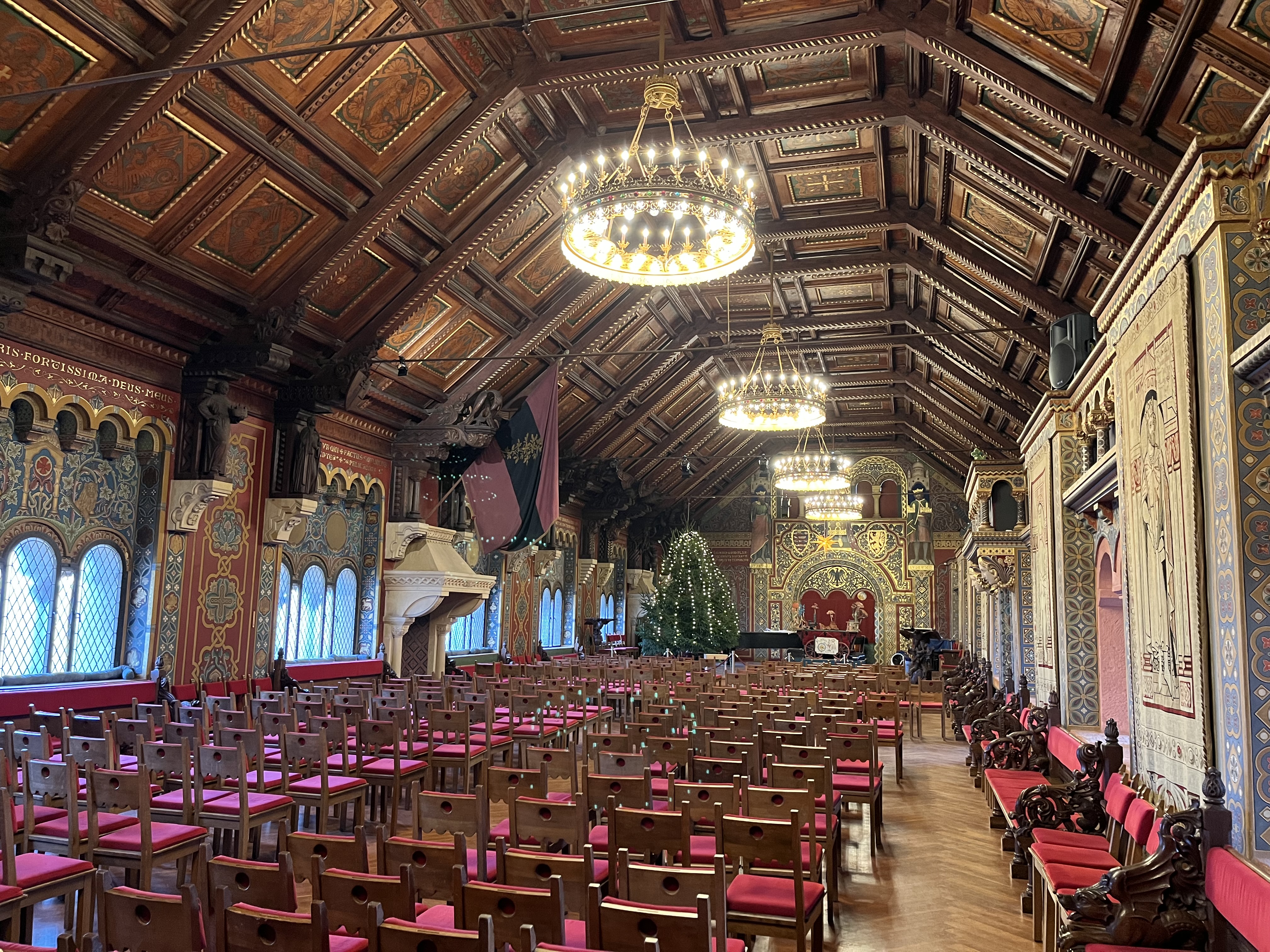
The castle above and below is the Wartburg, an important site for the development of what eventually became today’s Germany.
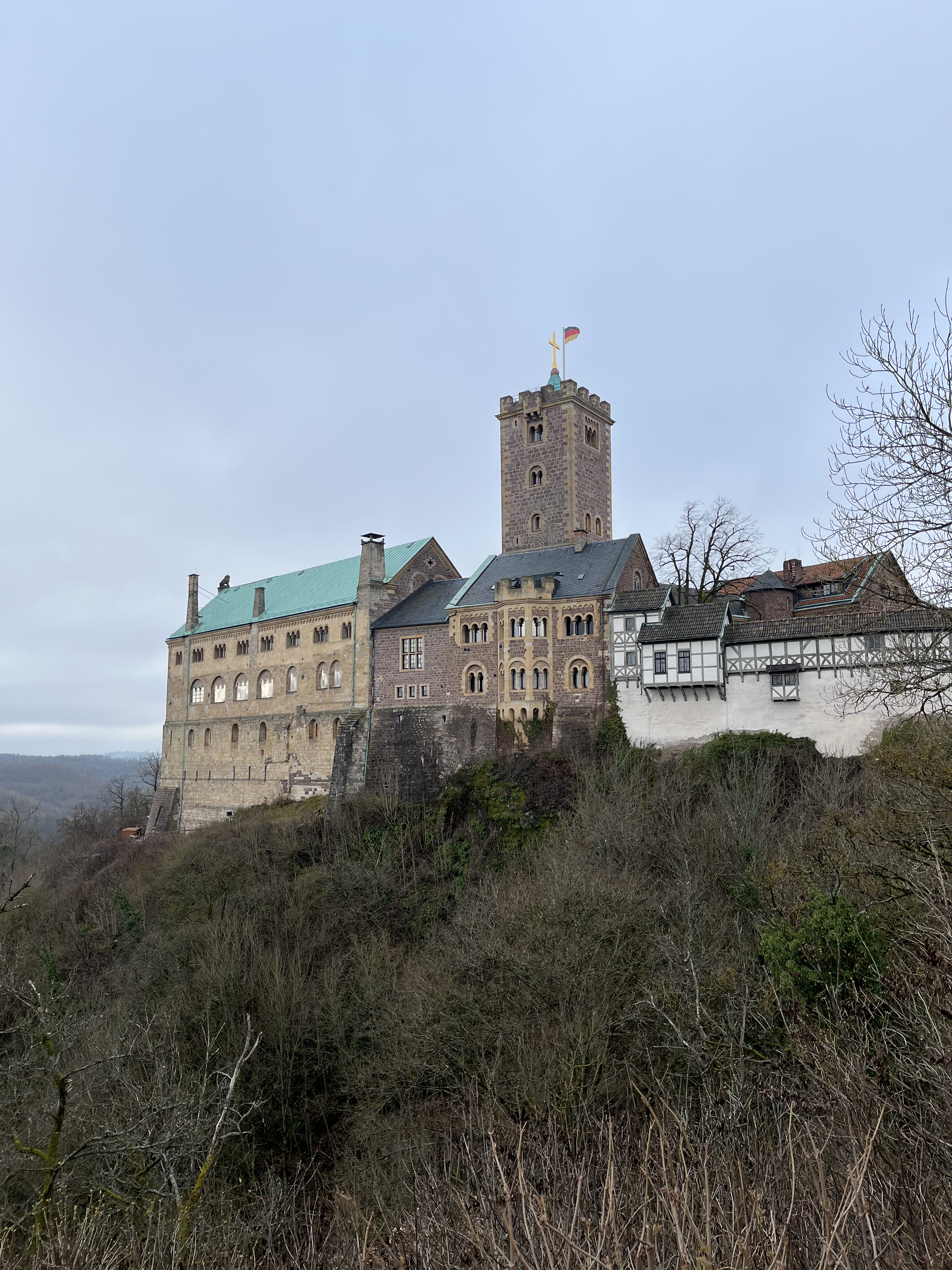

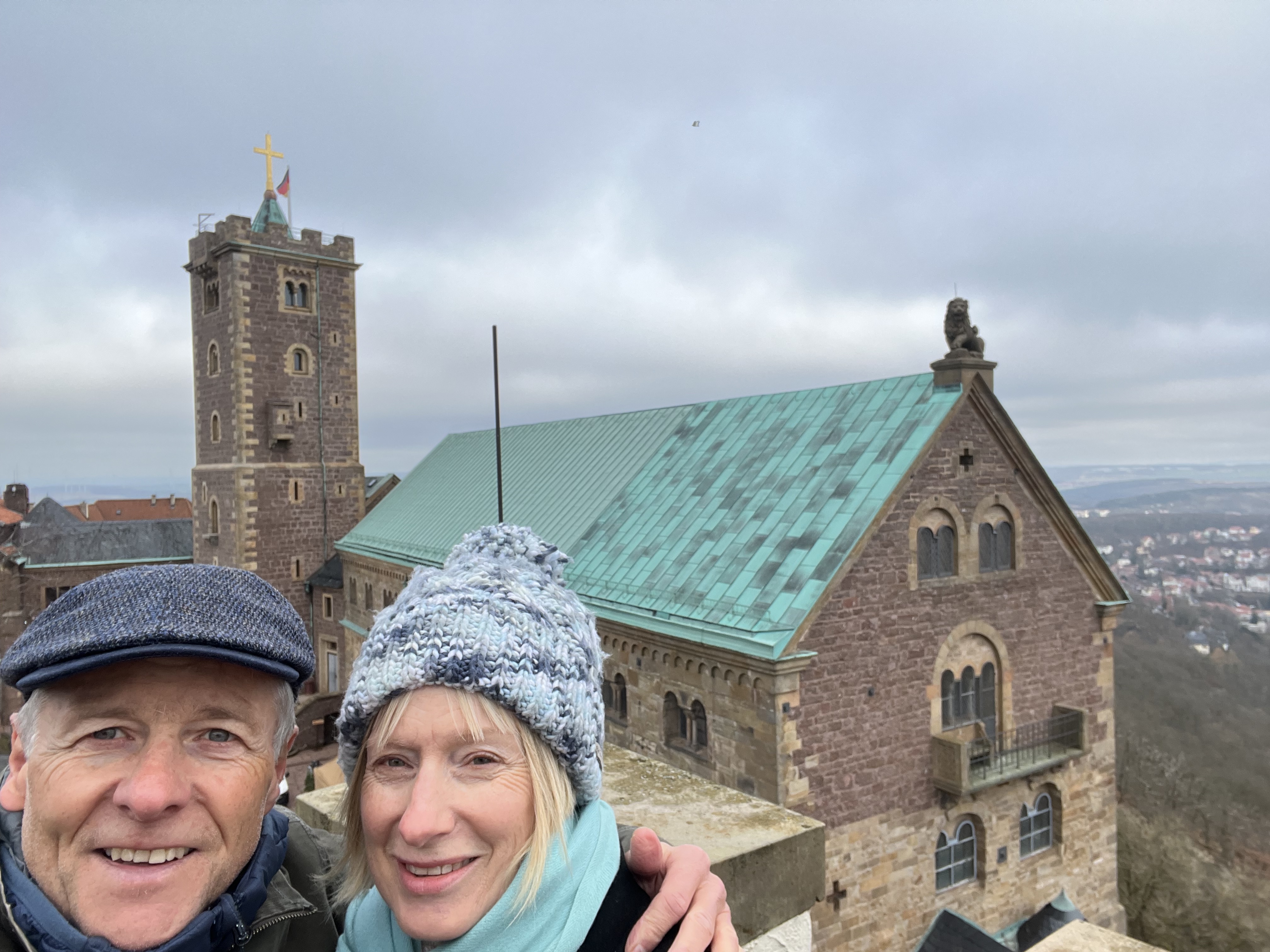
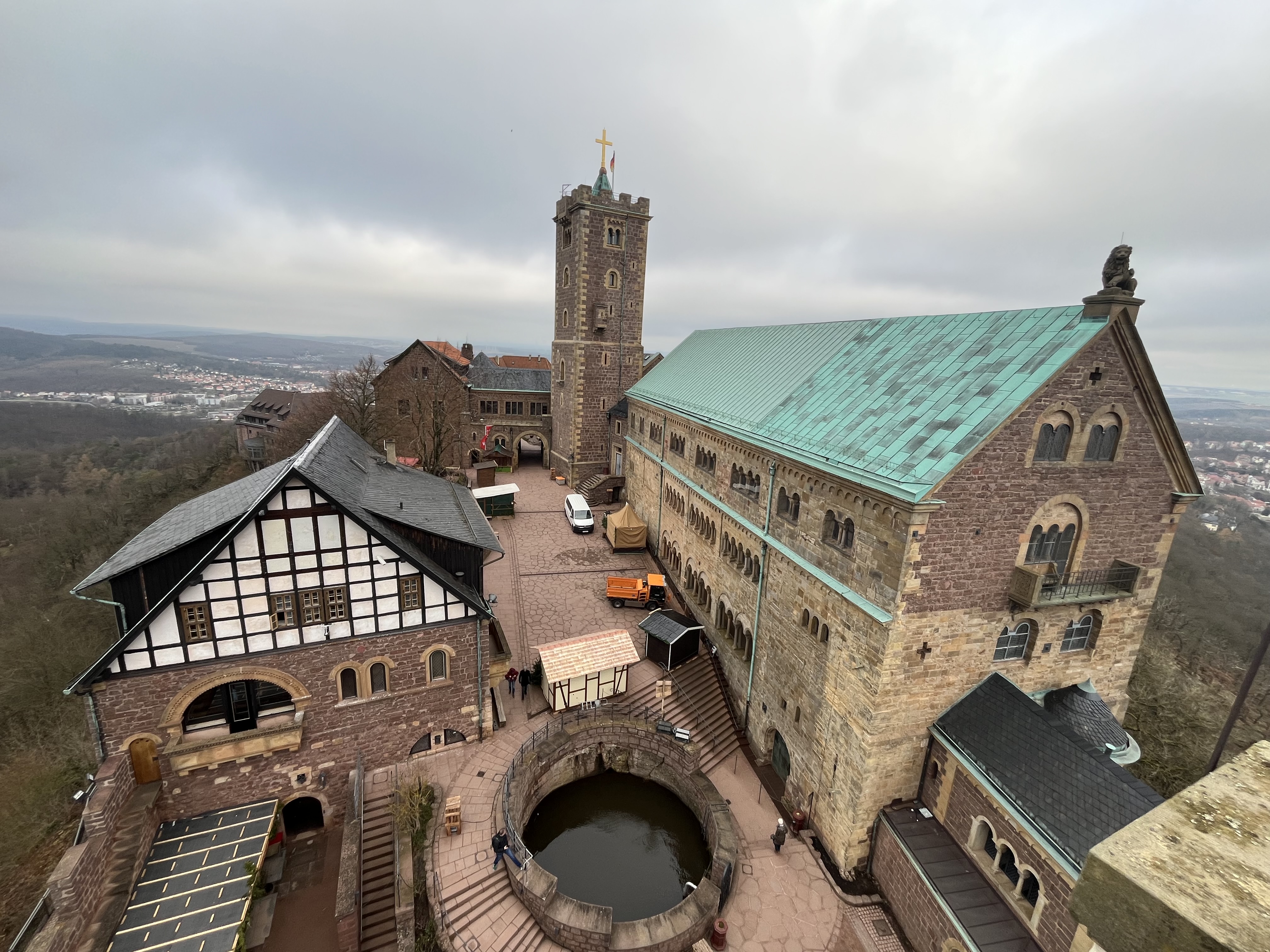
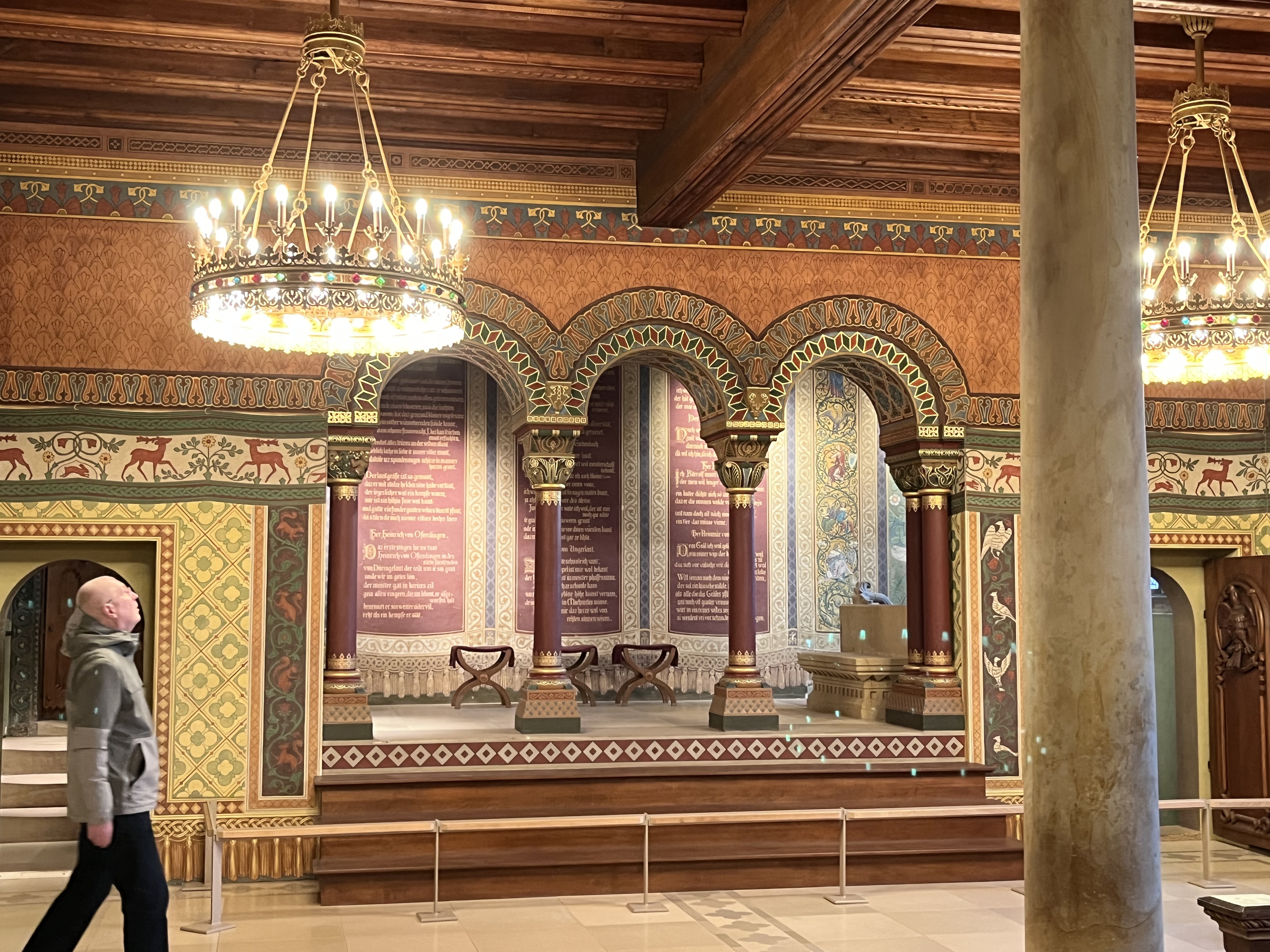
The castle, with some structures dating back to the 12th century, sits exposed on a ridge above the forest of Thuringia. This was the site where early German poets and singers came together. Here the Parzival was written. This legend inspired Richard Wagner to compose the Tannhaeuser opera in the 19th century. Ludwig II, the mad 19th century king of Bavaria, who visited the castle, was so impressed by the structure that he had the famous Neuschwanstein Castle built for himself in Bavaria, containing a hall almost identical to the Wartburg’s great hall pictured below. And, in 1817, when what we know as Germany today still consisted of numerous loosely aligned principalities, some 500 fraternity students came together in this great hall on the Wartburg to condemn feudalism and call for a united Germany under the motto Honor-Freedom-Fatherland.
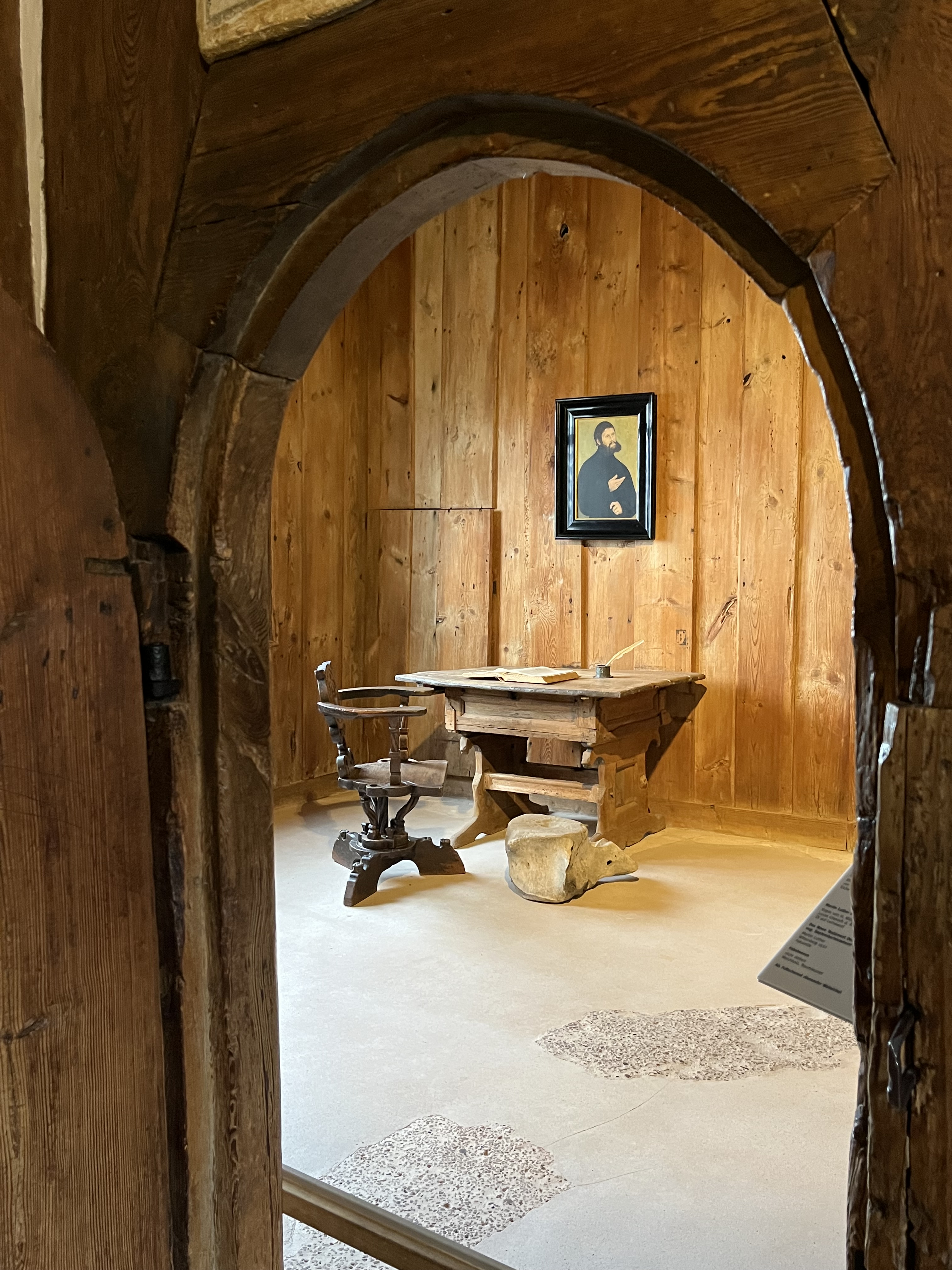
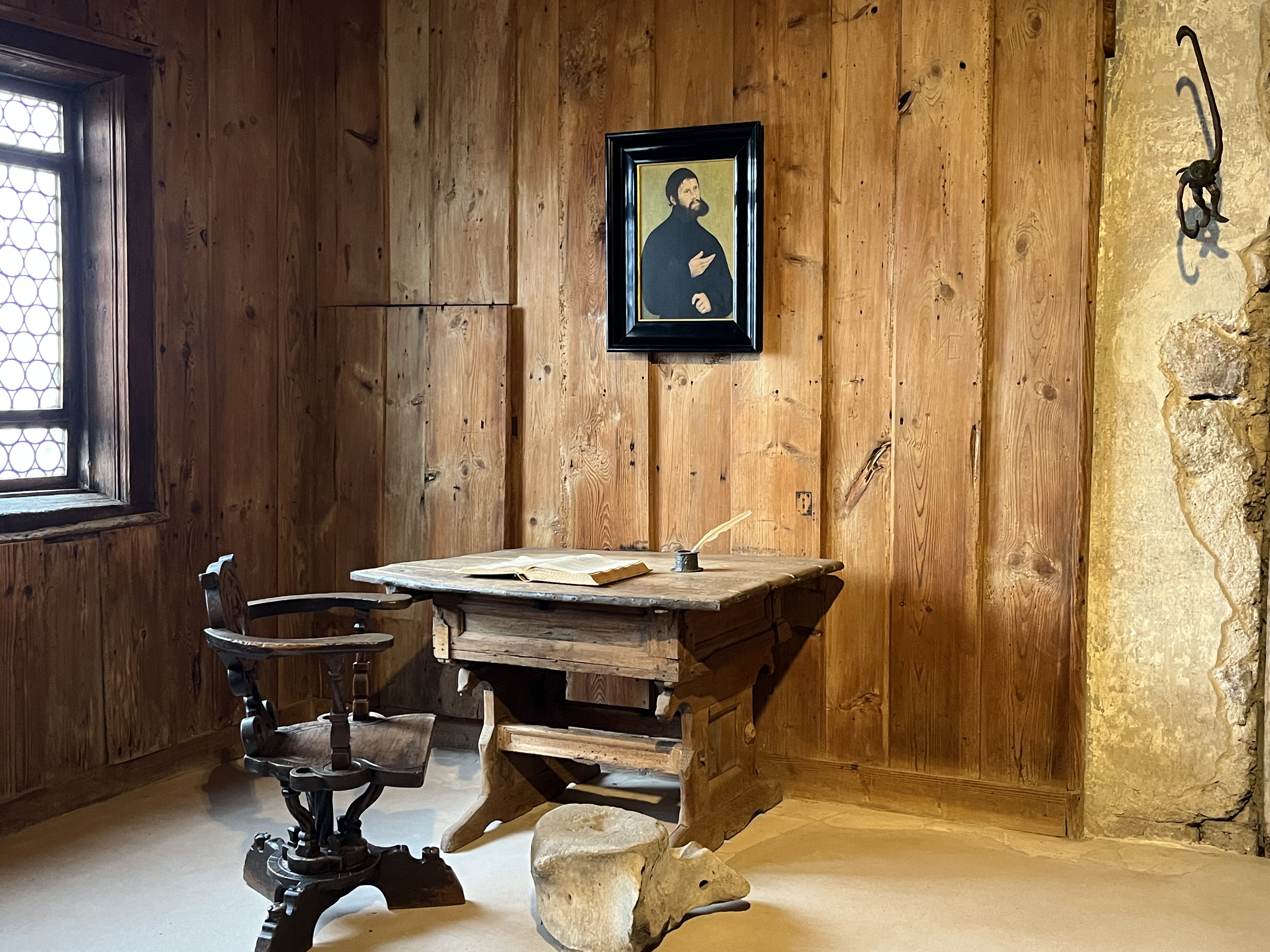
Yet, what the Wartburg internationally is mostly known for is that in 1521 Martin Luther, as a condemned outlaw, hid here from the Catholic Church and the Holy Roman Emperor, and during that time translated the Bible’s New Testament from Greek into German. The work on the translation further convinced Martin Luther, the monk, priest, and theologian, that the church needed to change and was in need of reform. However, he never wanted, nor intended, to cause a schism in the Church. Below is a portrait of him and his wife Katharina von Bora, who herself was a former cistercian nun prior to marrying Martin Luther. Below, you also see the room where Martin Luther worked on the Bible translation.


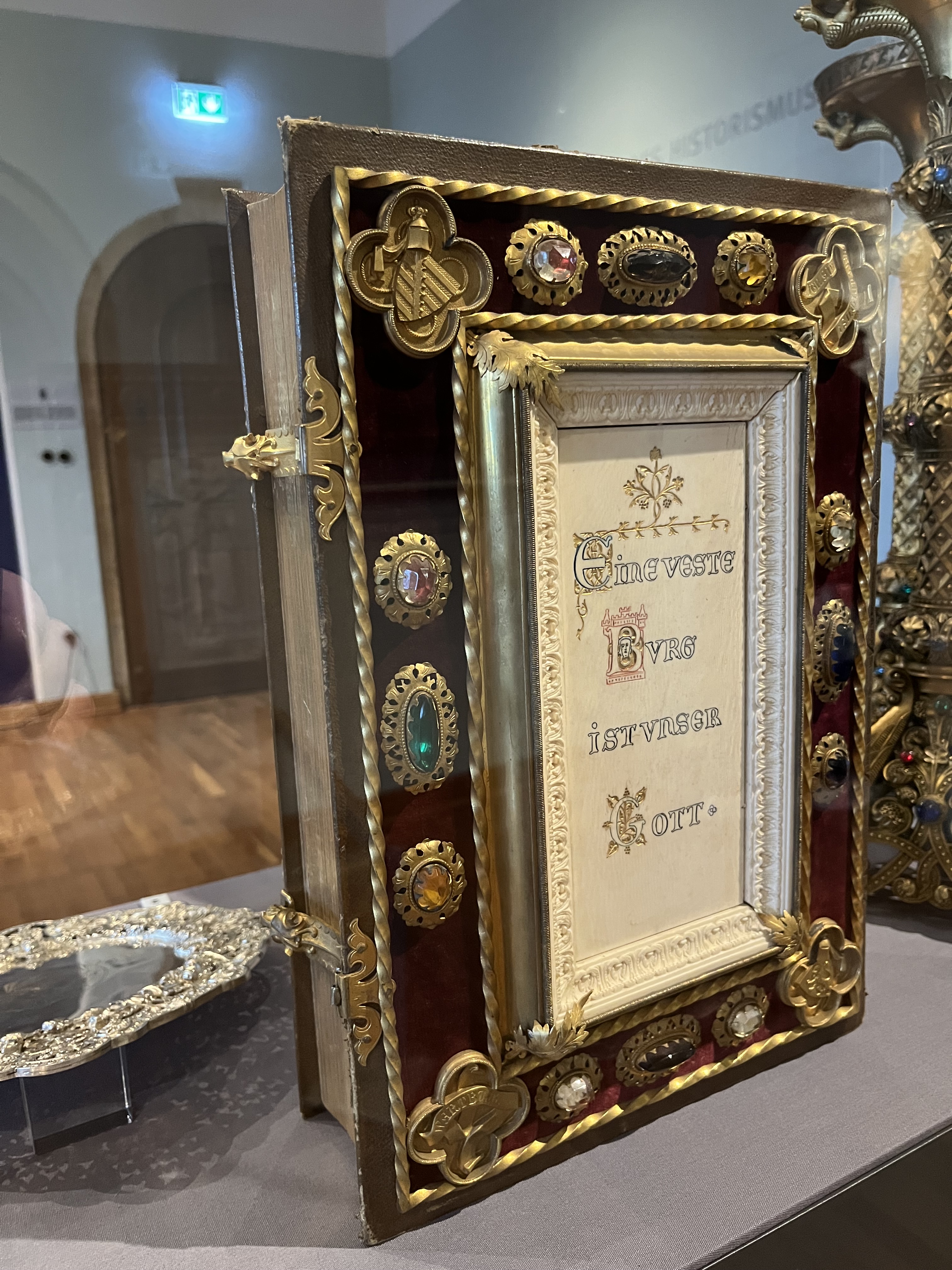
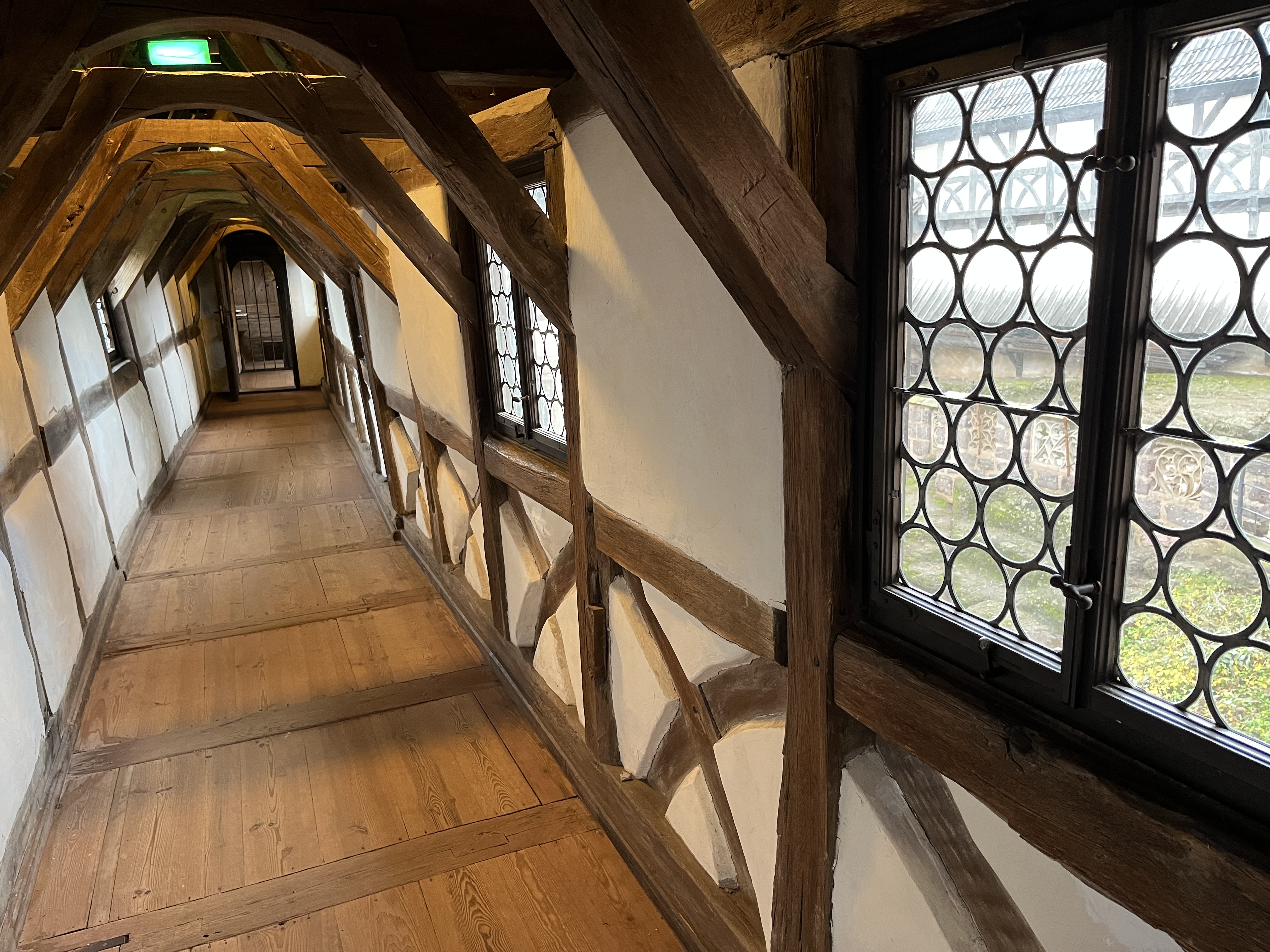
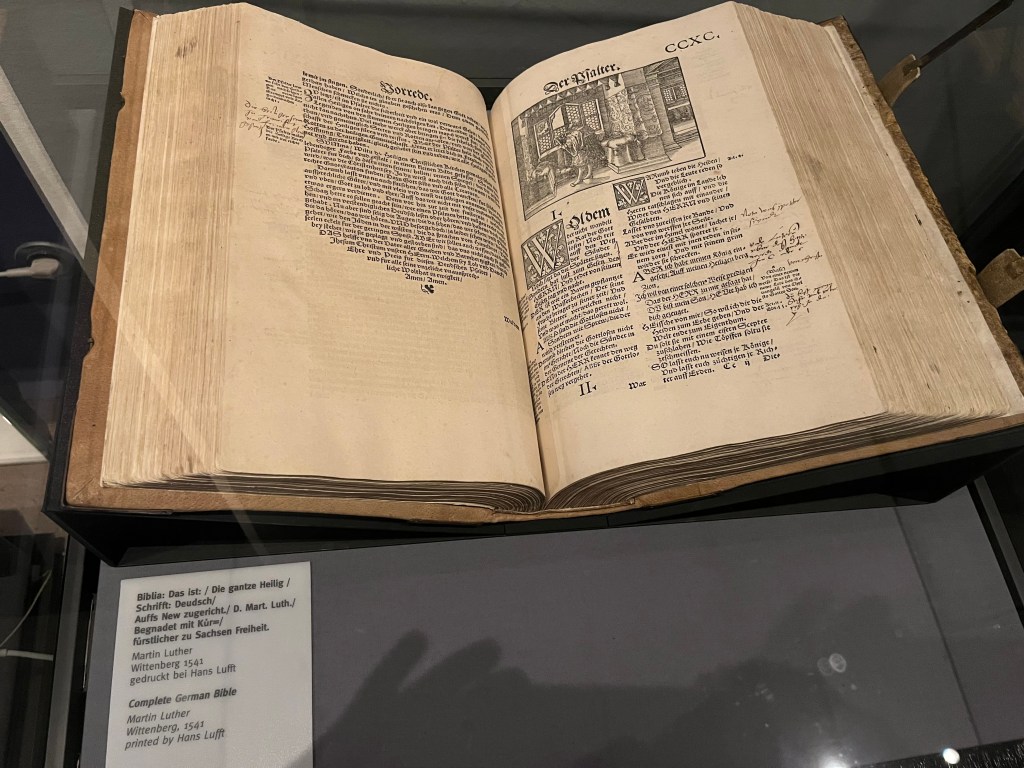
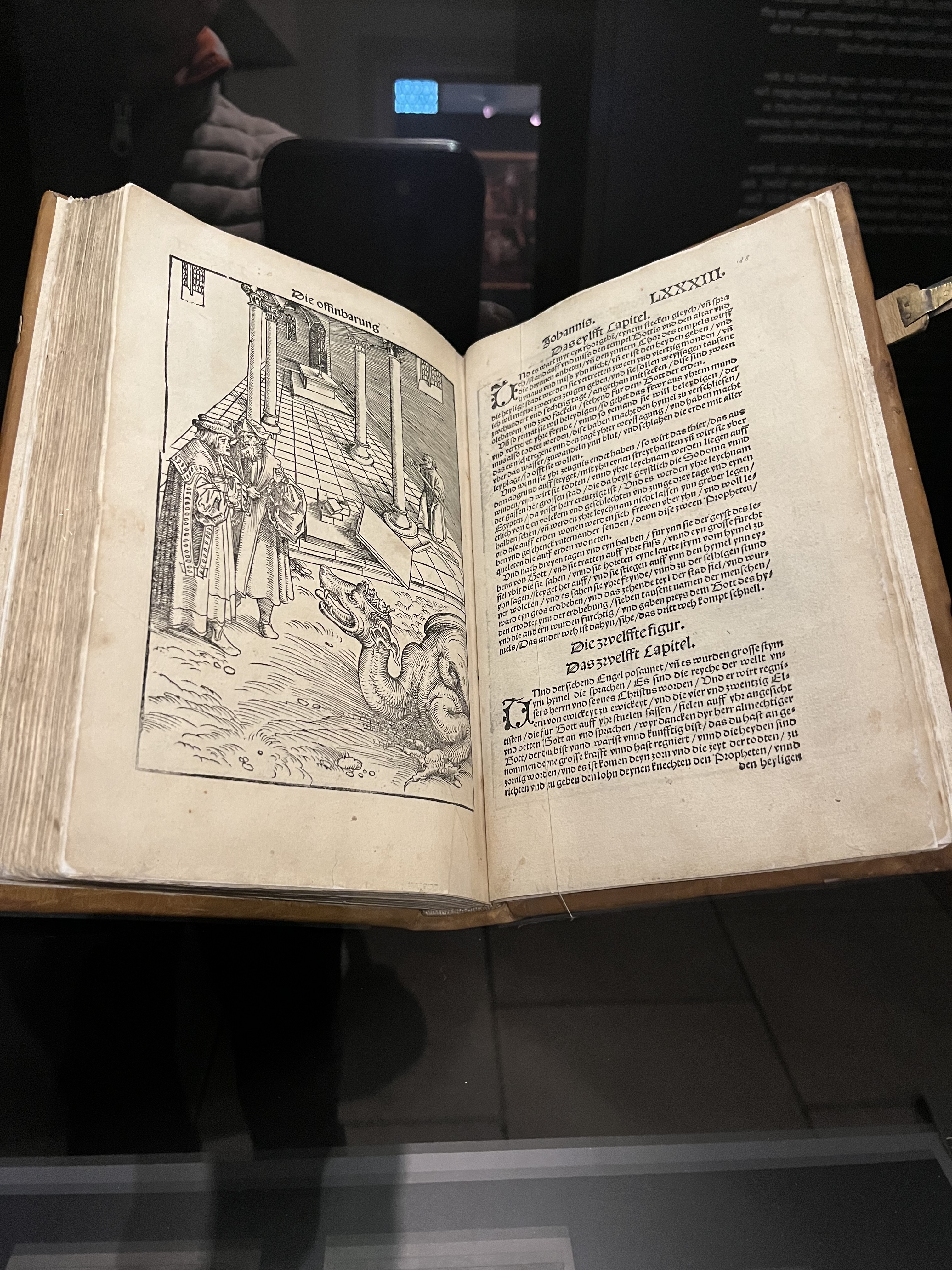
This complete German Bible from 1541 is based on Martin Luther’s translation. Enabling every German citizen to read the Bible themselves, in their own language, fueled the Reformation movement. With the recent invention of the printing press by Gutenberg, it made the Bible the biggest and most distributed German piece of literature. This was an important step in creating today’s German language, which up to then, only consisted of a multitude of local dialects.
From the Wartburg we followed Luther to Erfurt, the capital of the state of Thuringia. Here, in 1501 at age 17, Luther entered the University of Erfurt. After various fields of study, he had a religious experience of conversion in 1505 and enrolled in the St. Augustine monastery of Erfurt to become a monk, – see pictures below. Here he dedicated himself to the Augustinian Order and a life of fasting, prayer, pilgrimage, and confession.
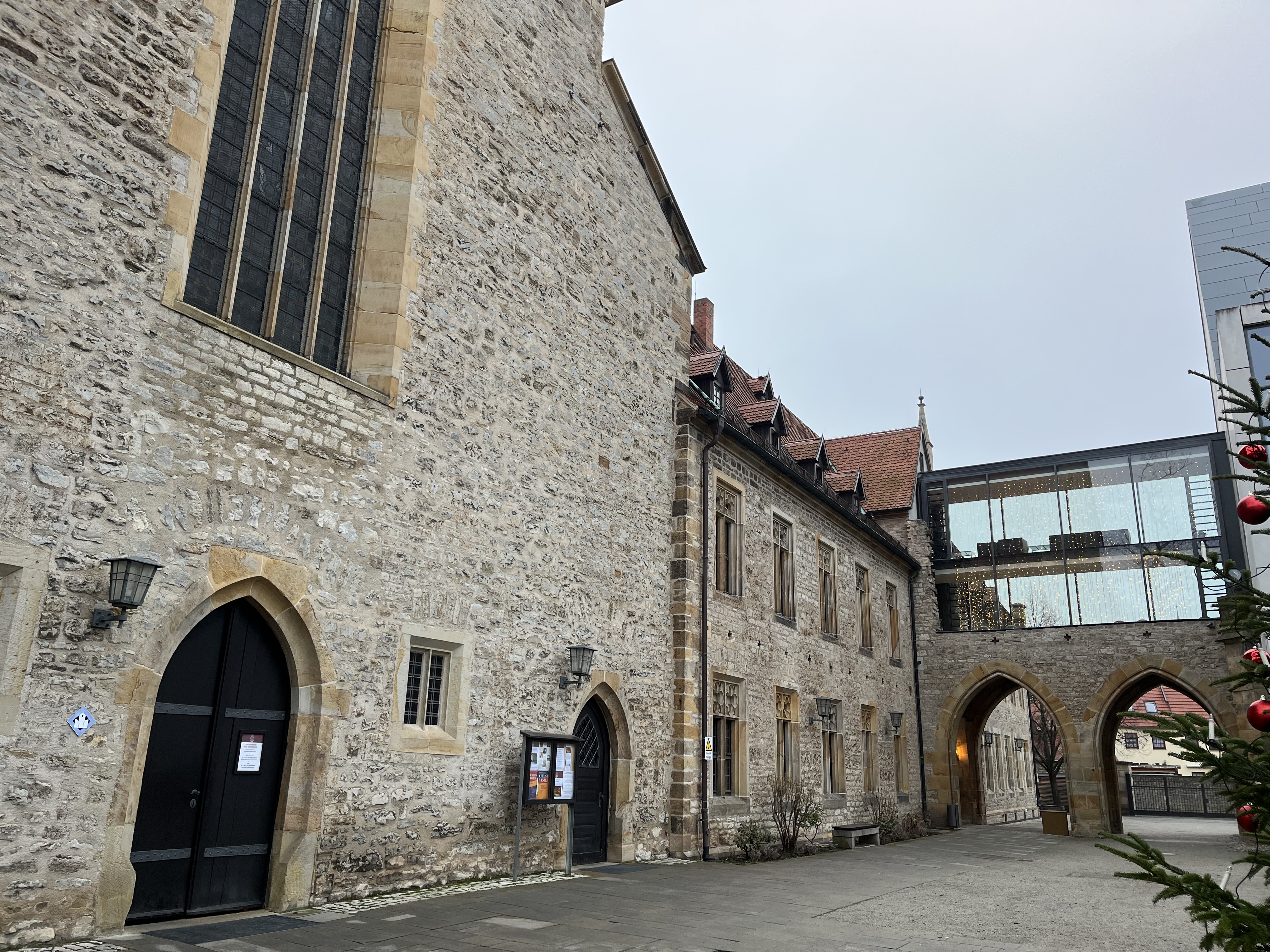
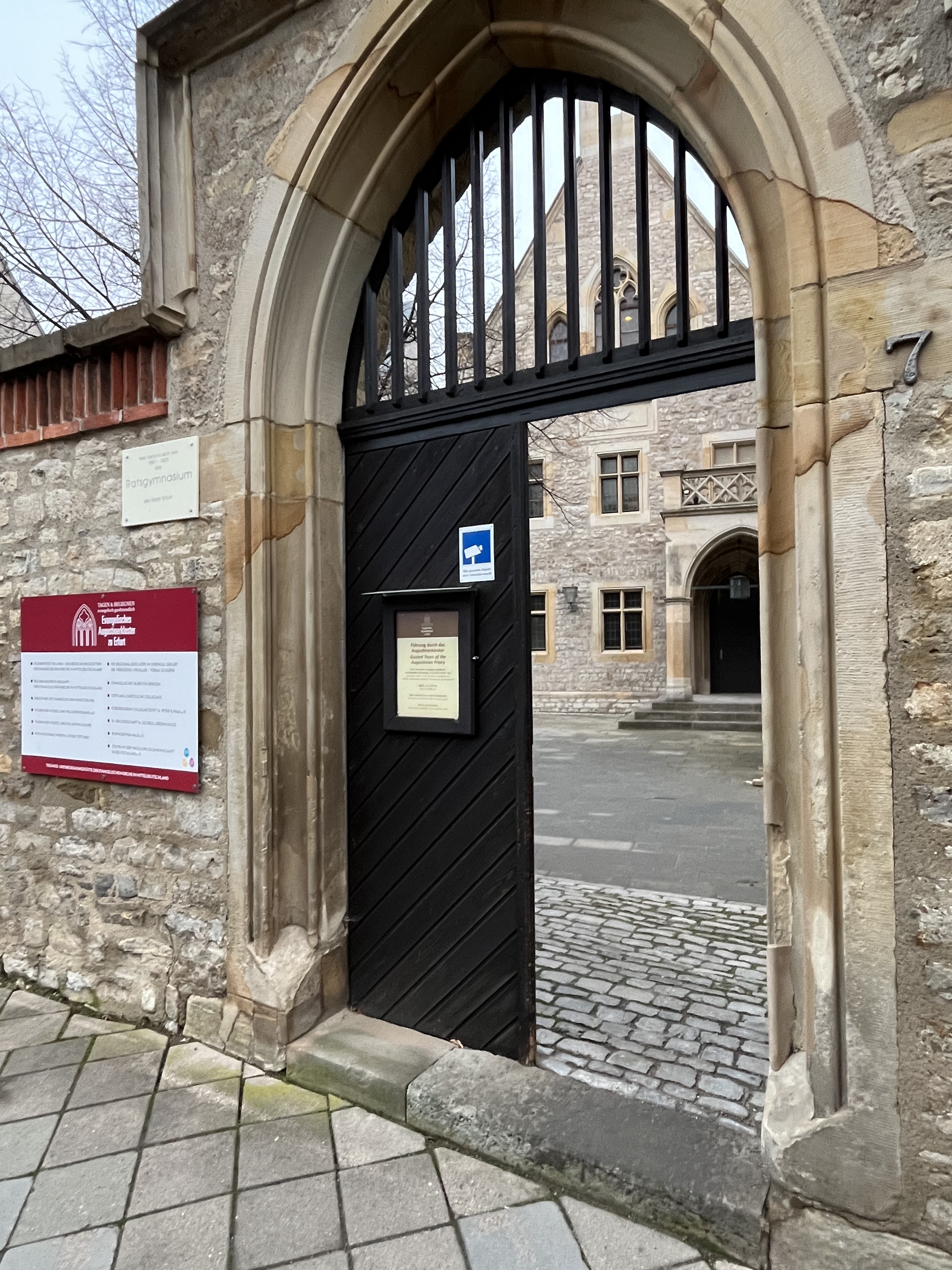
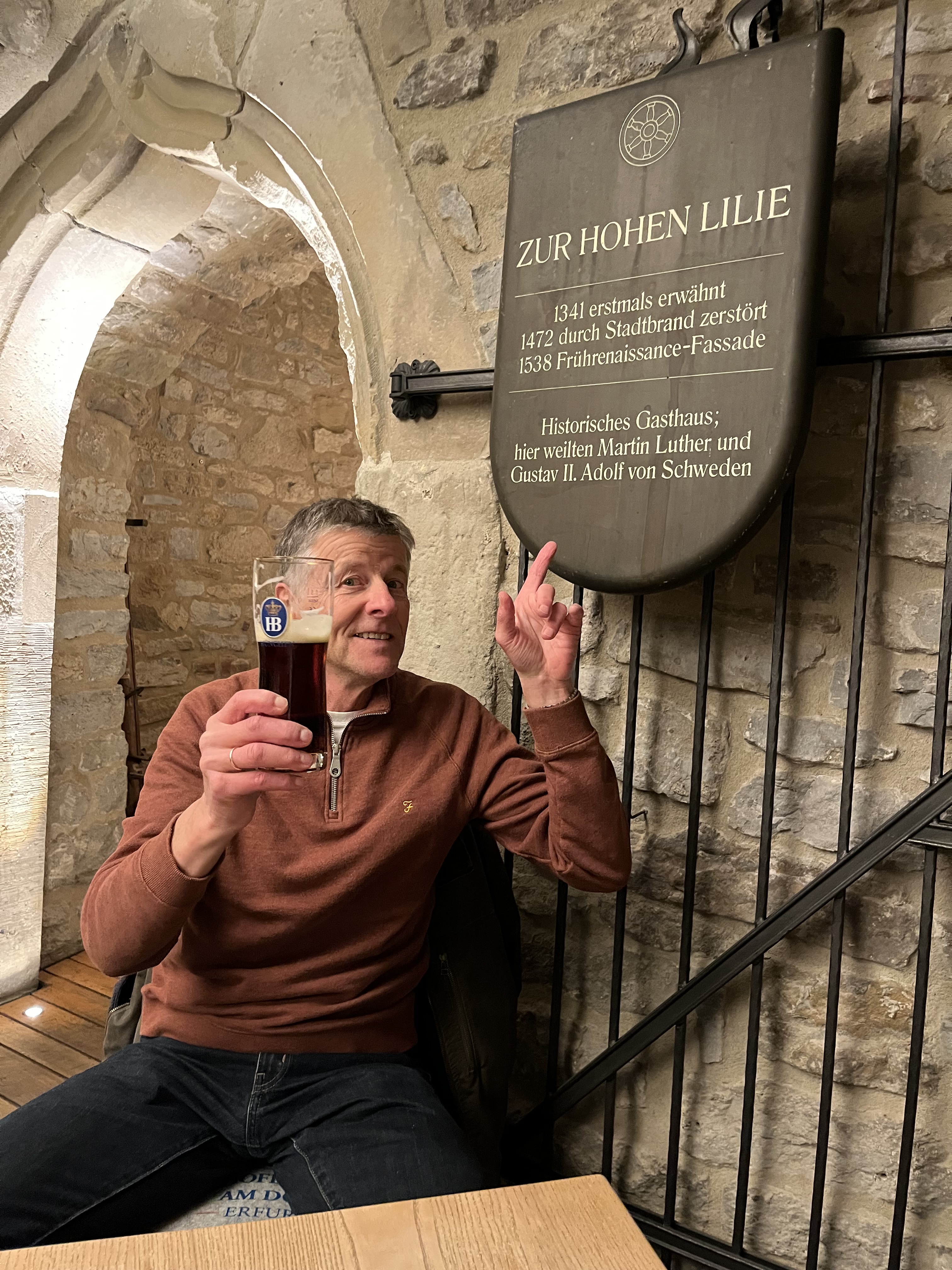
Above, I am sitting in an Erfurt beer hall, where Luther used to enjoy a pint or two prior to entering the monastery. Below, Erfurt is known to have one of the best preserved old town quarters in Germany.
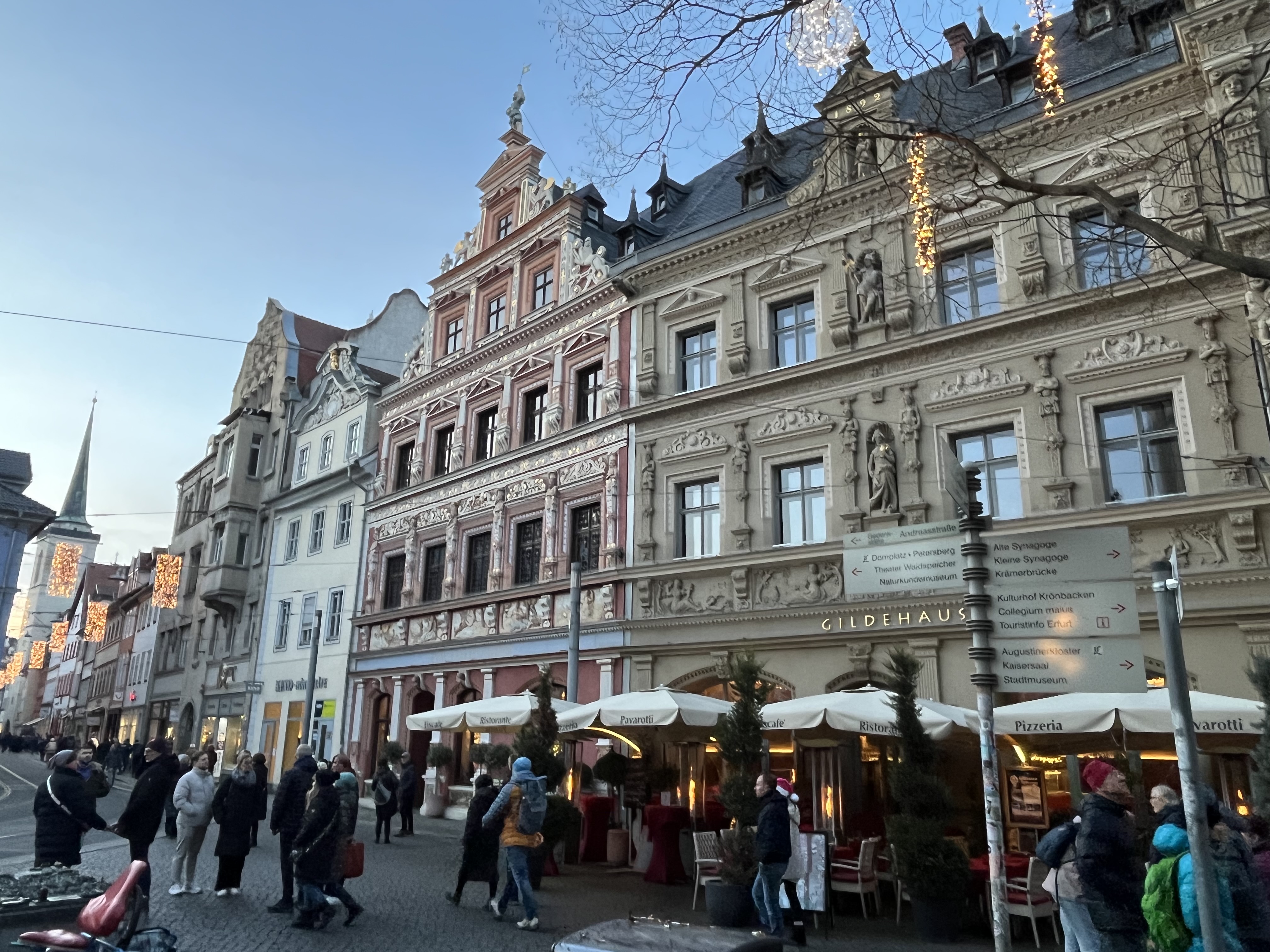
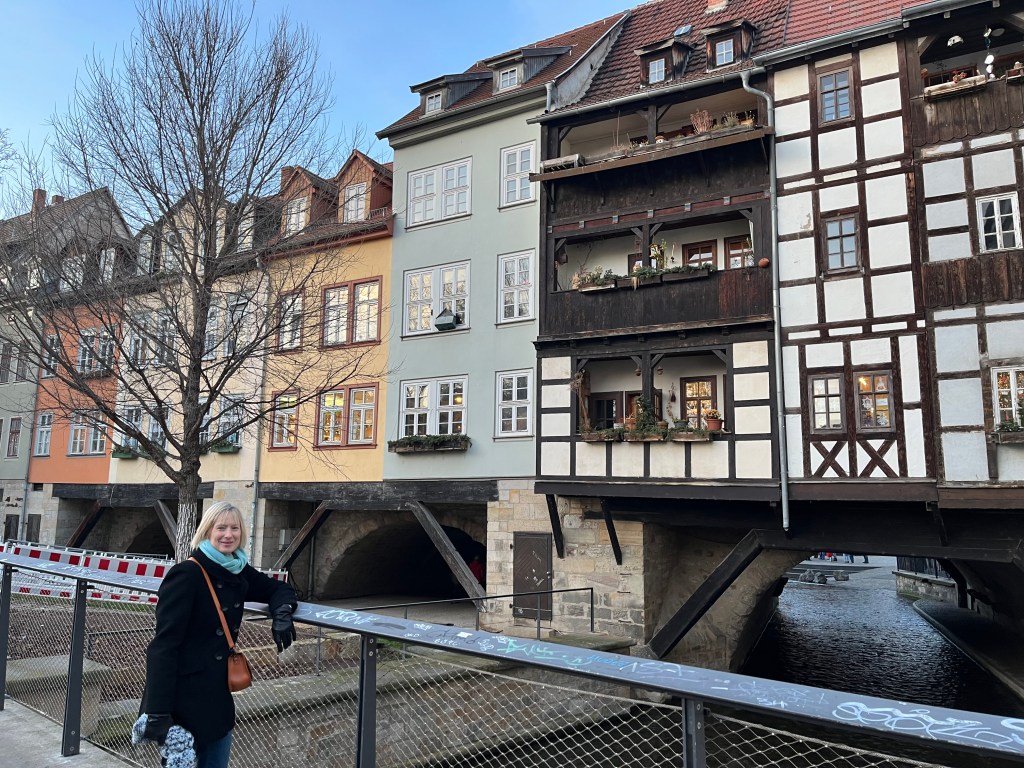
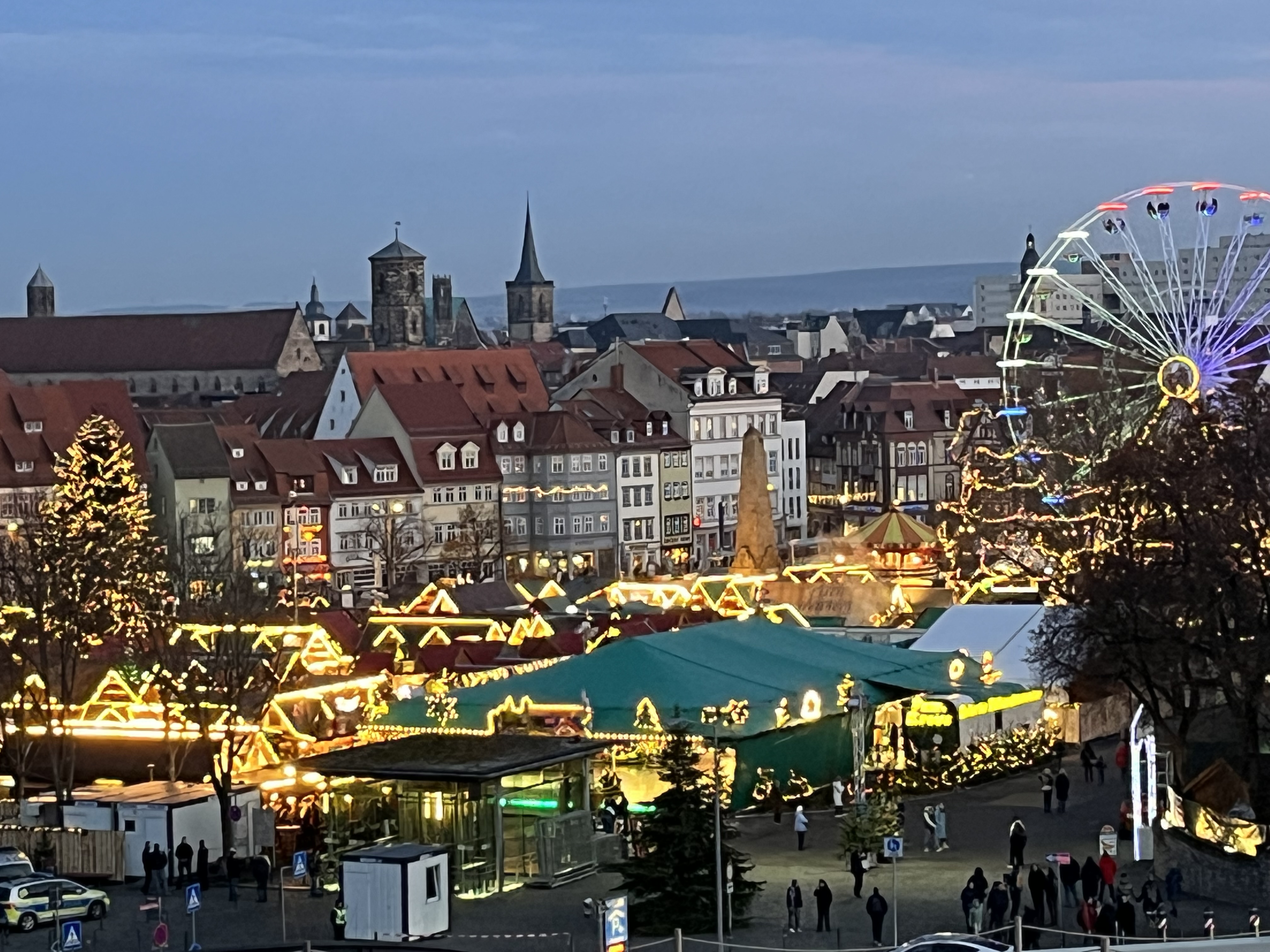
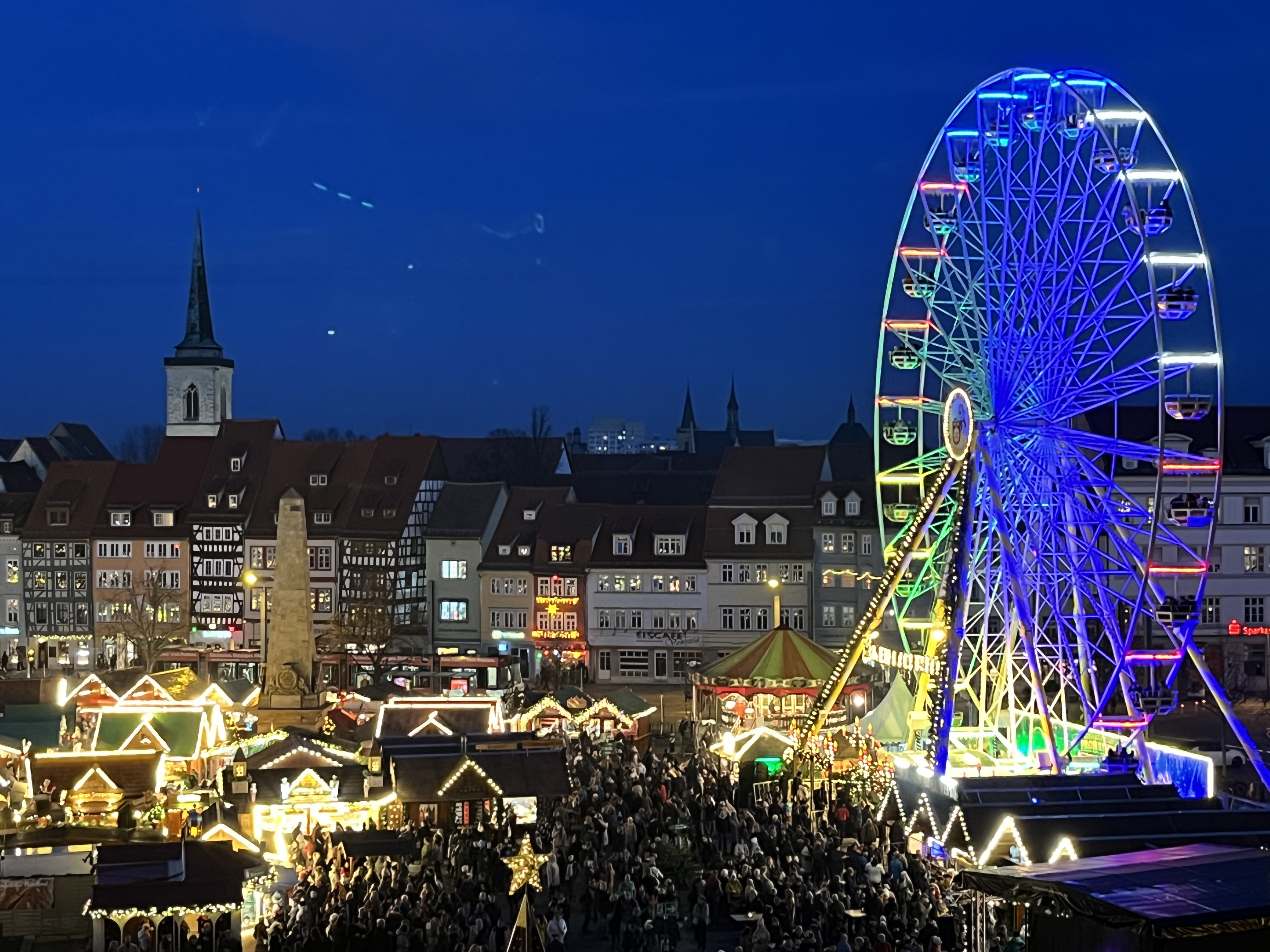
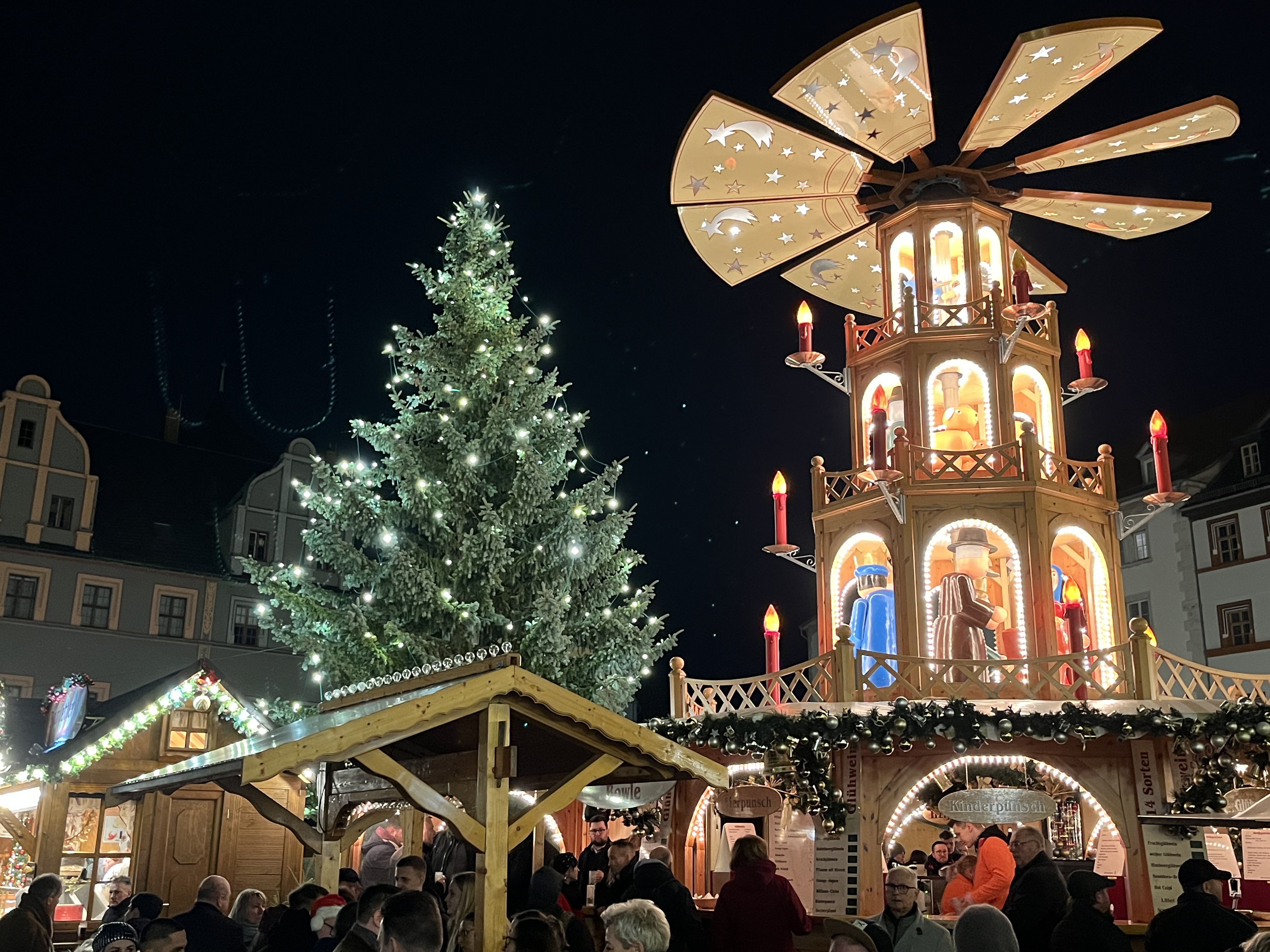
We traveled during the perfect time of year to see all of the typical and frequent Christmas Markets in this part of Germany. This is the one in Erfurt:


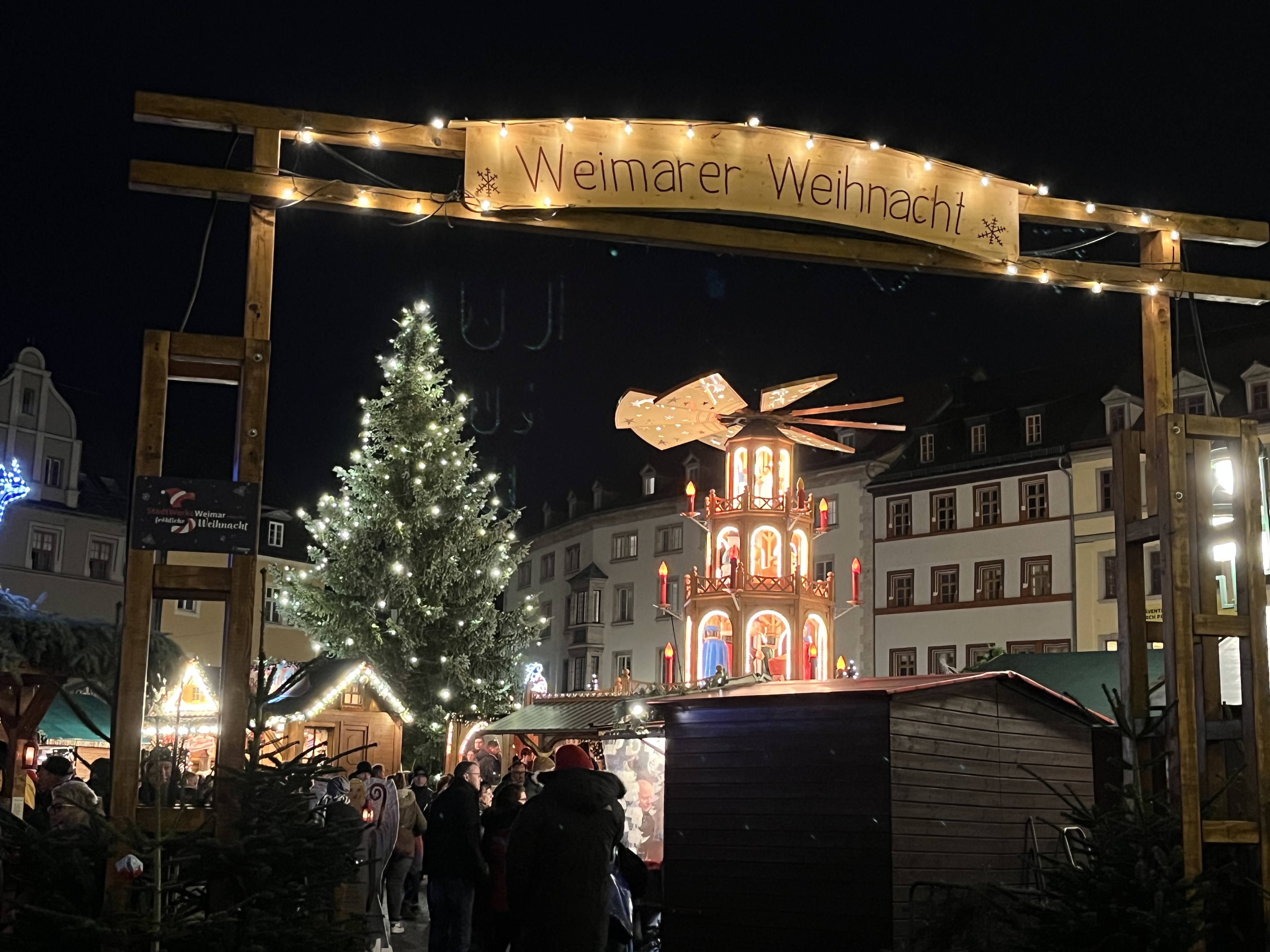
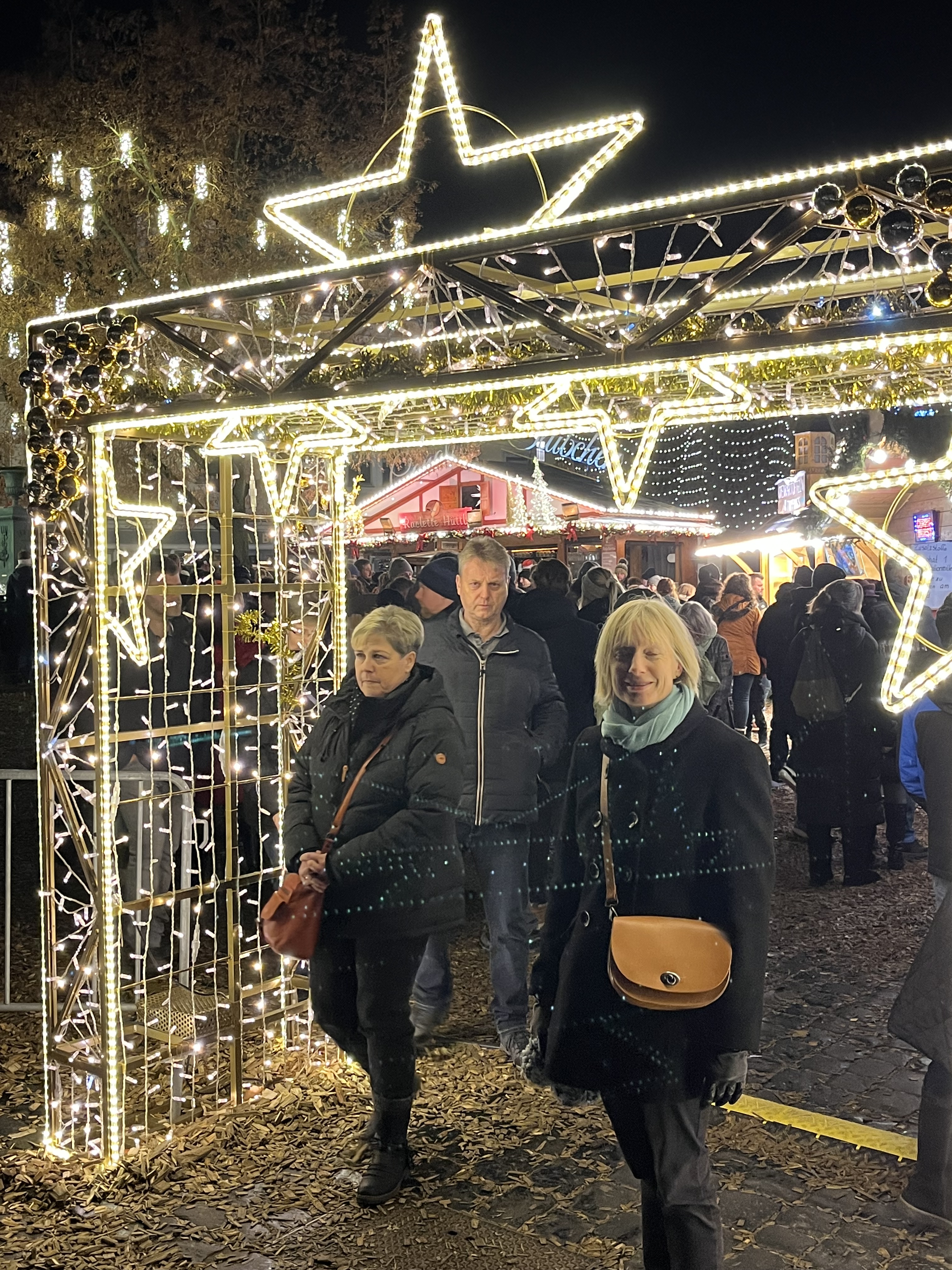
And here is the one in Weimar, just half an hour east of Erfurt:
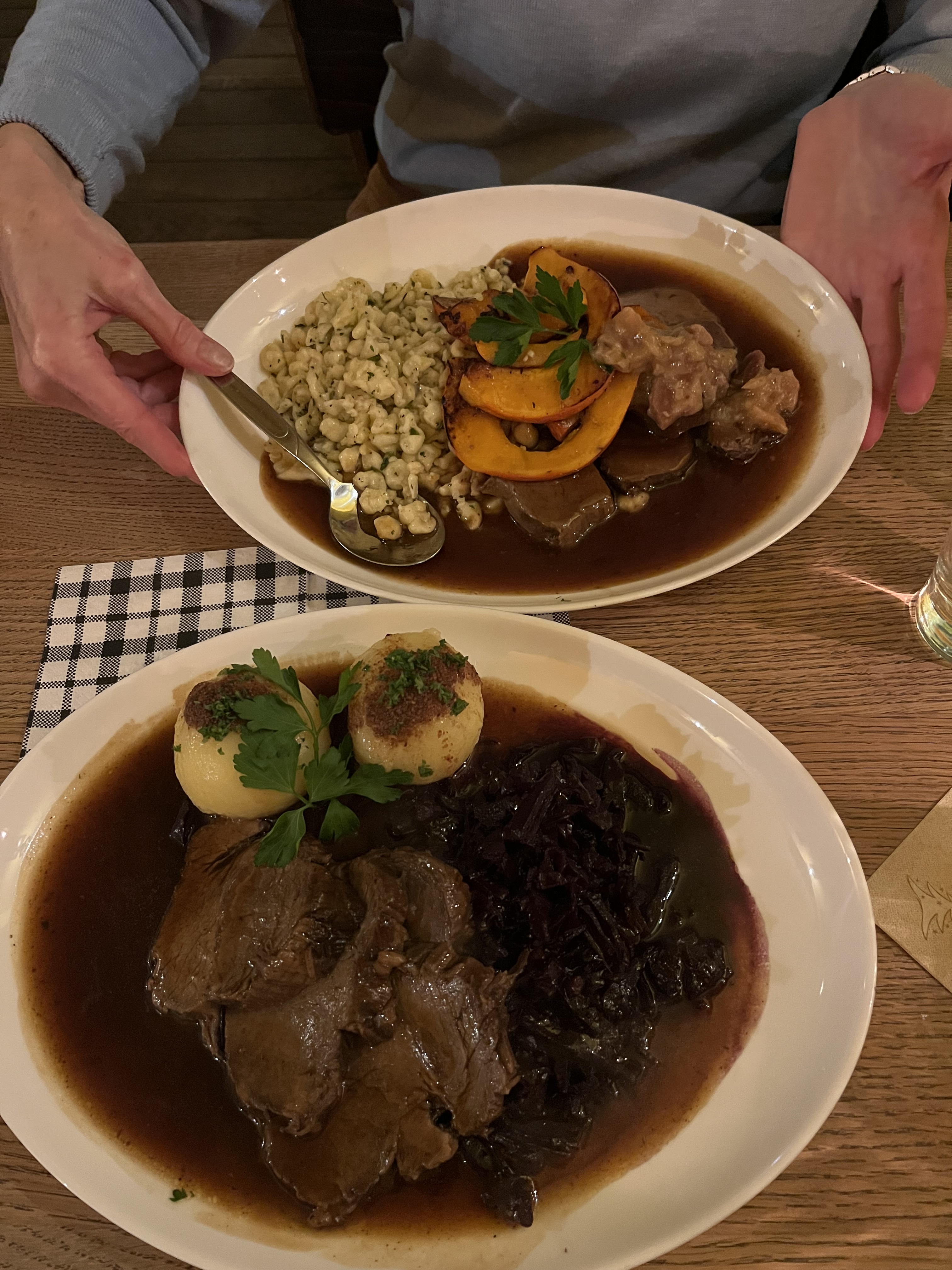
The area of Thuringia is not just known for Christmas Markets, it is also known for excellent, traditional German food, like this tasty Sauerbraten and dumplings with red cabbage dish below, which is especially fulfilling on a cold winter day:


The town of Weimar is known as the place where Germany’s first democratic constitution was signed in 1918 after World War I. The newly created republic was called the Weimarer Republik based on it’s place of origin, and lasted until 1933 when Hitler and his Nazis overthrew the constitutional rights and replaced the democratic Republik with their totalitarian regime.
Fortunately, there is a much better and brighter side to Weimar. During the time of the enlightenment, in the 18th century, German poets, writers, and musicians like Johann Wolfgang von Goethe, Friedrich Schiller and Franz Liszt congregated here.
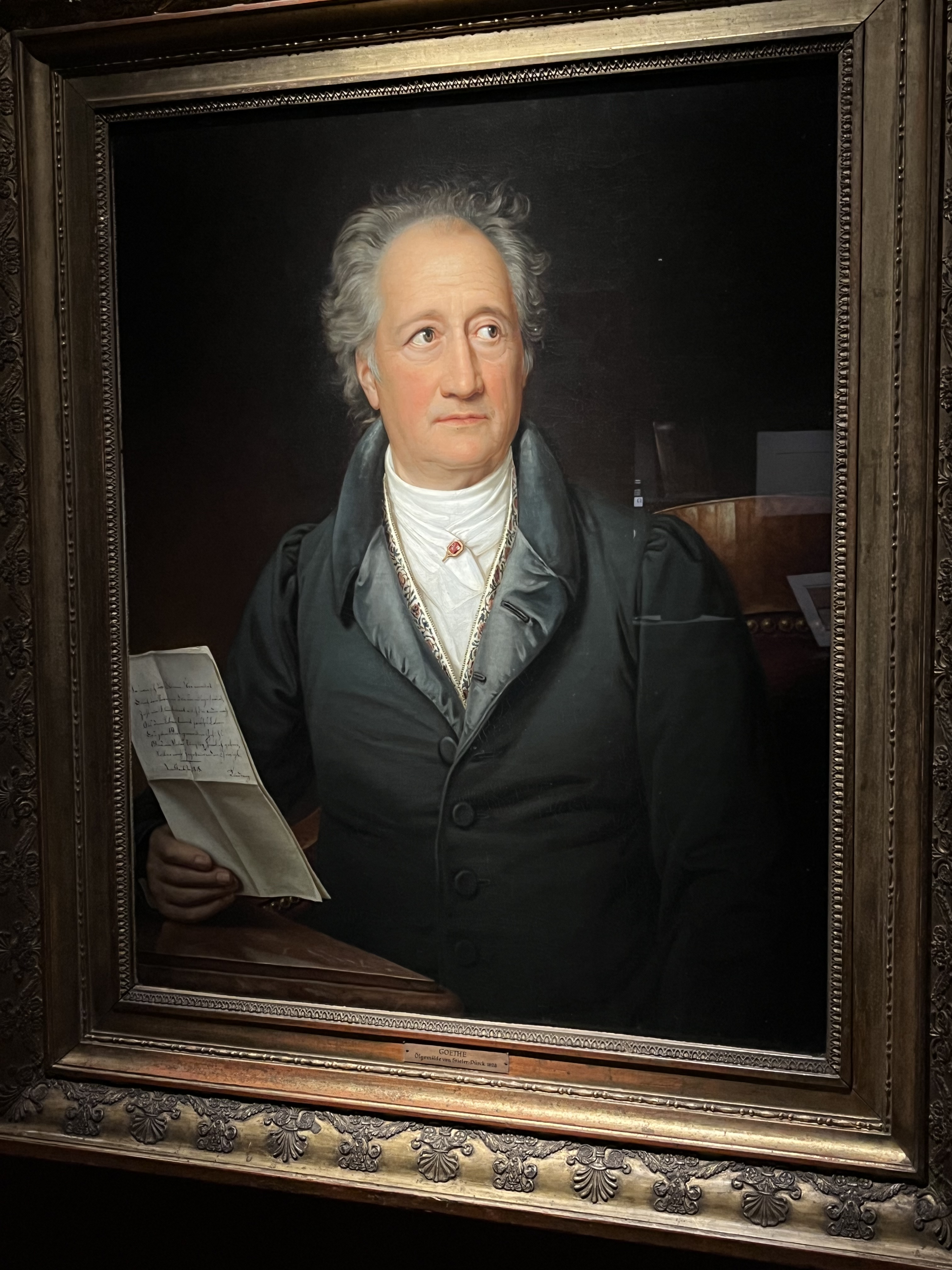
We visited the Goethe museum, located in Goethe’s house right next to the market square. Goethe is widely regarded as the most influential German writer, with works like Faust or Die Leiden des Jungen Werthers. He also had a big political and philosophical influence, through frequent exchanges with other giants of the enlightenment like, for instance, with his French friend Voltaire. Even Napoleon was known to have sought Goethe’s advice, and Goethe’s poems were set to music by Mozart, Beethoven, Schubert, Berlioz, Wagner, Liszt, Mahler and Mendelssohn. As an inquisitive thinker of the enlightenment, he also studied the natural world, especially the field of botany.
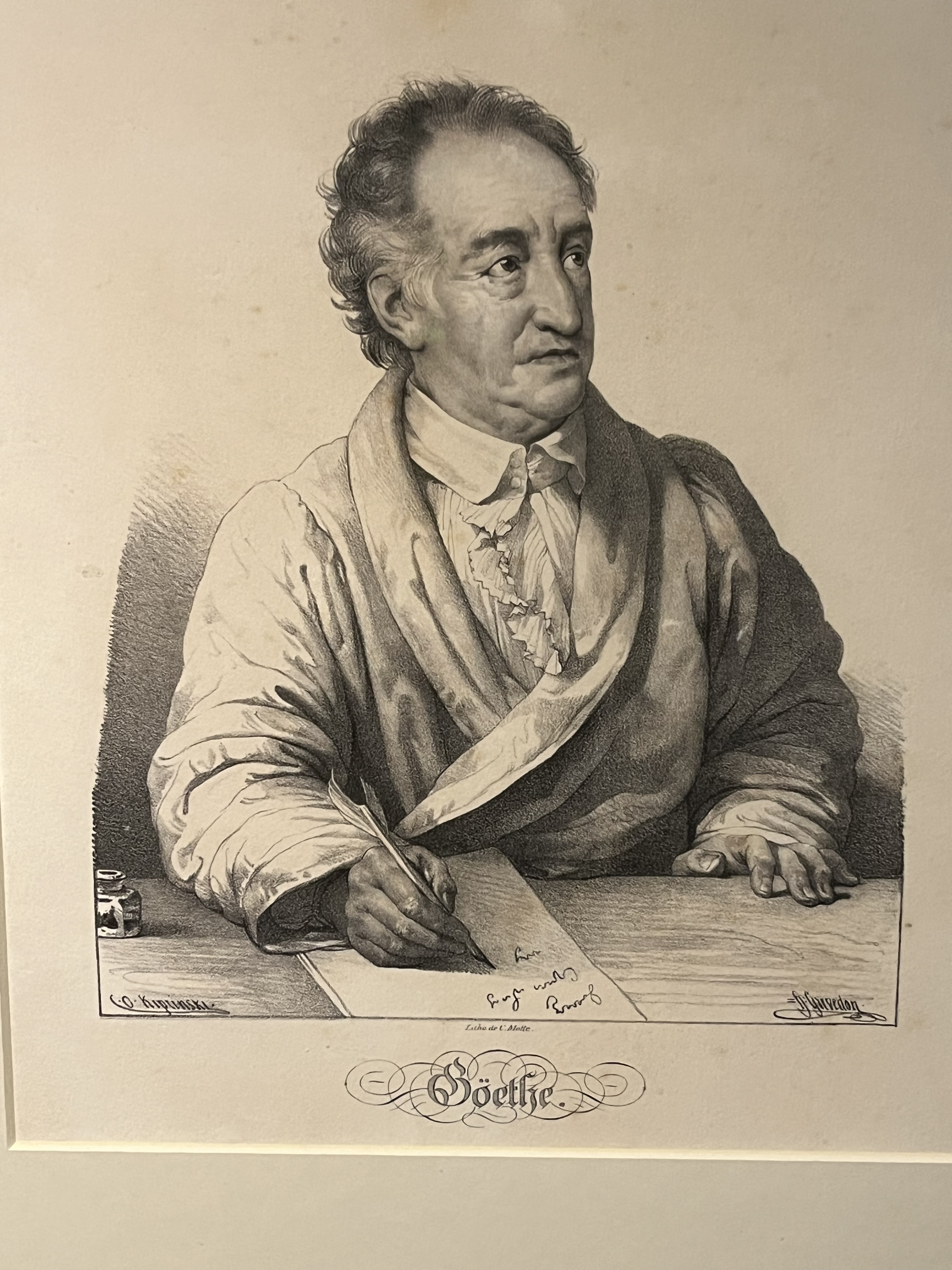
Below, next to two of Goethe’s portraits, you see his original study room where he spent most of his time. His work is being kept alive by the Goethe Institutes around the world, a non profit German cultural organization, operating through 150 institutes in 99 different countries.

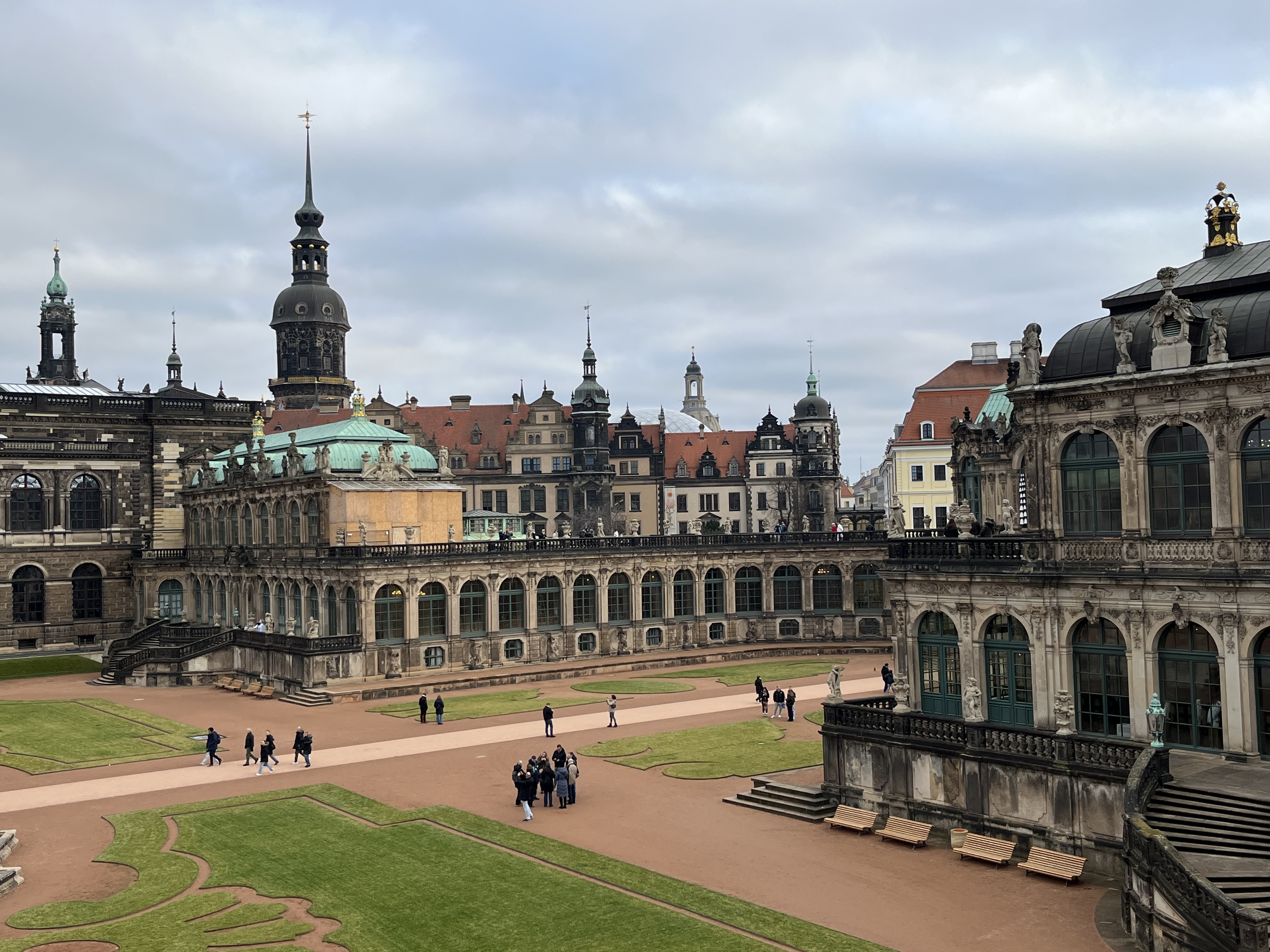
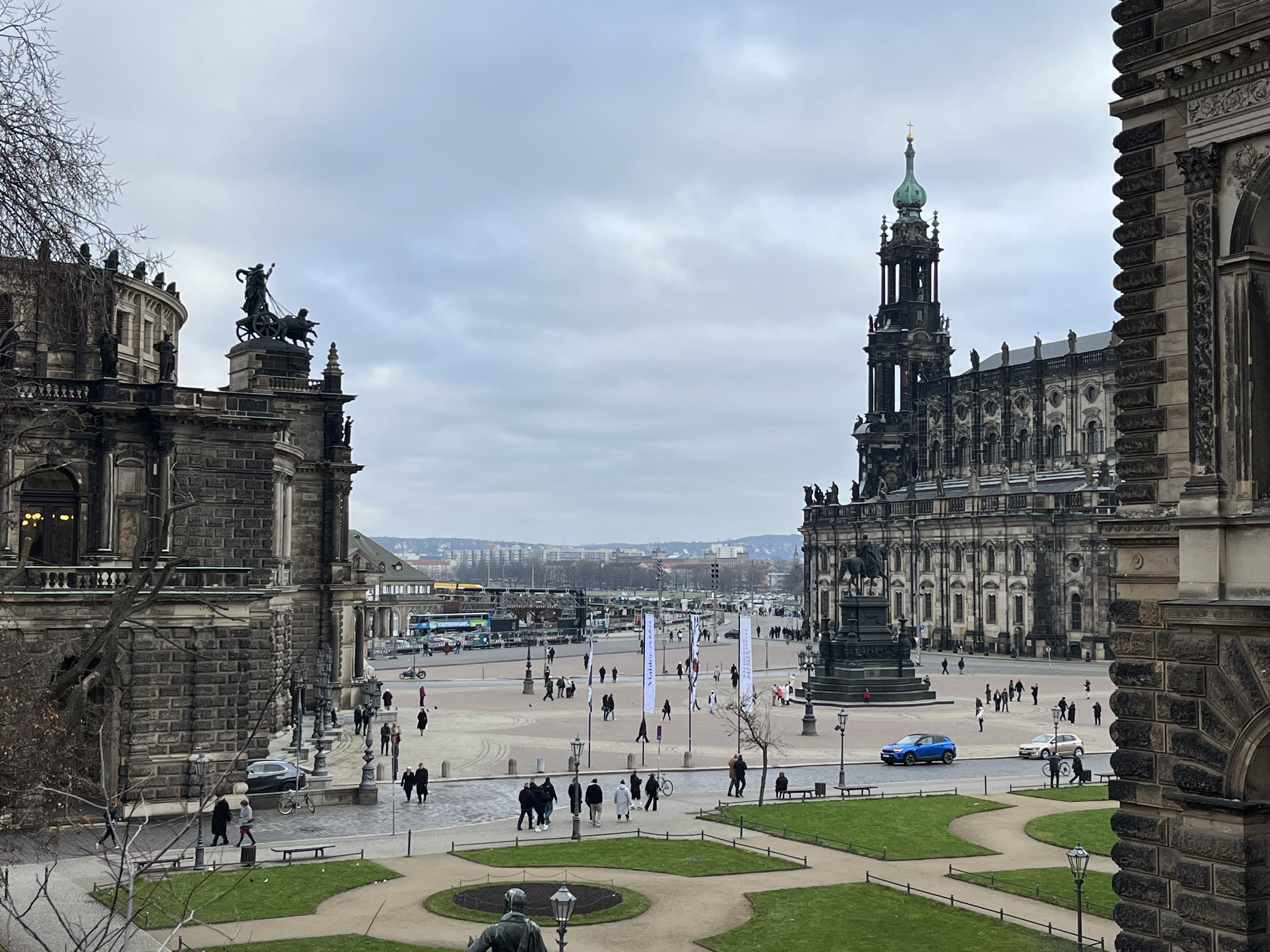
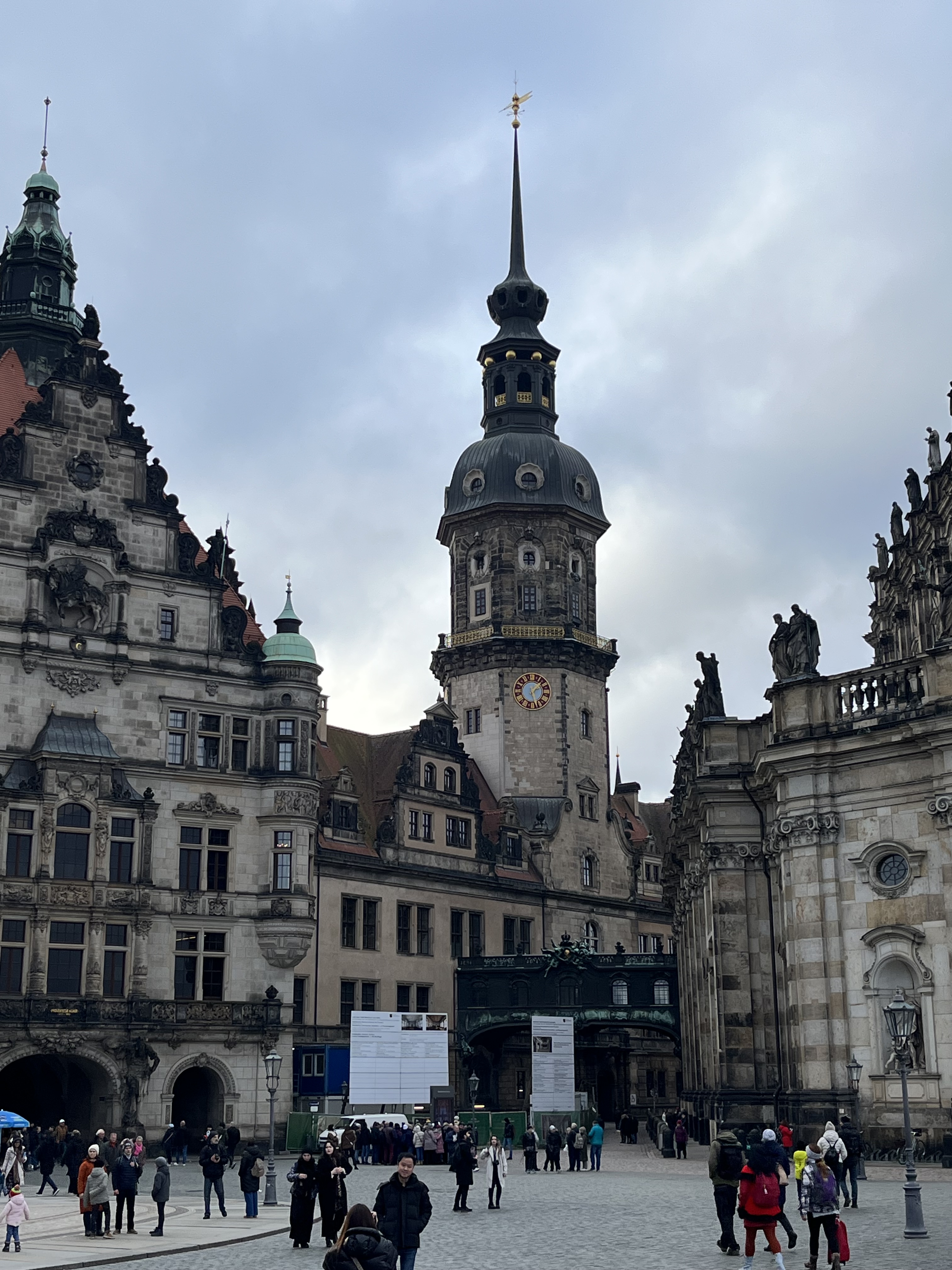
We’re now in Dresden, the capital of Saxony. Dresden is often referred to as the Florence on the Elbe, due its cultural importance and setting on the banks of the Elbe river. We perceived it as being more of an interesting mix of wanna be classical French and Russian style architecture. The closeness to Europe’s East, is clearly evident here. For instance, by the frequent encounter of Eastern languages spoken and the appearance and behavior of the people. We guessed that almost half of the people in Dresden are from the former Eastern Block of Europe. In and around Dresden we also noticed a large share of semi trucks from the Czech Republic, which is just one hour further east, and a noticeable number of vehicles from Ukraine.
This big Baroque complex is called the Zwinger. It is the most famous architectural monument in Dresden, and a great example of the transcontinental French and Russian influences:

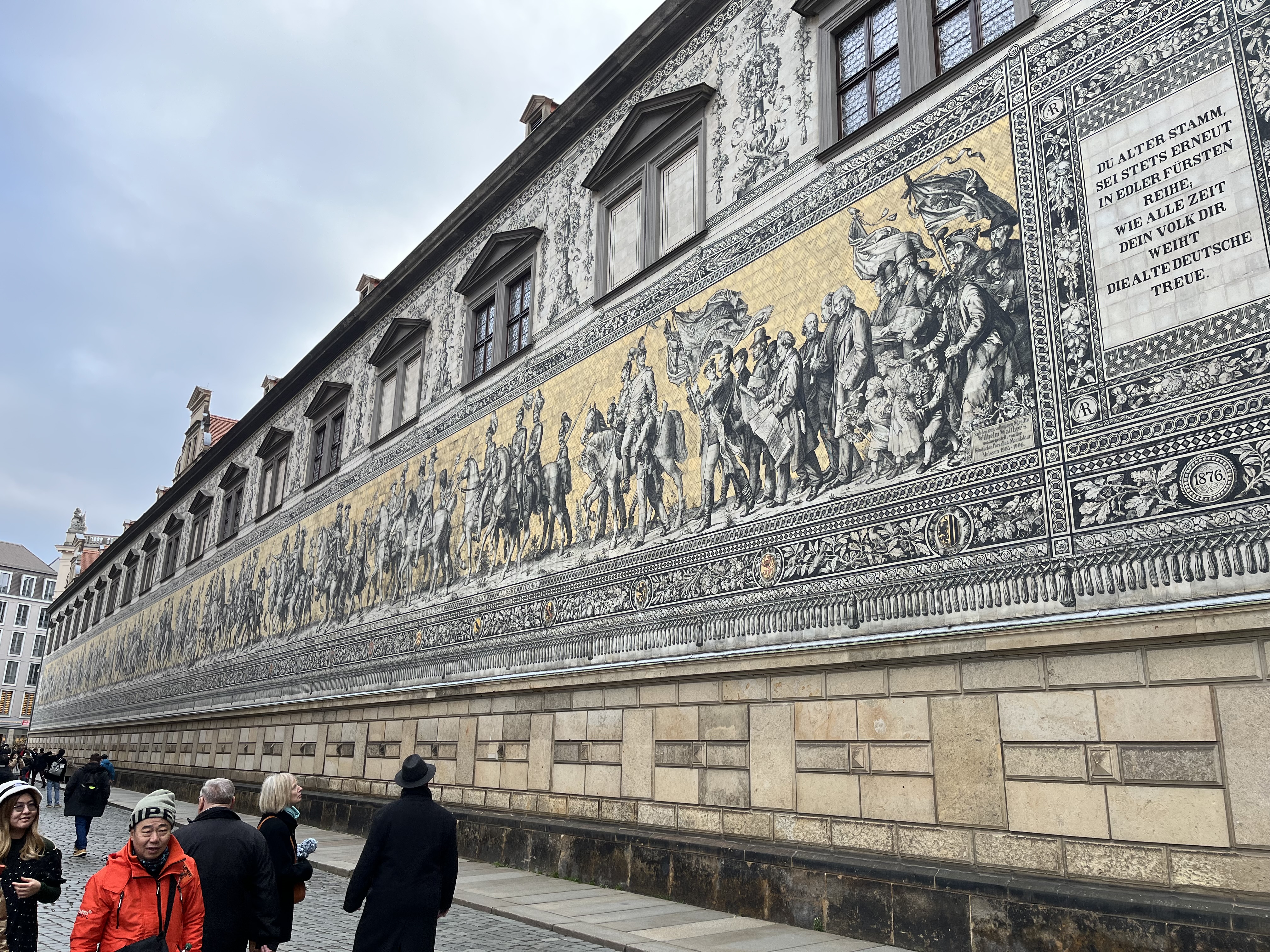
Below are two pictures showing the beginning and end of the 335′ long Fuerstenzug, or Parade of Princes. On over 23,000 porcelain tiles it shows a horse mounted, chronological procession of the rulers of Saxony. Dresden is known for the art of tile and porcellan making, like the famous Meissner Porzellan:

At the end of WWII, between February 13 – 15, 1945 the Royal Air Force, together with the US Air Force, dropped 1,182 tons of incendiary bombs and 1,478 tons of high explosive bombs over Dresden, resulting in 25,000 casualties and an almost complete destruction of the city.
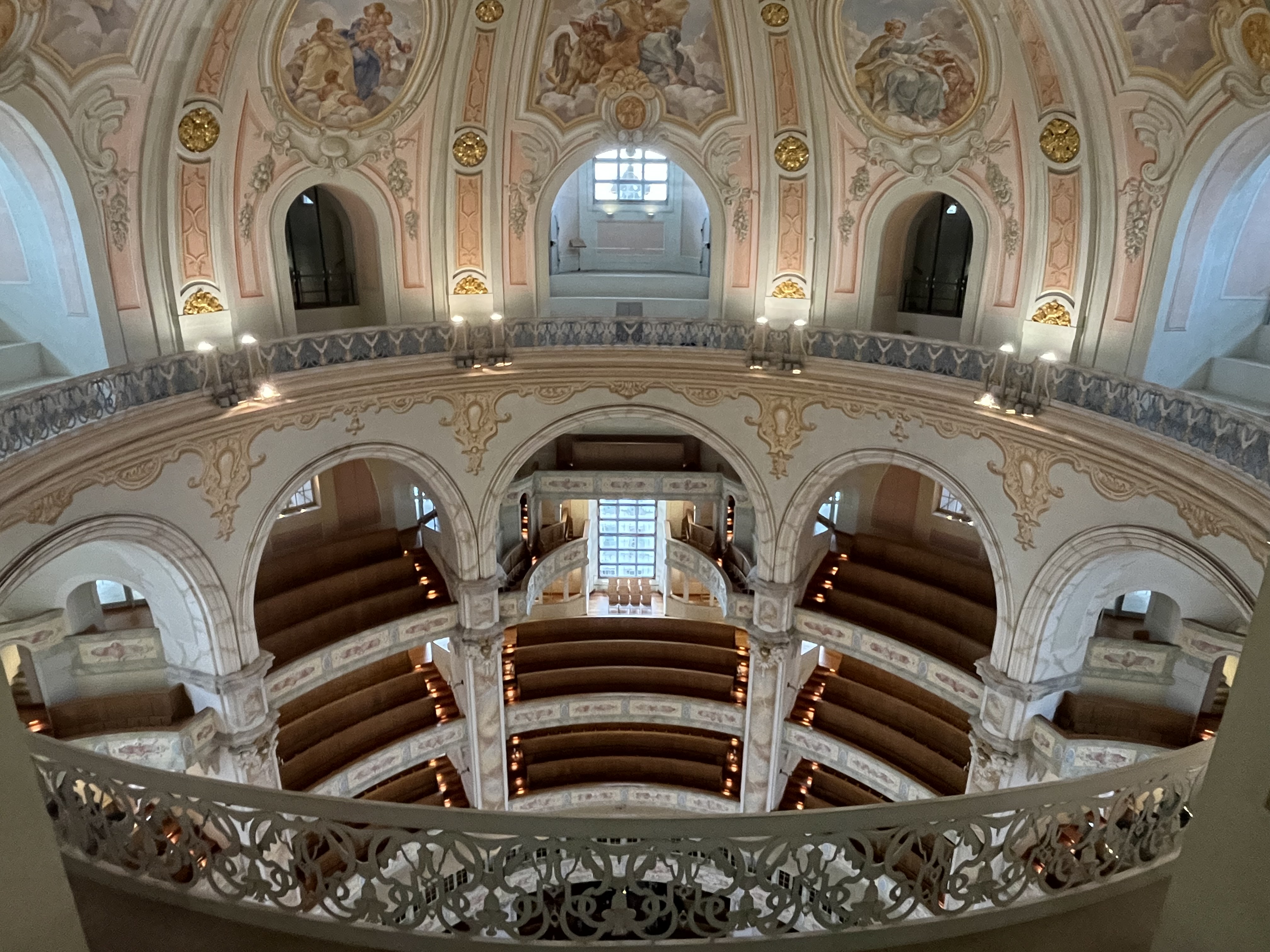
One example of the destruction and huge rebuilding effort undertaken since then is the Baroque Frauenkirche below:


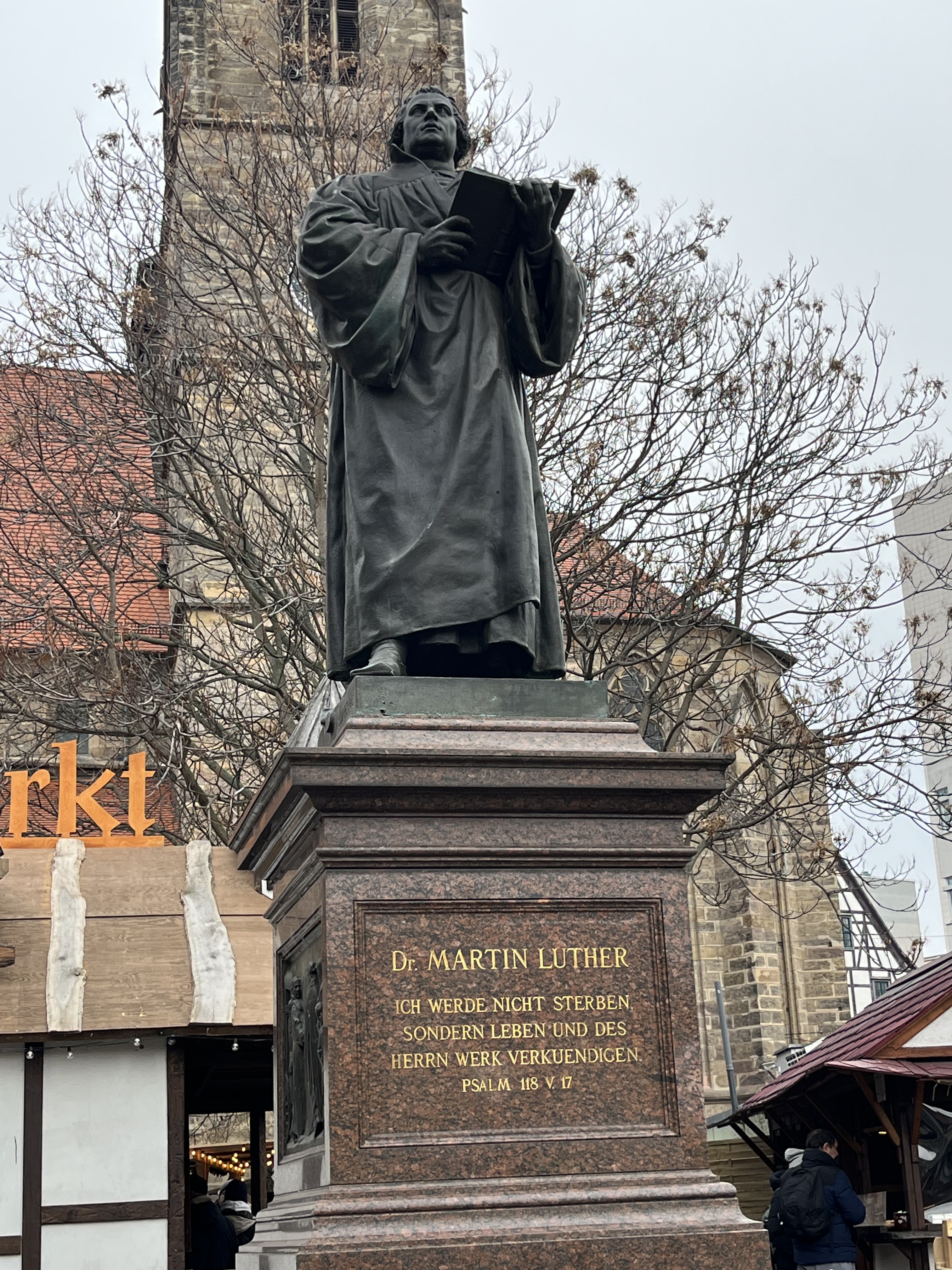
It looks as if the ever present Martin Luther stands on his pedestal looking towards heaven, unfazed by the surrounding destruction. After WWII the DDR intentionally left the ruins of this famous building as a reminding monument. It took until 1993 before the painstaking and elaborate rebuilding effort began, which was completed in 2005. We’re no fans of the Baroque style, yet the church’s architectural layout in a circle, with rounded seating on multiple levels, almost like a classical theater, is very intriguing and engaging for a church building.
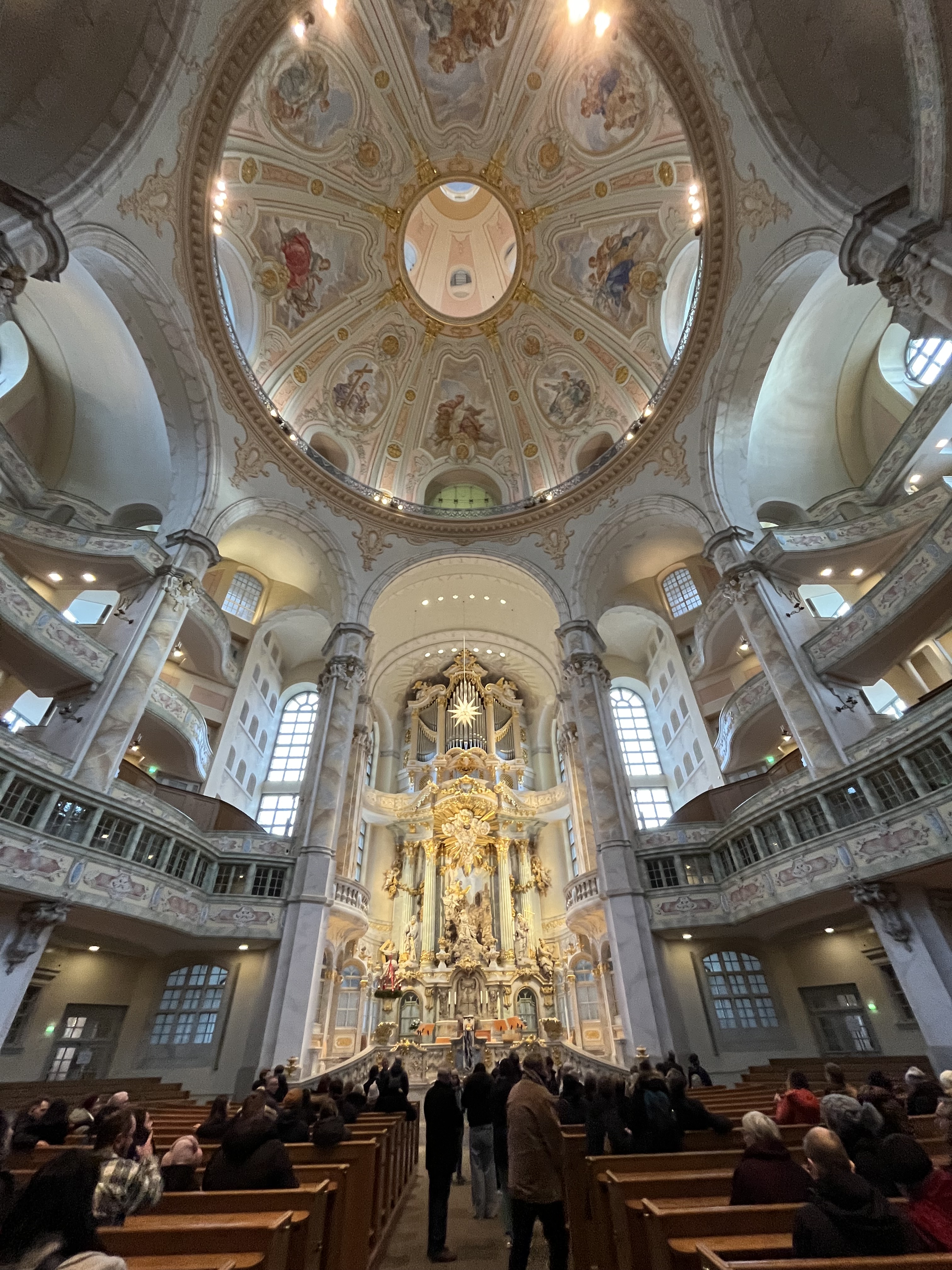
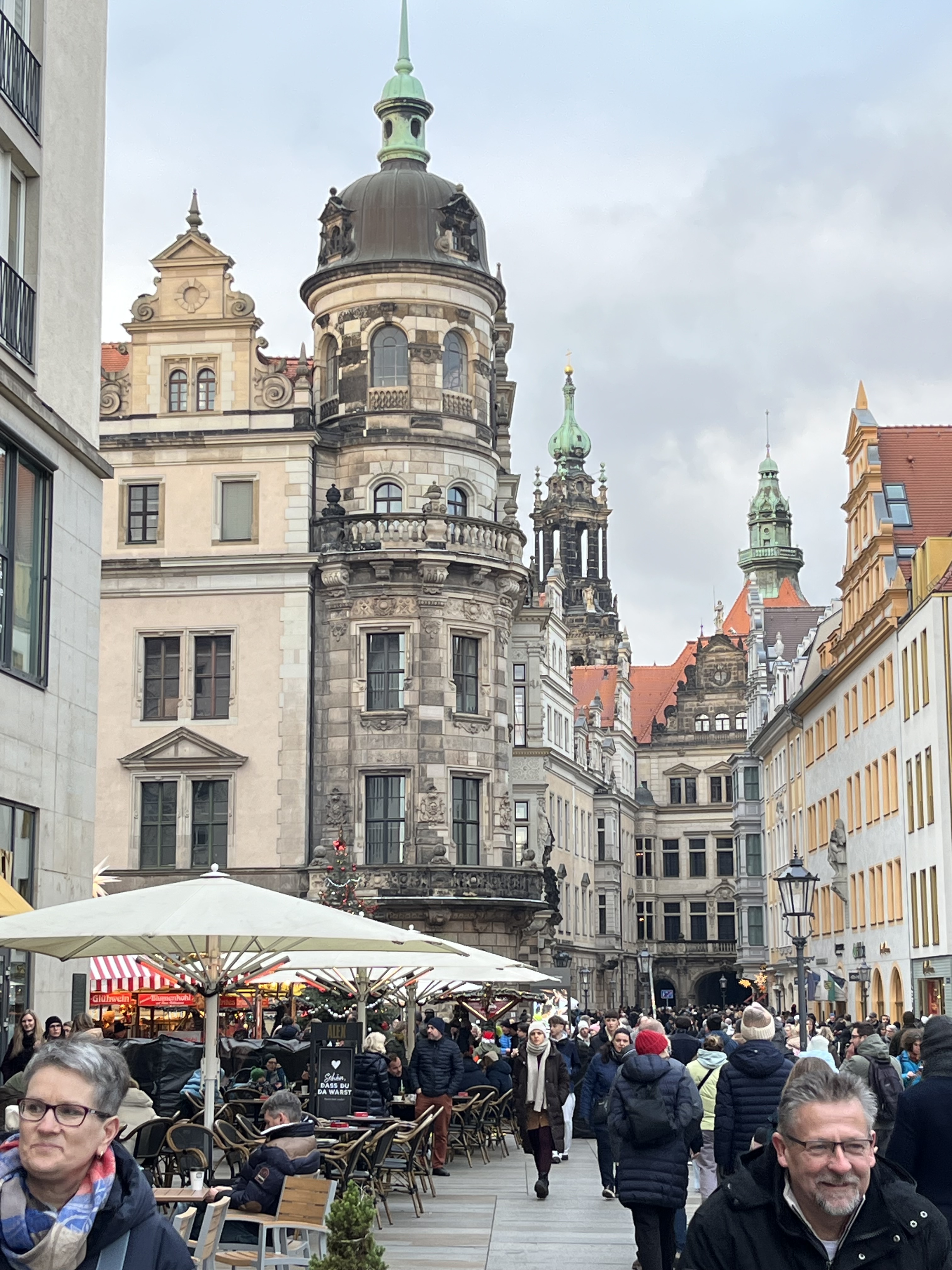
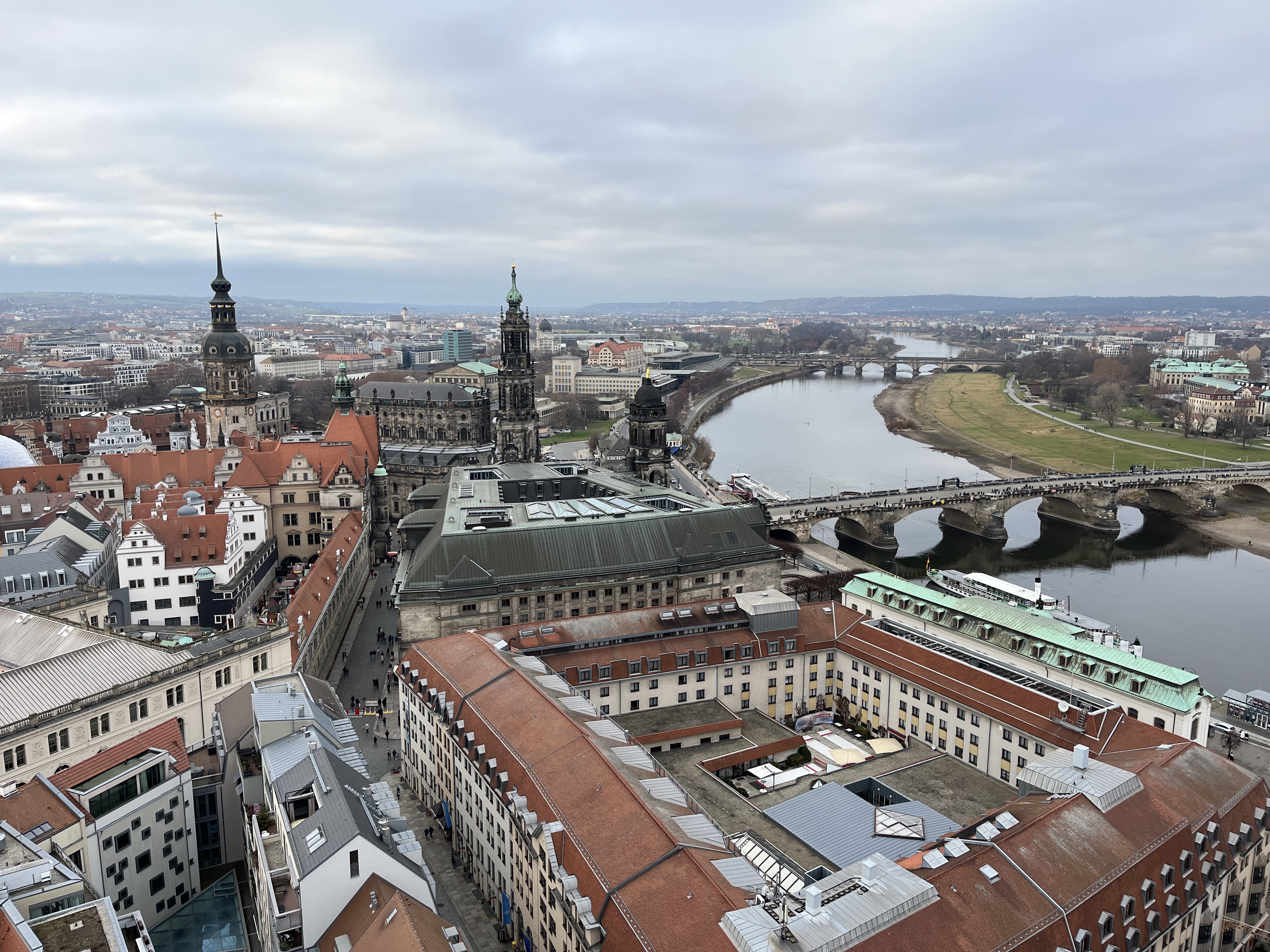
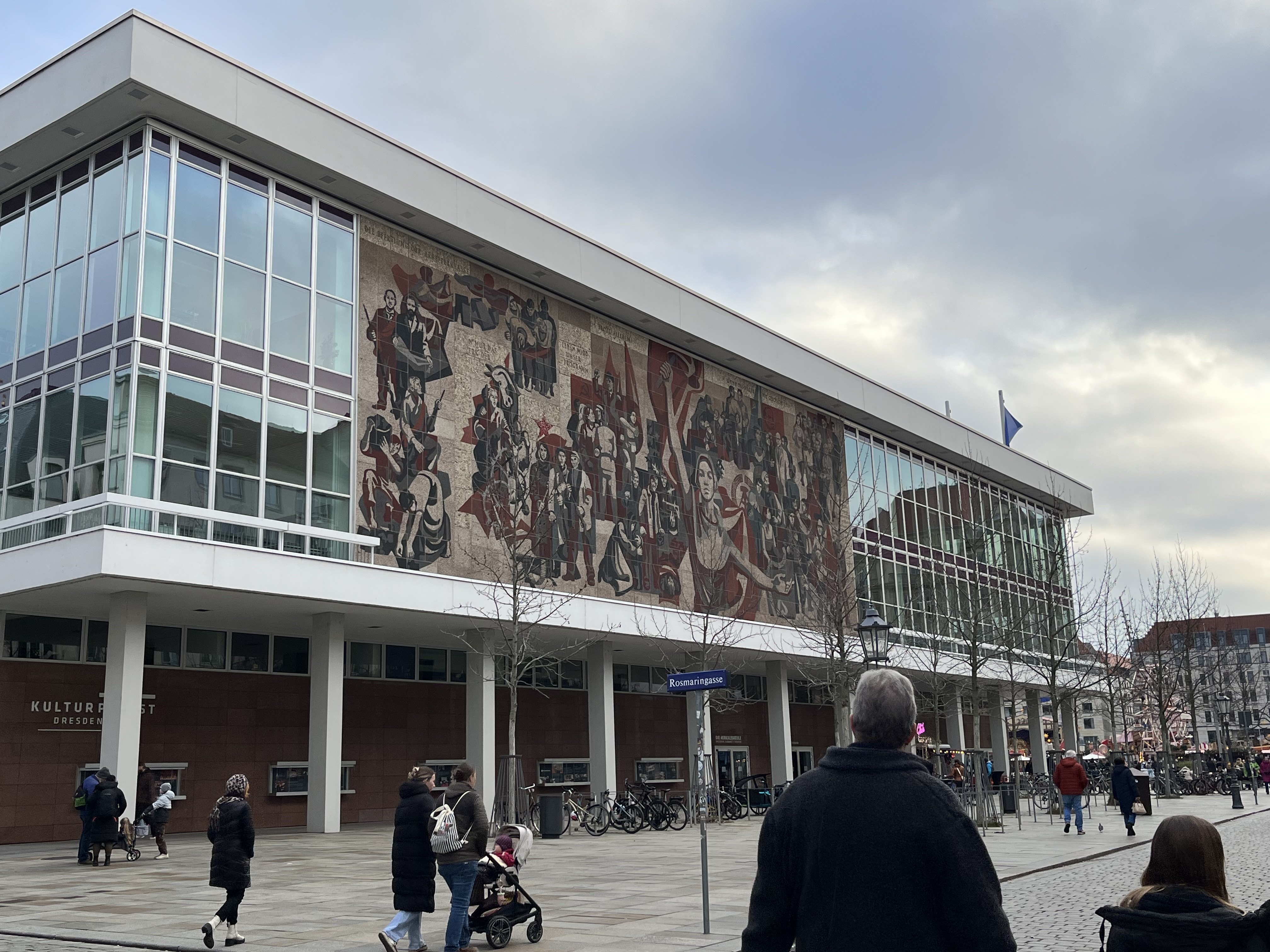
The last picture above shows the Kultur Palast, a typical post WWII era Eastern Block building depicting large murals of the accomplishments of the working class.
Below is the Residenz Schloss, which nowadays contains numerous museums:
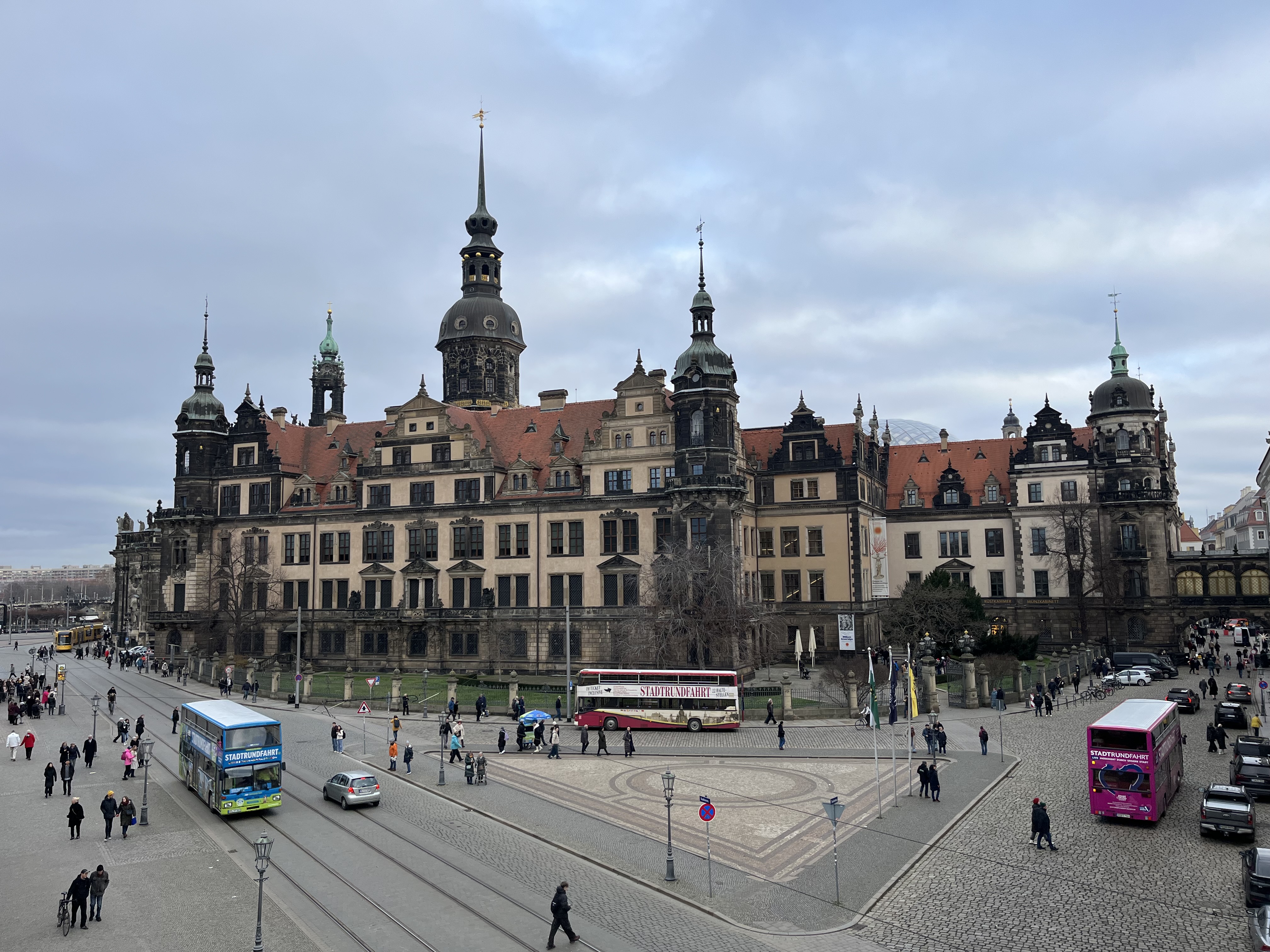
The renovation and rebuilding of this castle, and most of its museums, was just completed a few years ago. The few pictures of the museum exhibits below only give a brief impression of the sheer wealth the former rulers of Saxony amassed here, a wealth that was mostly based on the silver and iron mining in the adjacent Erz Gebirge. It also makes one realize the huge cost and effort the rebuilding of the castle and its museums must have taken:

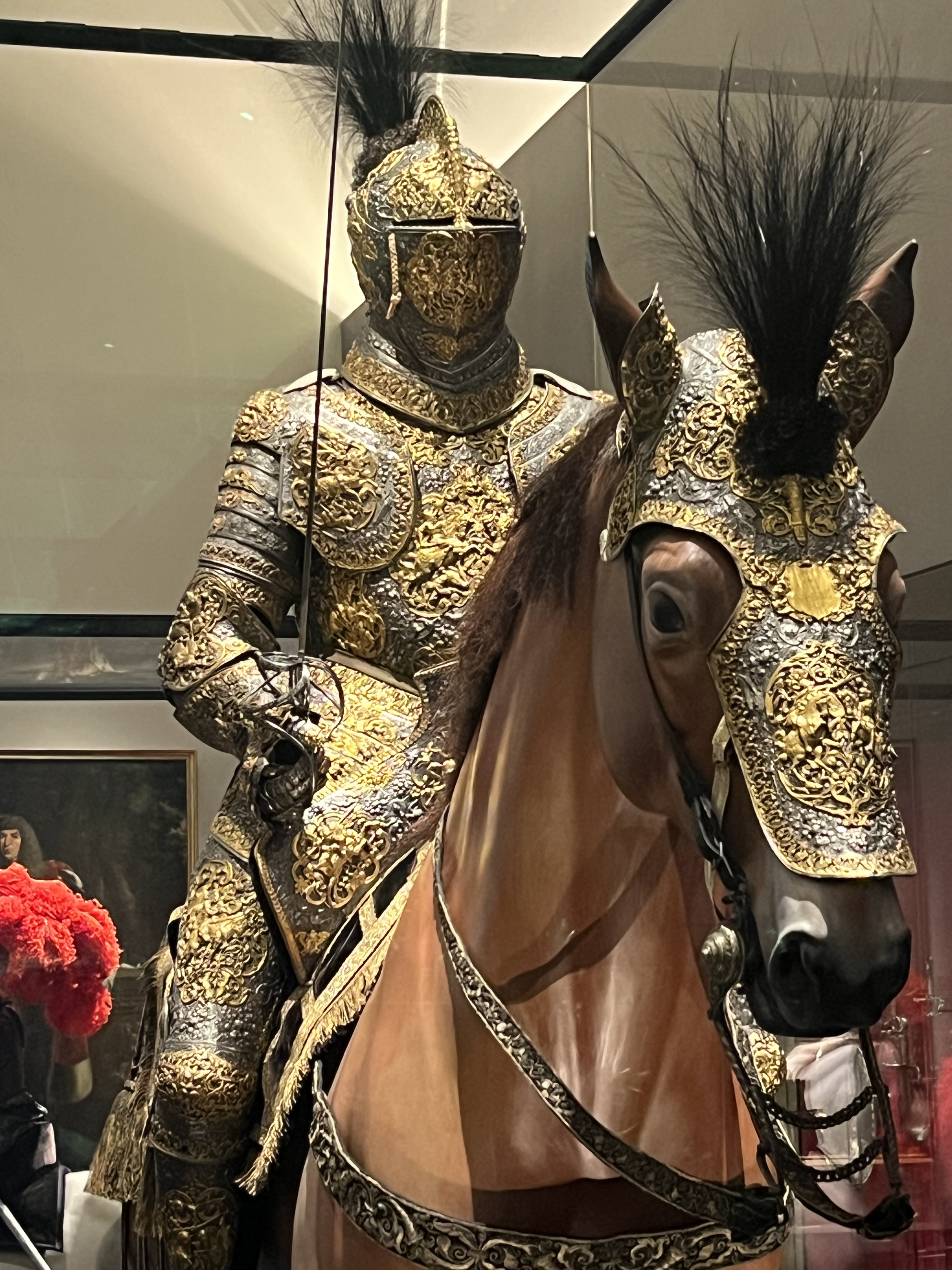

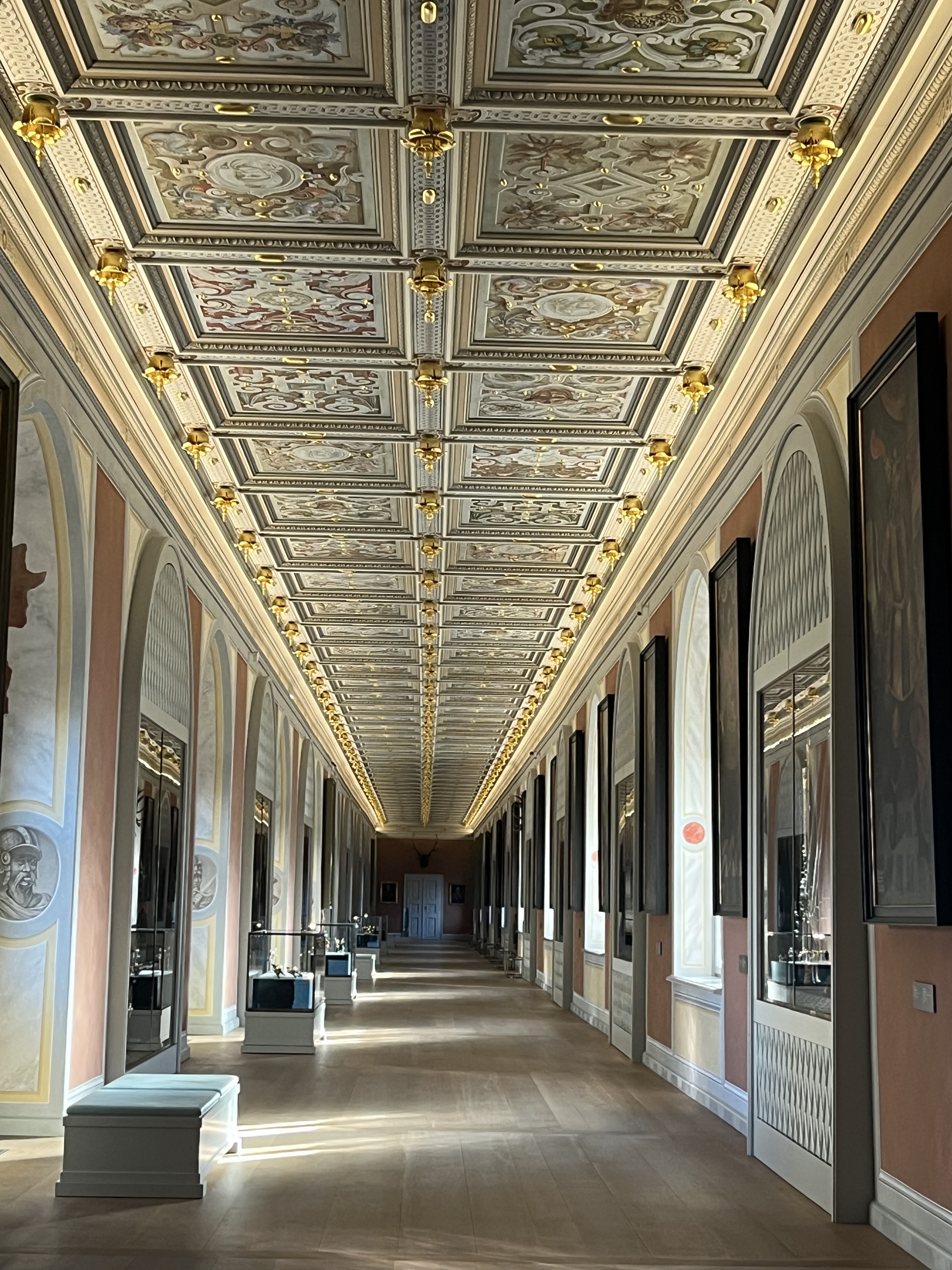
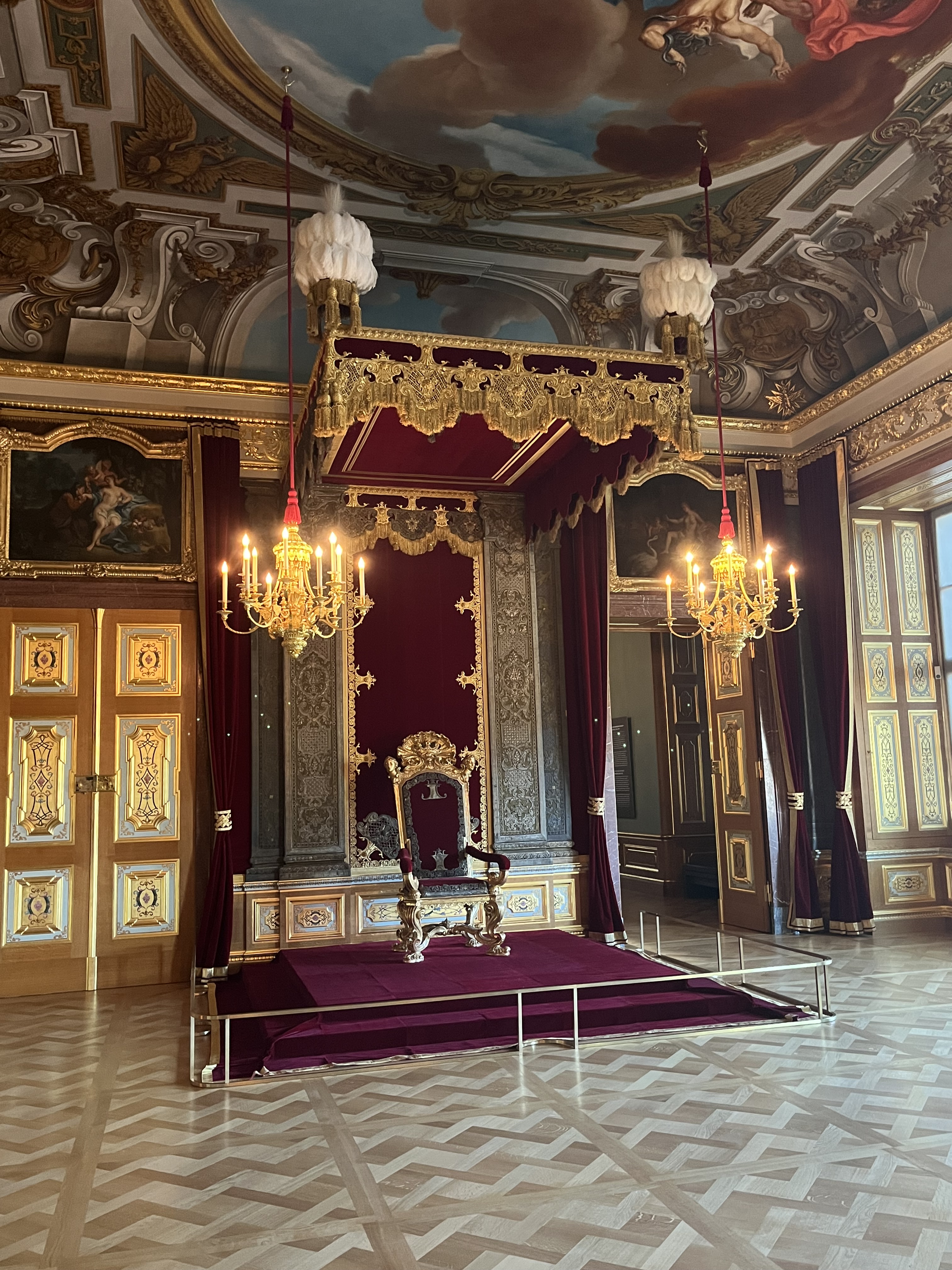

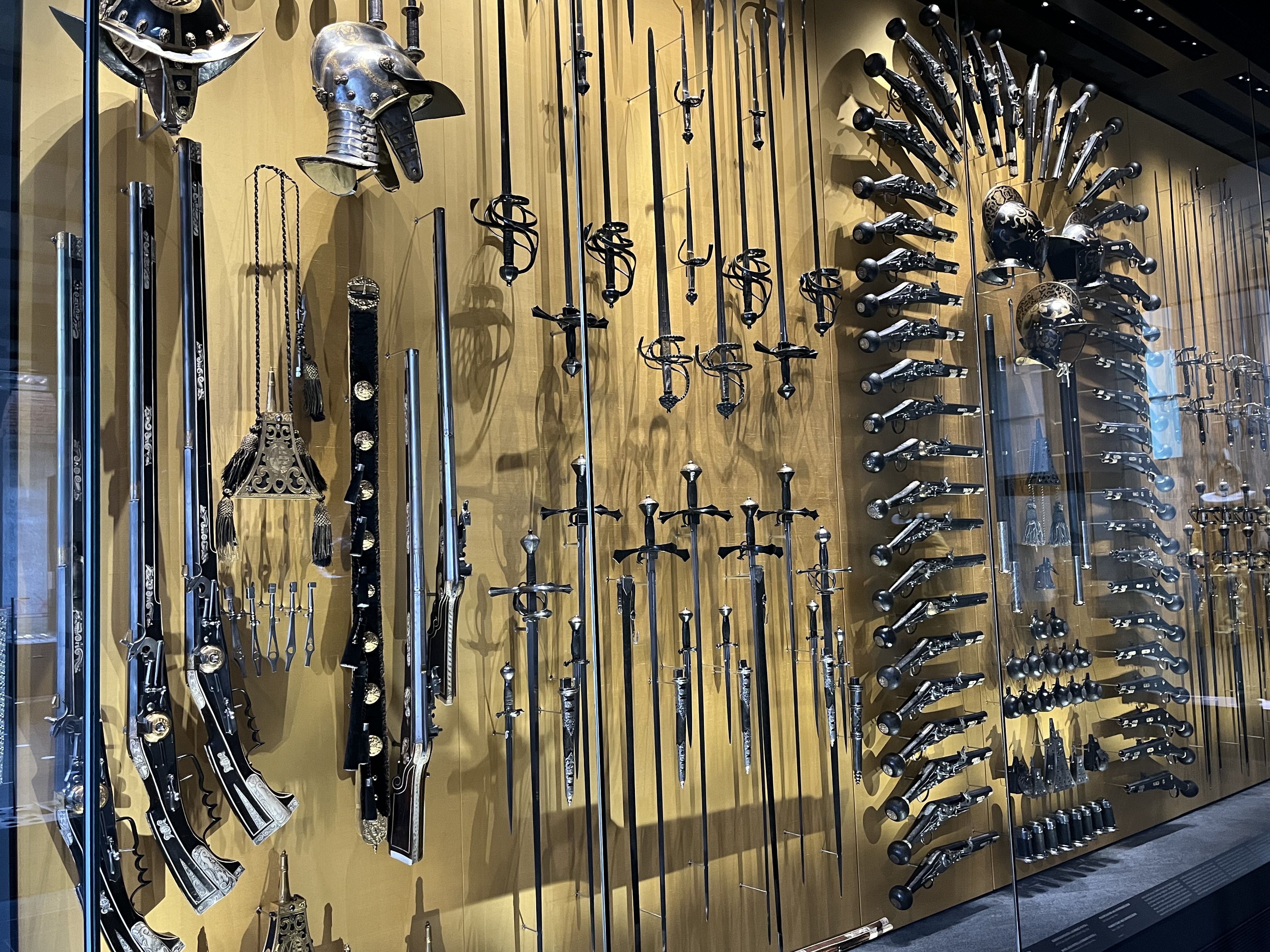


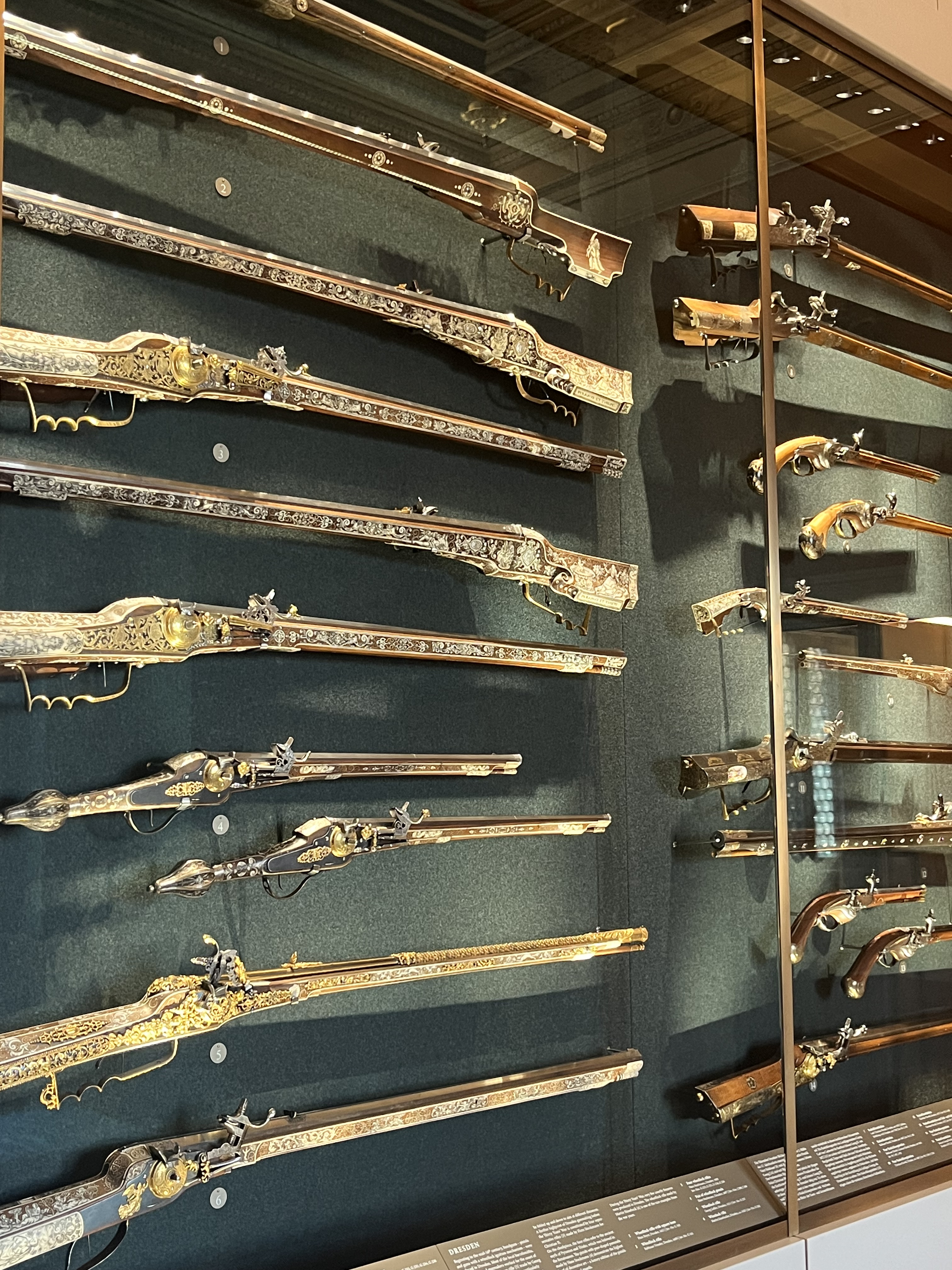

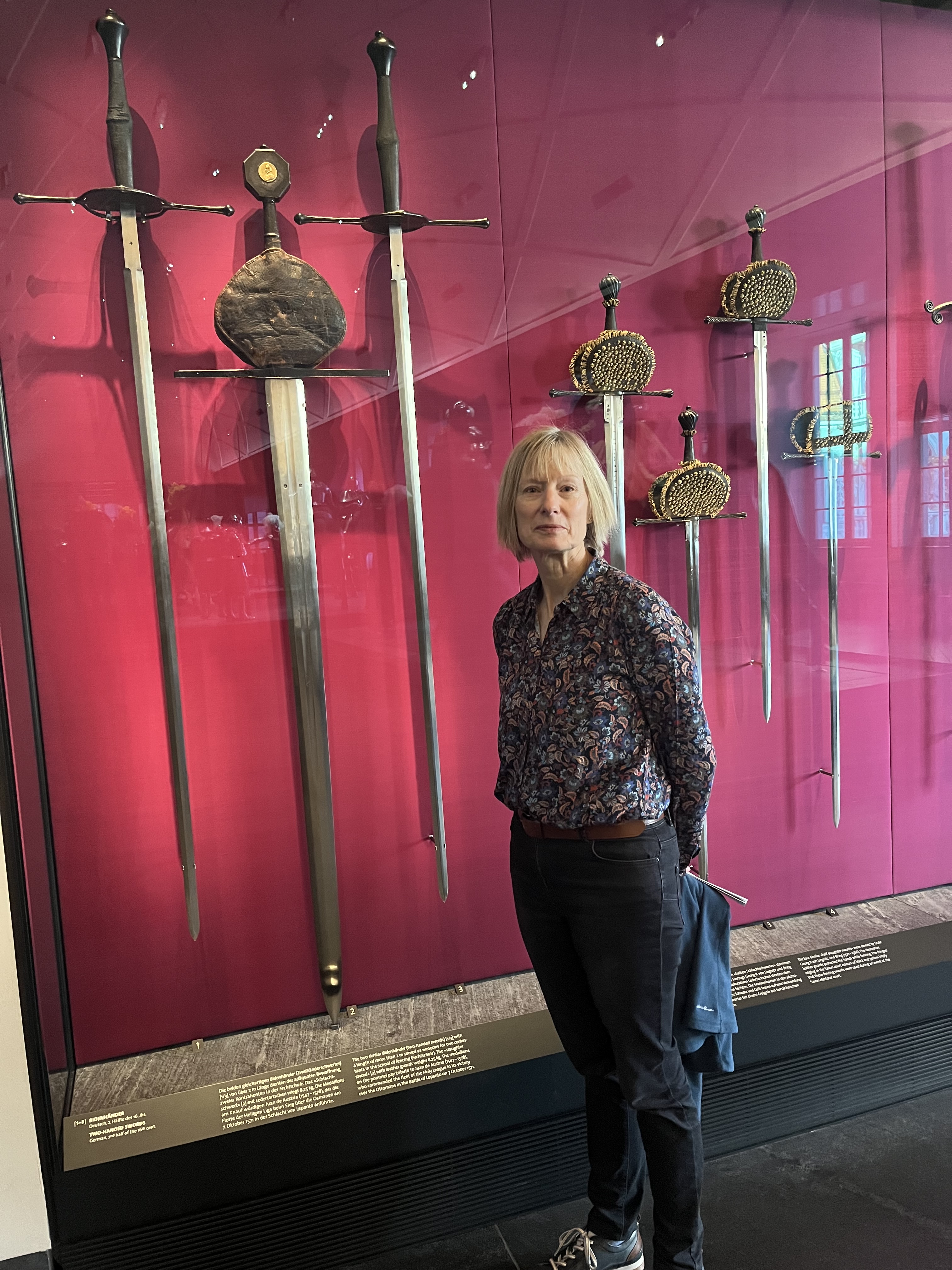
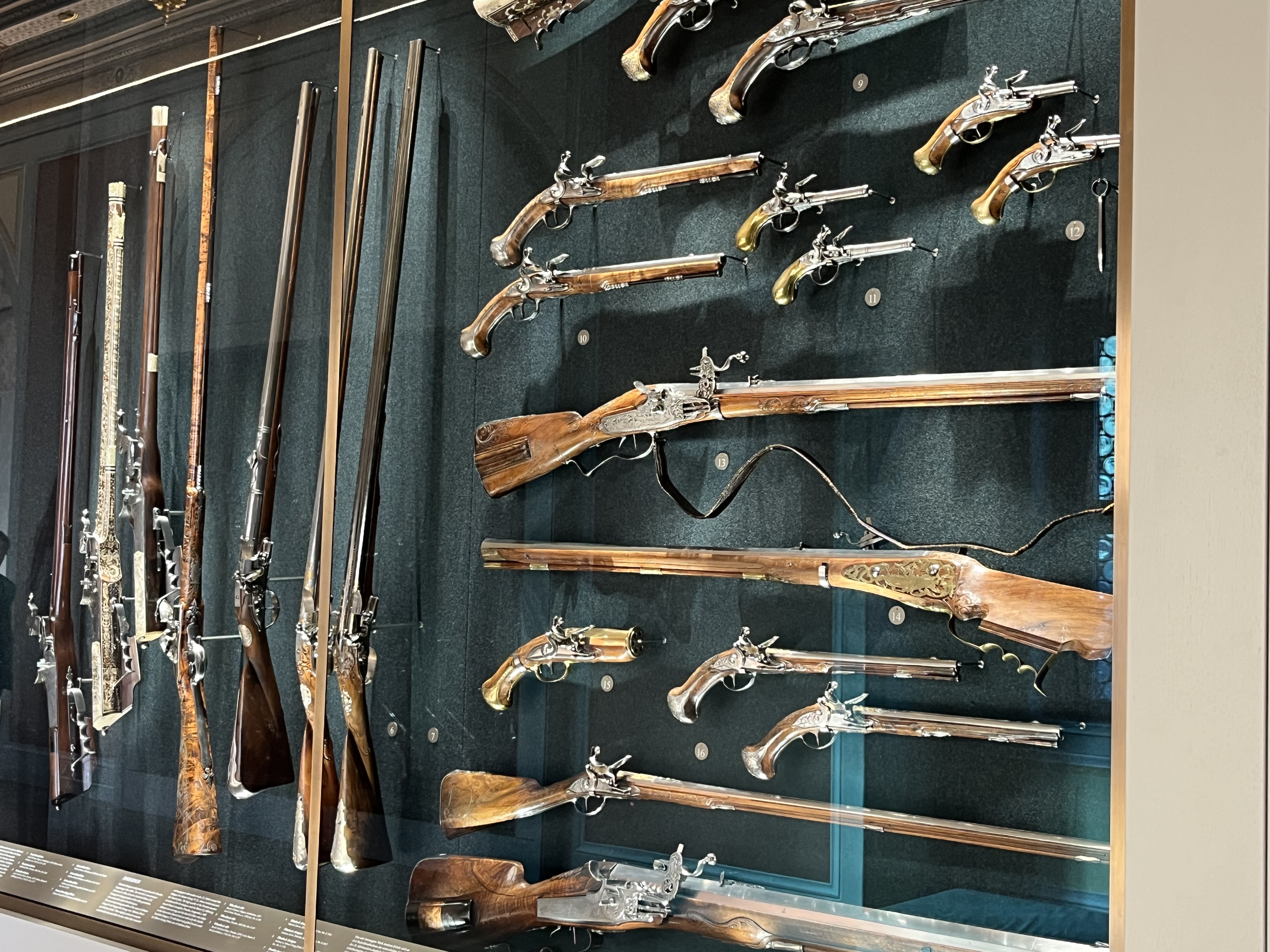
Good to have a volunteer willing to stand in for scale and demonstrate the size of these medieval two handed swords. These few impressions are of the weapon museum. There is also the elaborate coin and mint museum and the famous Gruenes Gewoelbe museum, which exhibits jewelry, gems, and anything decadent in porcelain one could think of.
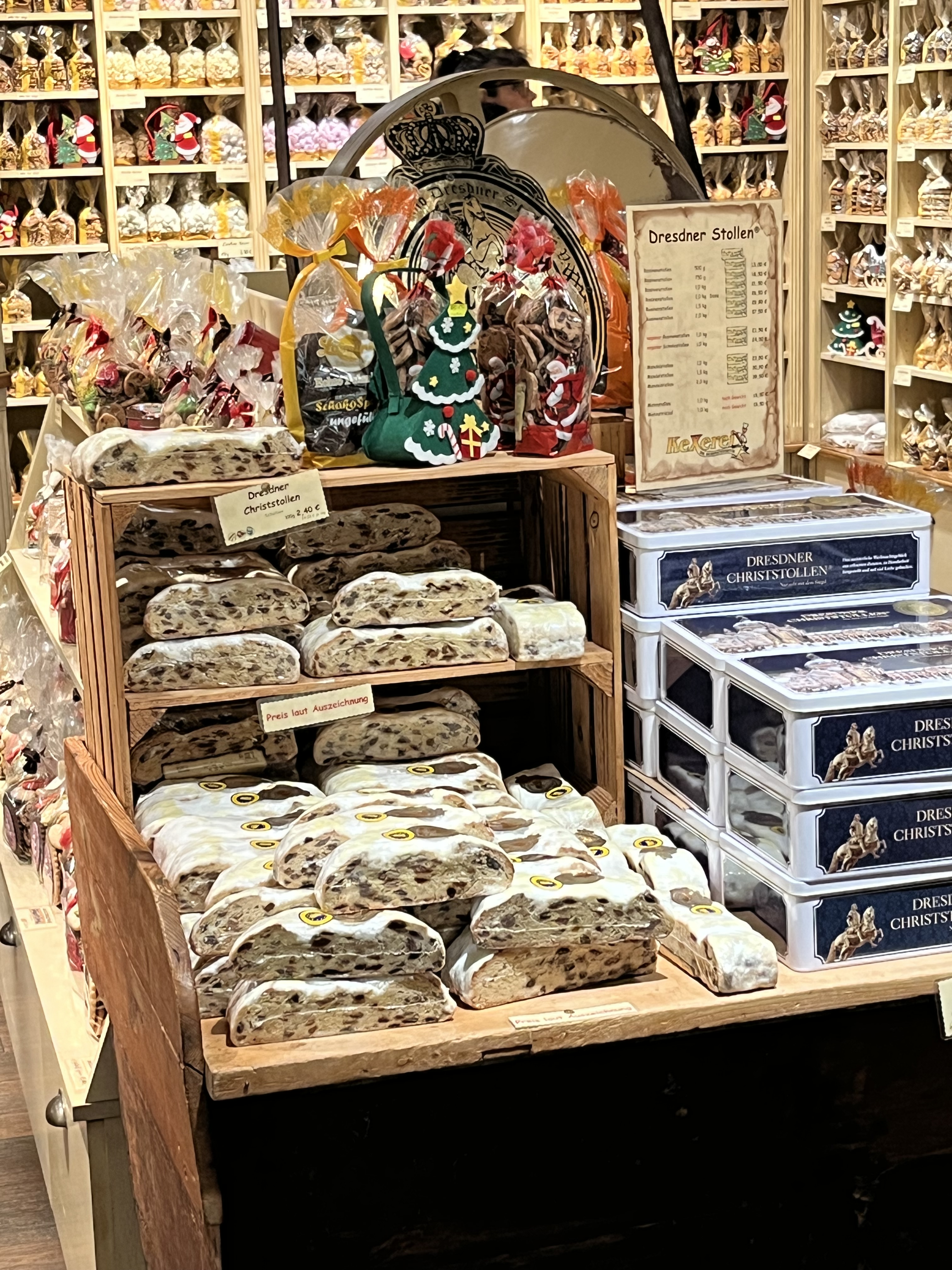
On the sweeter side, Dresden is the birthplace of Germany’s famous Christ-Stollen. No, Lauri did not actually hesitate to go in there…..

Below is Dresden’s Christmas Market, the Striezelmarkt, which is the most famous Christmas Market in Germany. It didn’t appear to be the largest, yet we were easily in agreement that it is the prettiest Christmas Market that we’ve seen:
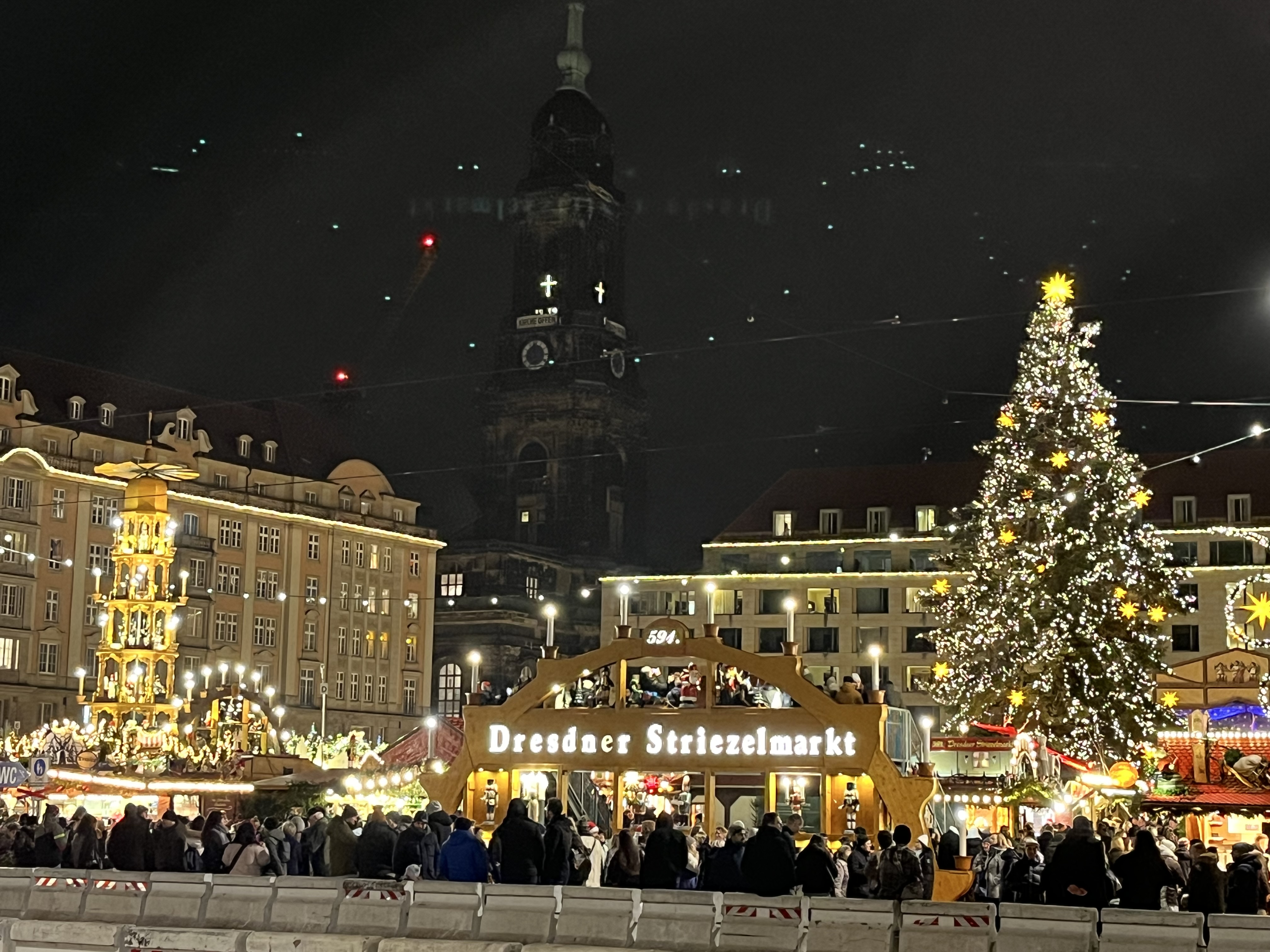
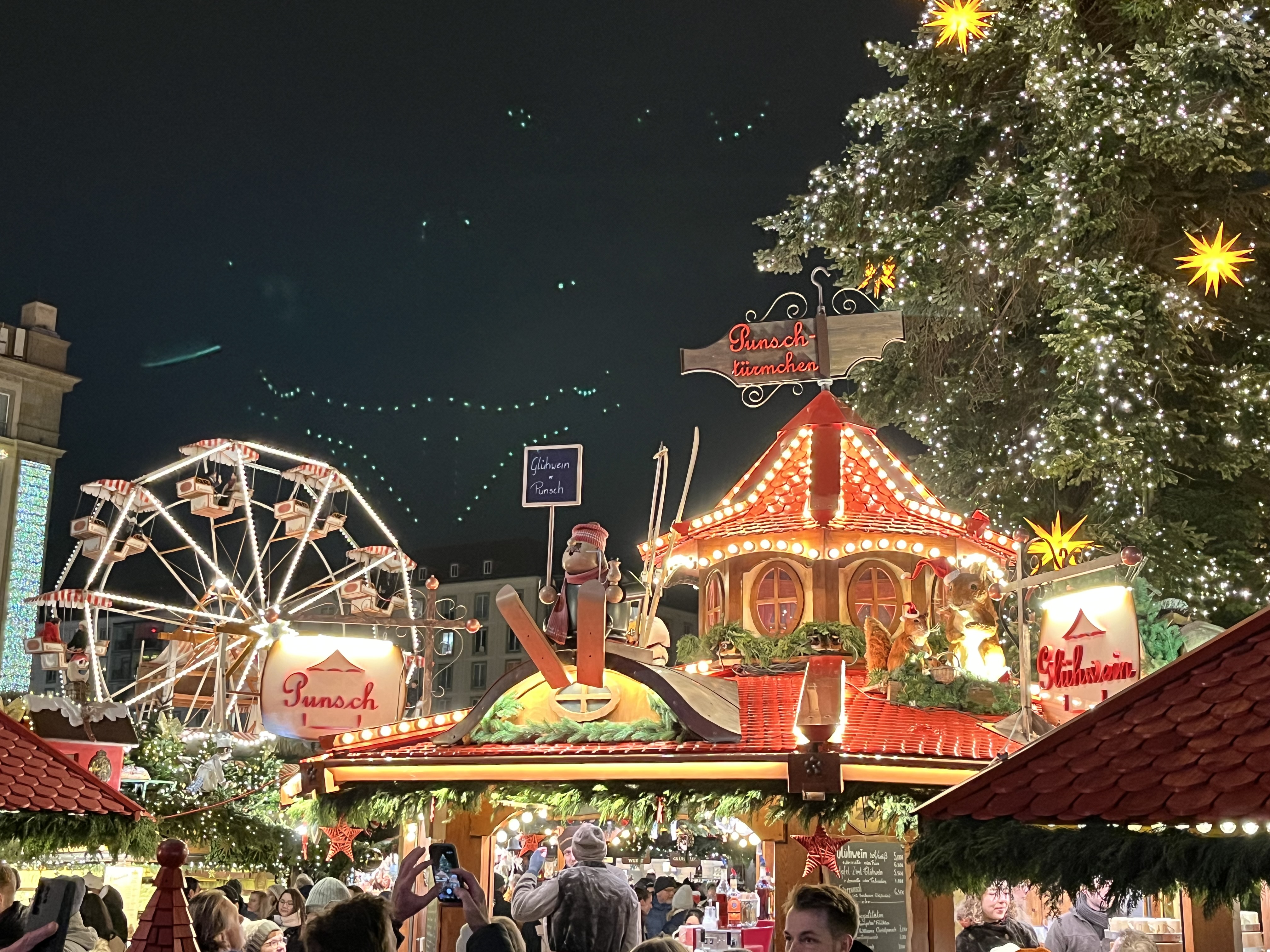
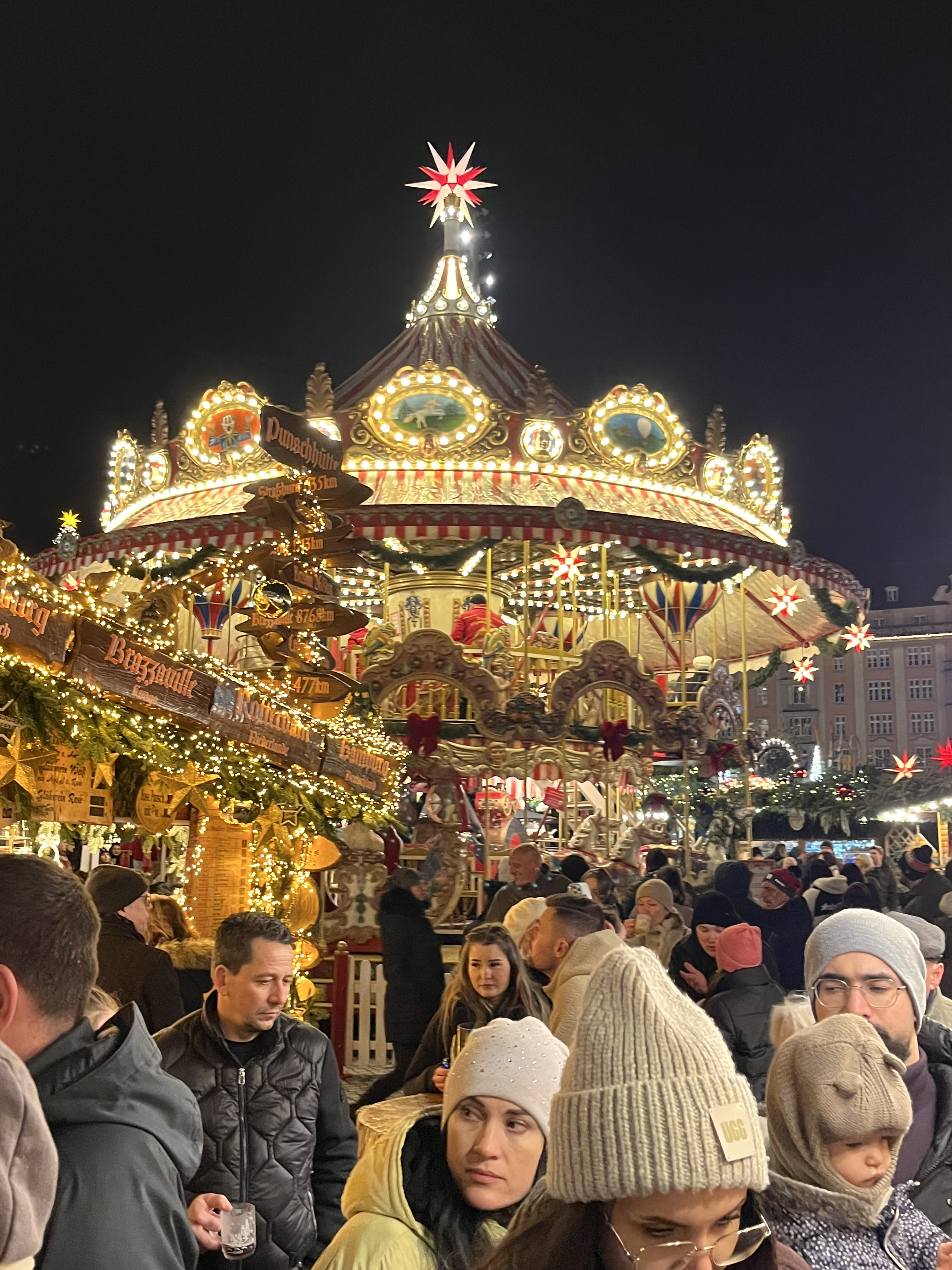
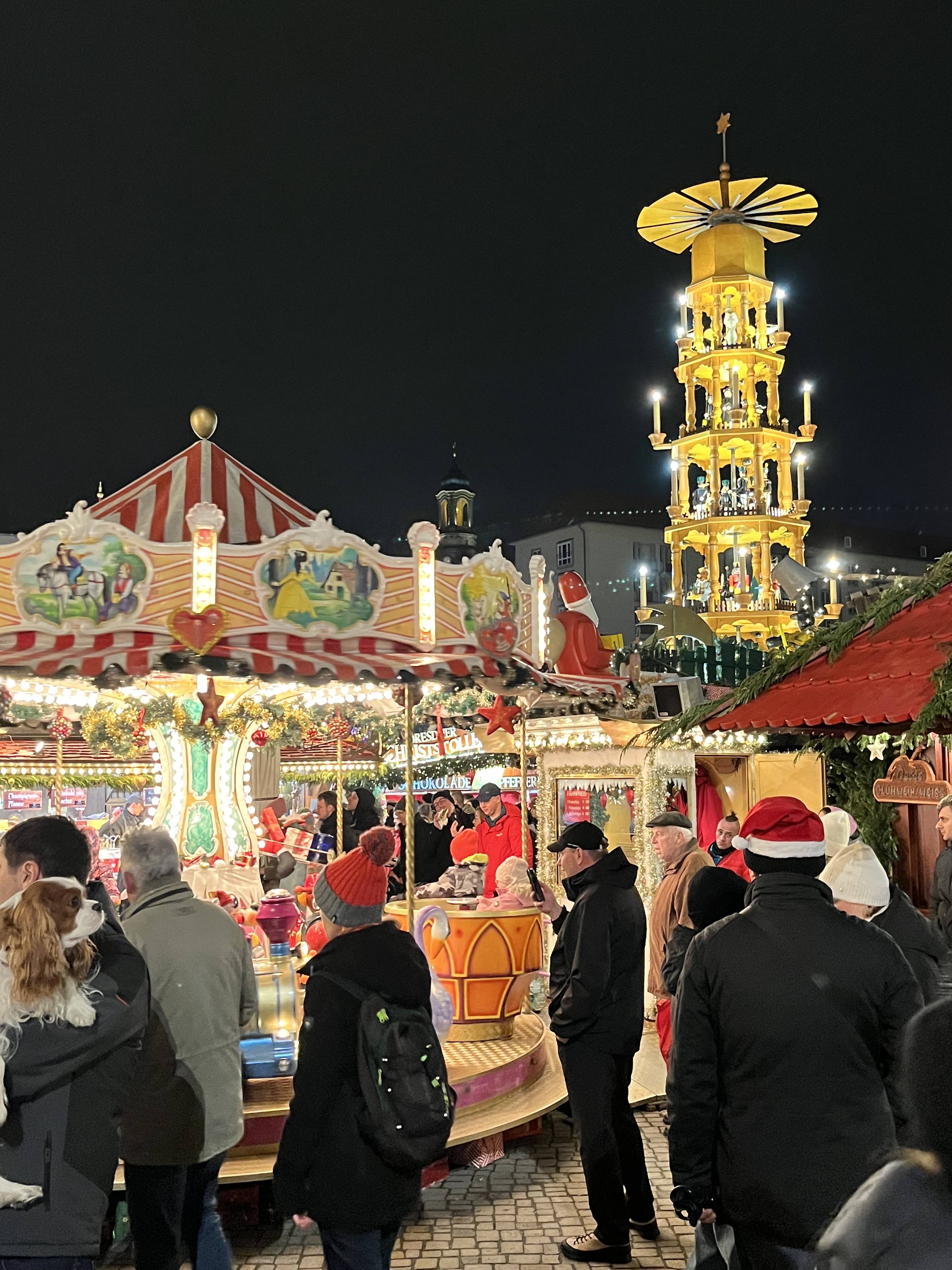
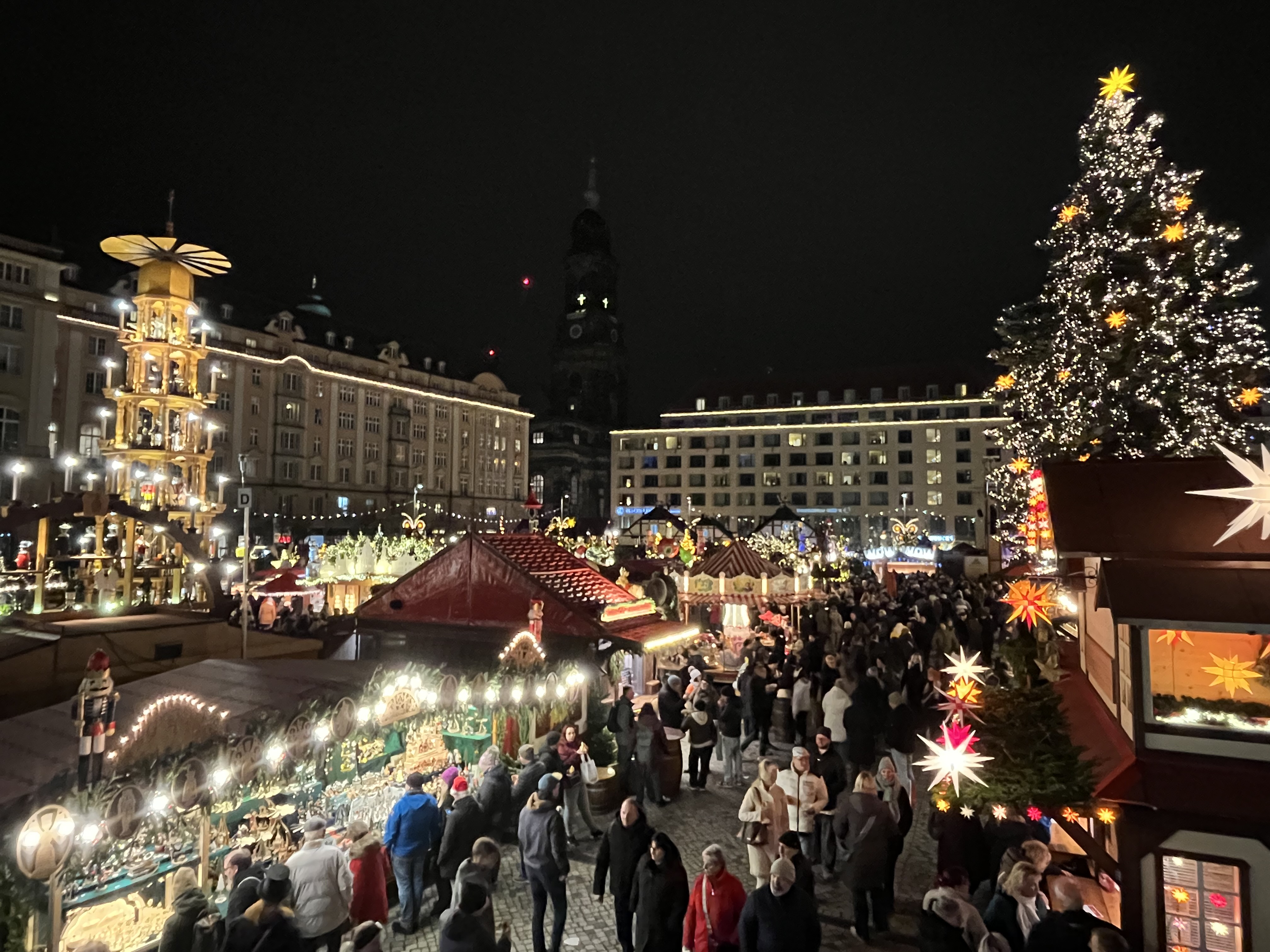

The quality and cuteness of the displays and vendor booths were just sparklingly perfect! And how to better finish off this bliss, than with another irresistible plate of Sauerbraten with dumplings and red cabbage:
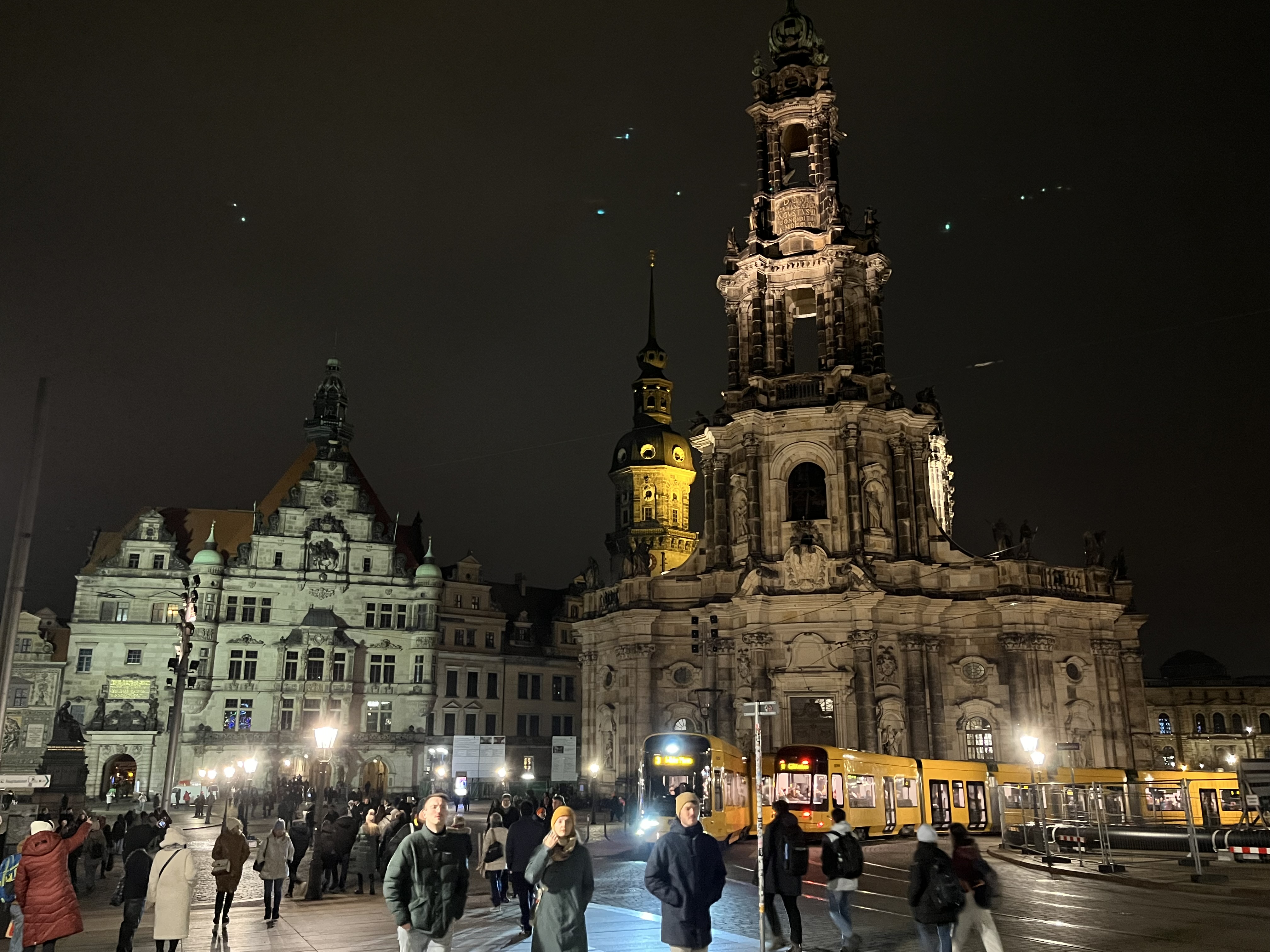
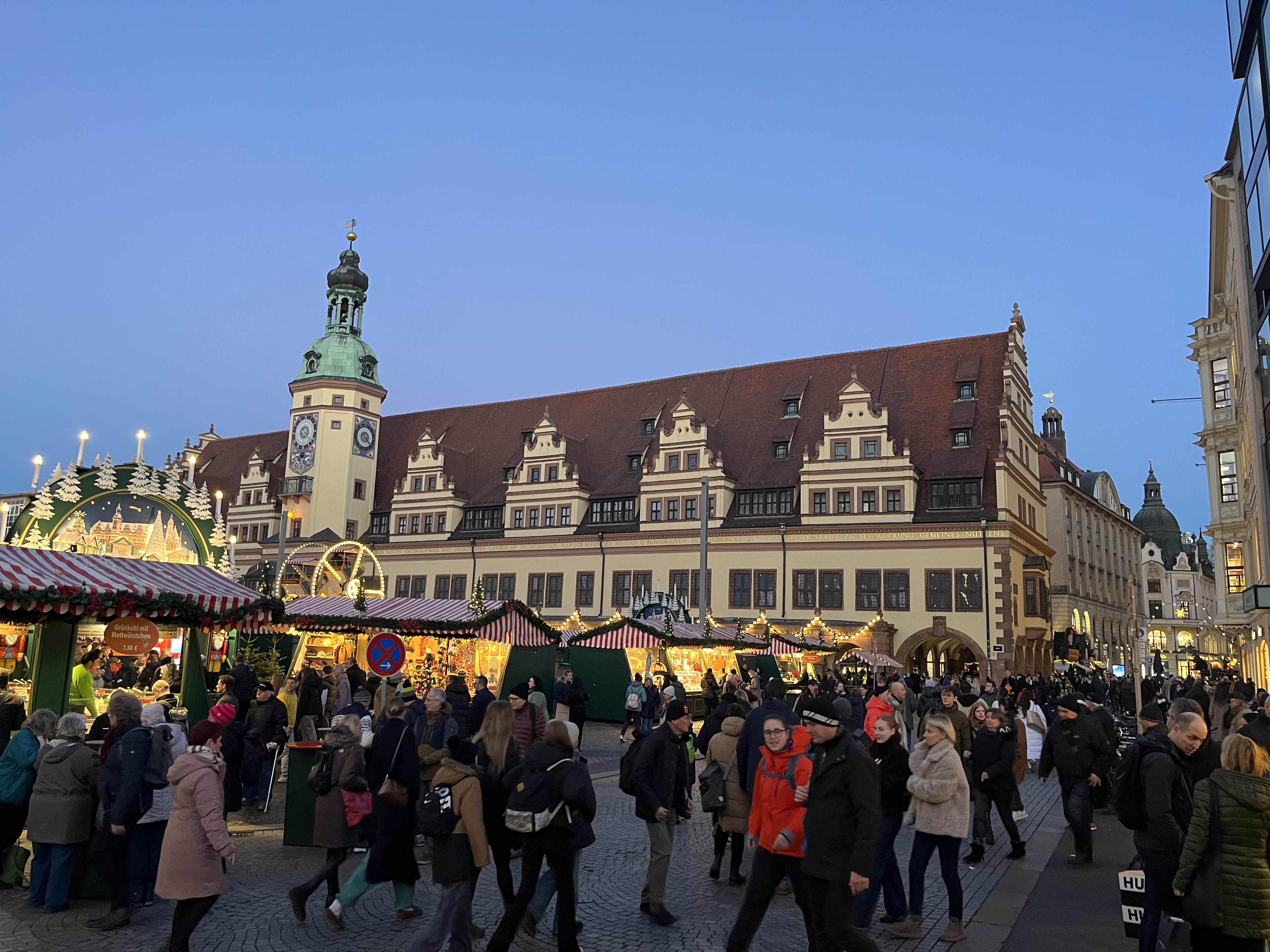
Another 1 1/2 hours NW, and we arrived in Leipzig, the business center and largest city of Saxony. Leipzig is a vibrant and dynamic city known for trade since Roman times. Below is the old Rathaus, with yes, another Christmas Market:

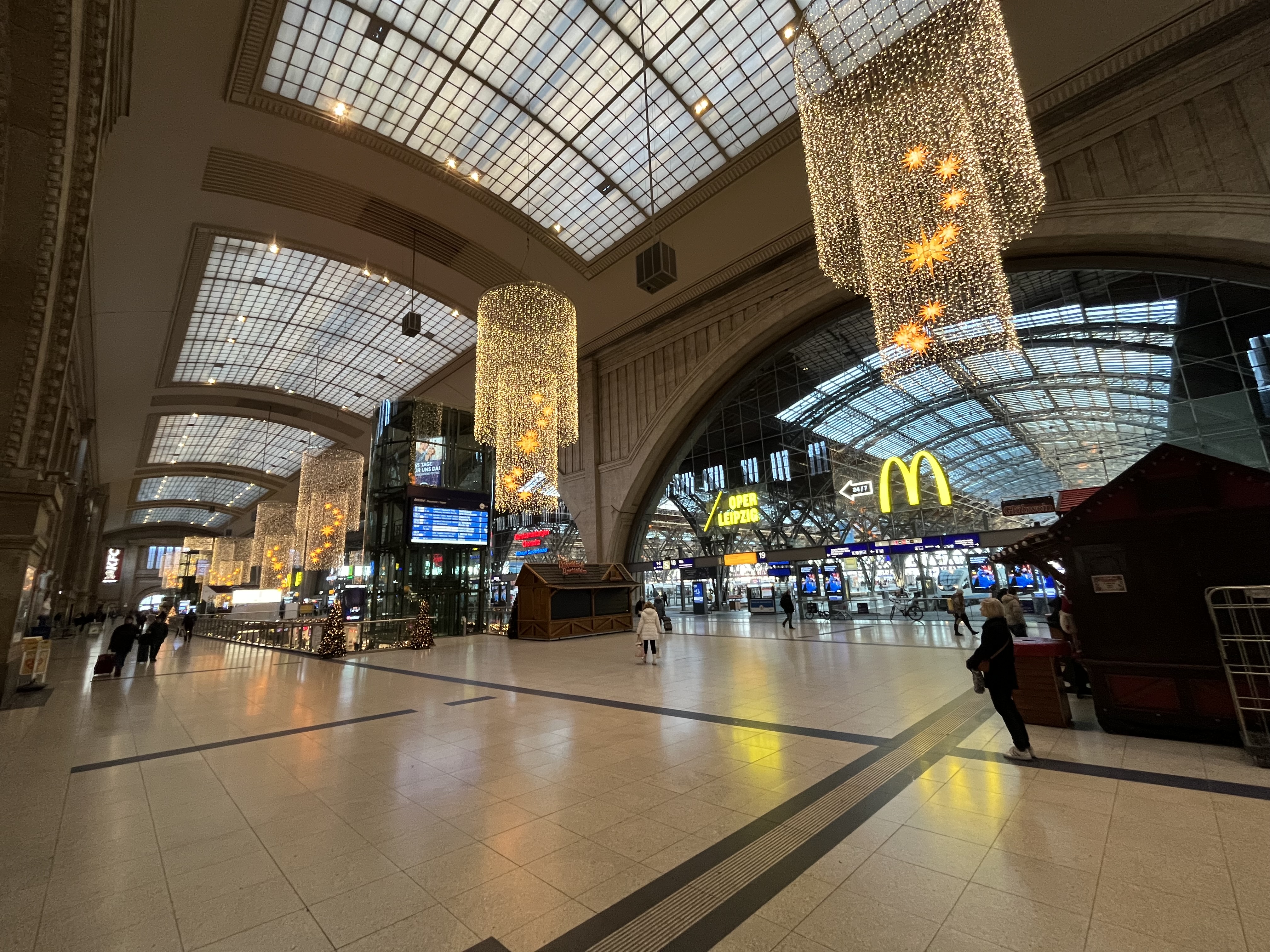
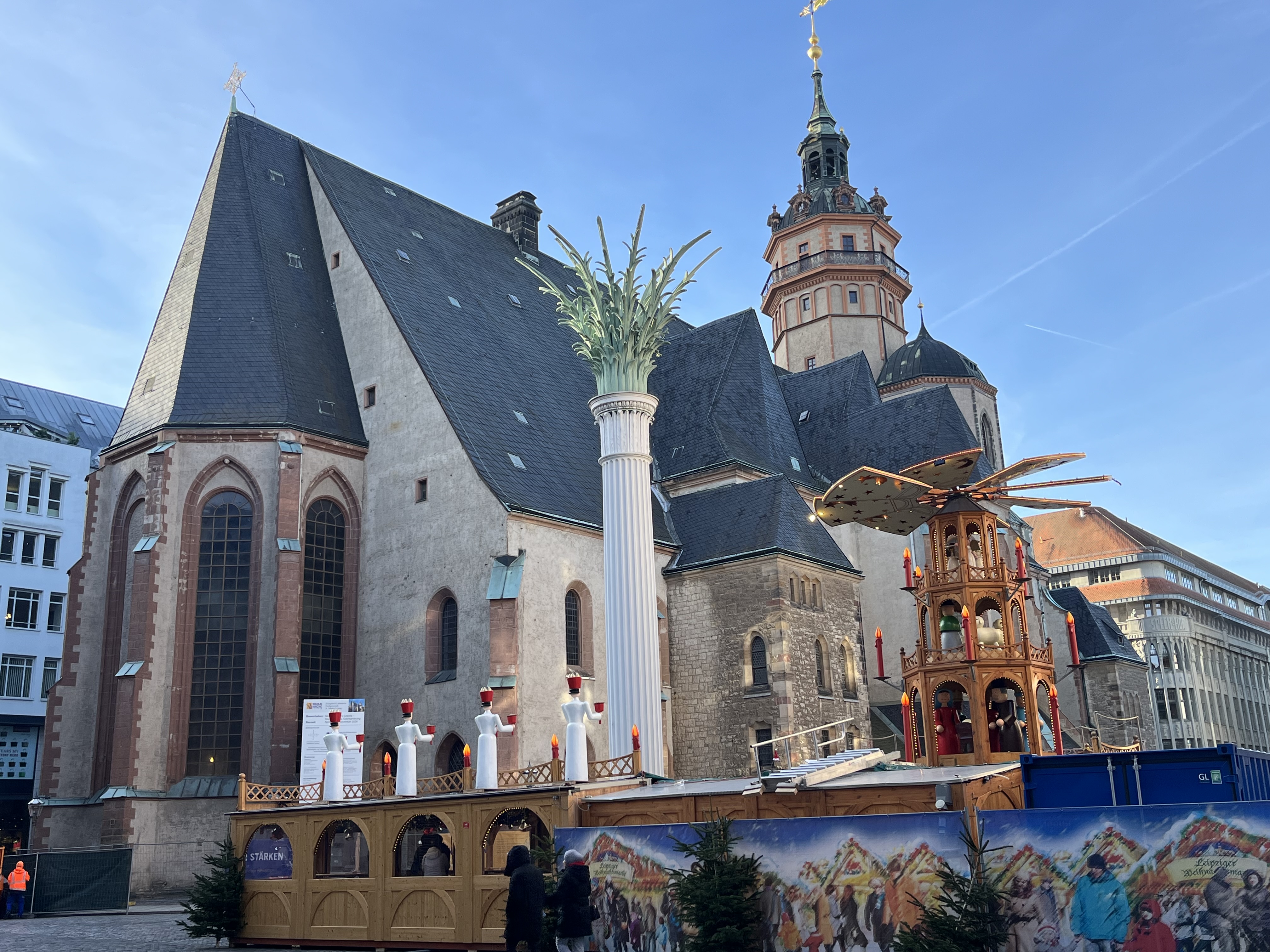
The three pictures above show Leipzig’s University in its stunning Gothic-Modern blend, the huge Hauptbahnhof, and the Nicolai Kirche. In 1989 the Nicolai Kirche rose to fame as the place of the peaceful candlelight demonstrations against the communist rule of the DDR, which eventually helped to open the border to the West and collapse the Iron Wall in 1989.

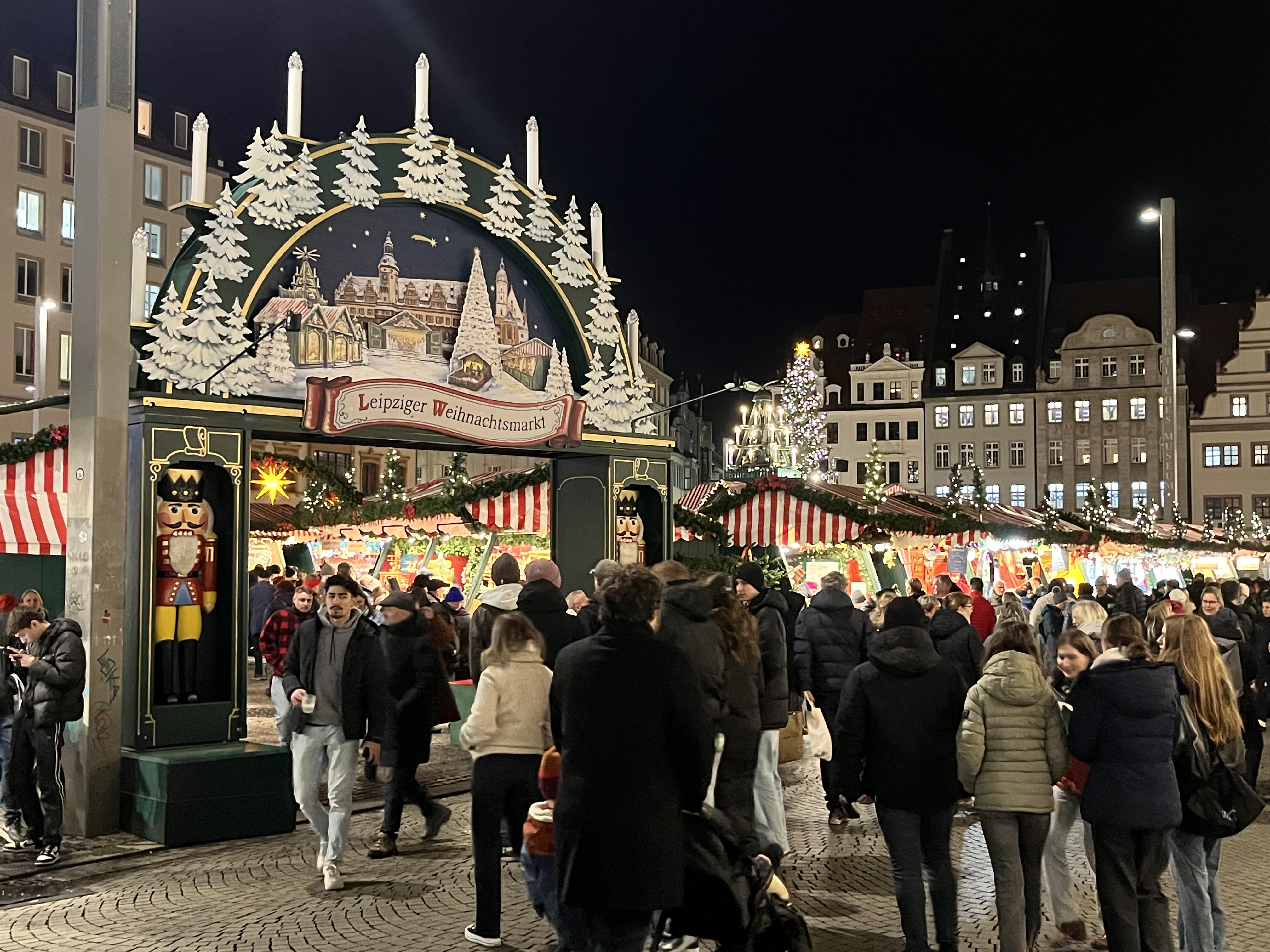

Close to the Rathaus and Christmas Market is the Maedler Gasse, a fancy, upscale shopping gallery. From inside the Maedler Gasse is the entrance to the Auerbachs Keller, which dates back to the 15th century and was made famous as the setting of a scene out of Goethe’s Faust. Like most tourists, we went there for dinner and the typical German ambiance reminded us of Bavaria’s big beer halls. During our stay, a brass band came into the restaurant and played German Christmas carols:
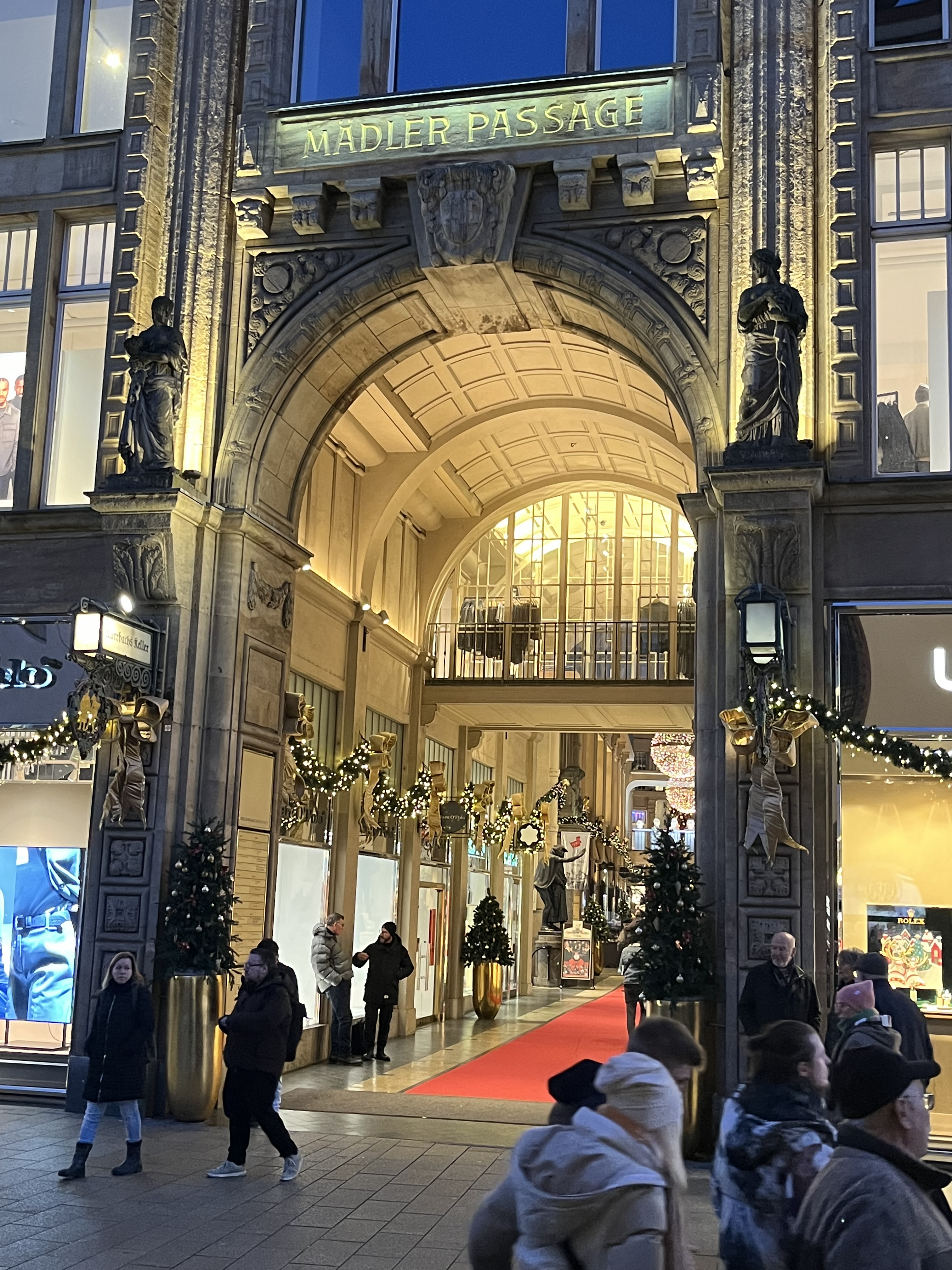
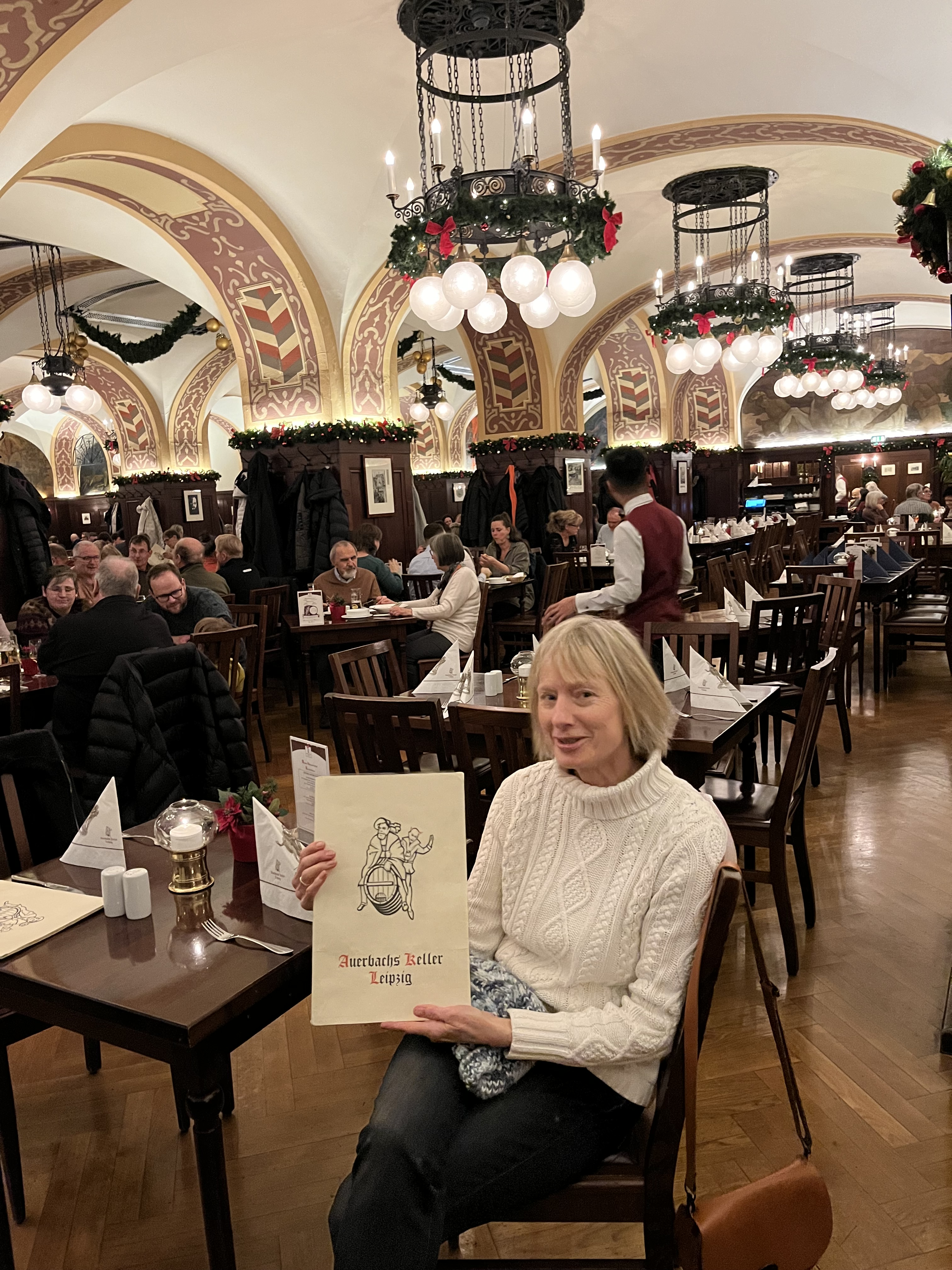
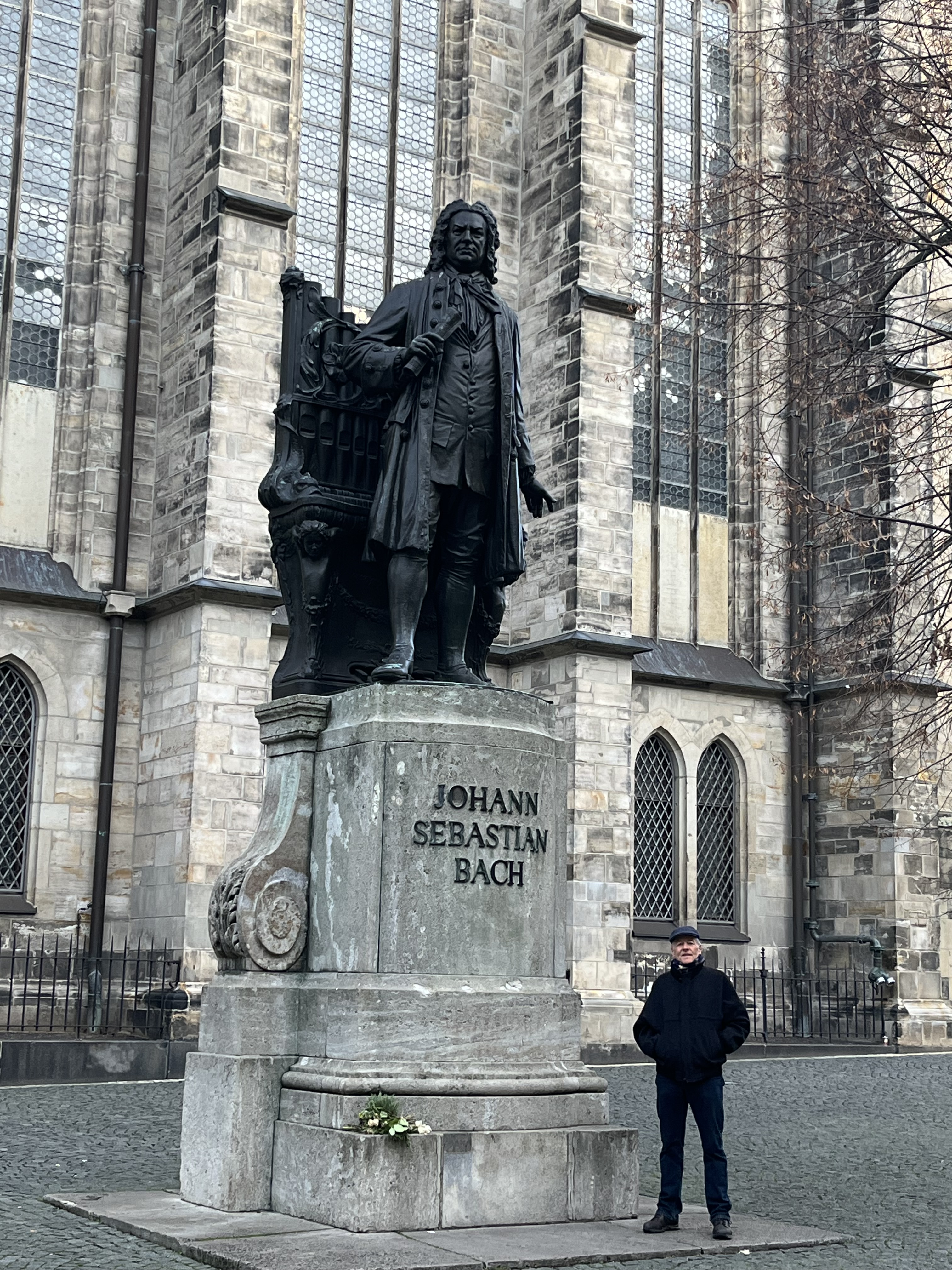
Our main draw to travel to Leipzig was not to visit the Auerbachs Keller or see another Christmas Market. It was due to the Giant who is standing on the pedestal next to me in the picture below: Johann Sebastian Bach, the musical giant, who composed an avalanche of music during his active work life, of which his 27 years in Leipzig was his most prolific period. He brought the 17th to early 18th century High Baroque period into the Classic period. His mastery of counterpoint, harmonic, and motivic organization, and his adaptation of rhythms, forms, and textures, continues to influence countless composers to this day.
Over his 65 year life span, Bach produced an astonishing 1,128 pieces of music, not counting 23 that are known to be missing, and occasionally there is still a new piece being found that no-one knew about! He composed hundreds of cantatas, sacred and secular works, chorales, concertos, suites, songs, and masses etc, for a multitude of instruments, like harpsichord, organ, violin and cello. His Brandenburg Concertos, Ave Maria, Goldberg Variations, The Art of Fugue, or The Well Tempered Clavier might be some of his most widely known works.
He did all this while being appointed Thomaskantor, meaning being in charge of providing Leipzig’s four Protestant churches with weekly music, while leading the large Thomas Boys Choir and School, and giving countless private music lessons for various instruments to support his family. Astonishingly, he still fathered 20 children over two marriages, as his first wife, with whom he had 7 children passed away relatively young. From those 20 children some died young and some became known composers themselves, like Carl Philipp Emanuel Bach. Bach’s drive and creativity are inspiring and awing!
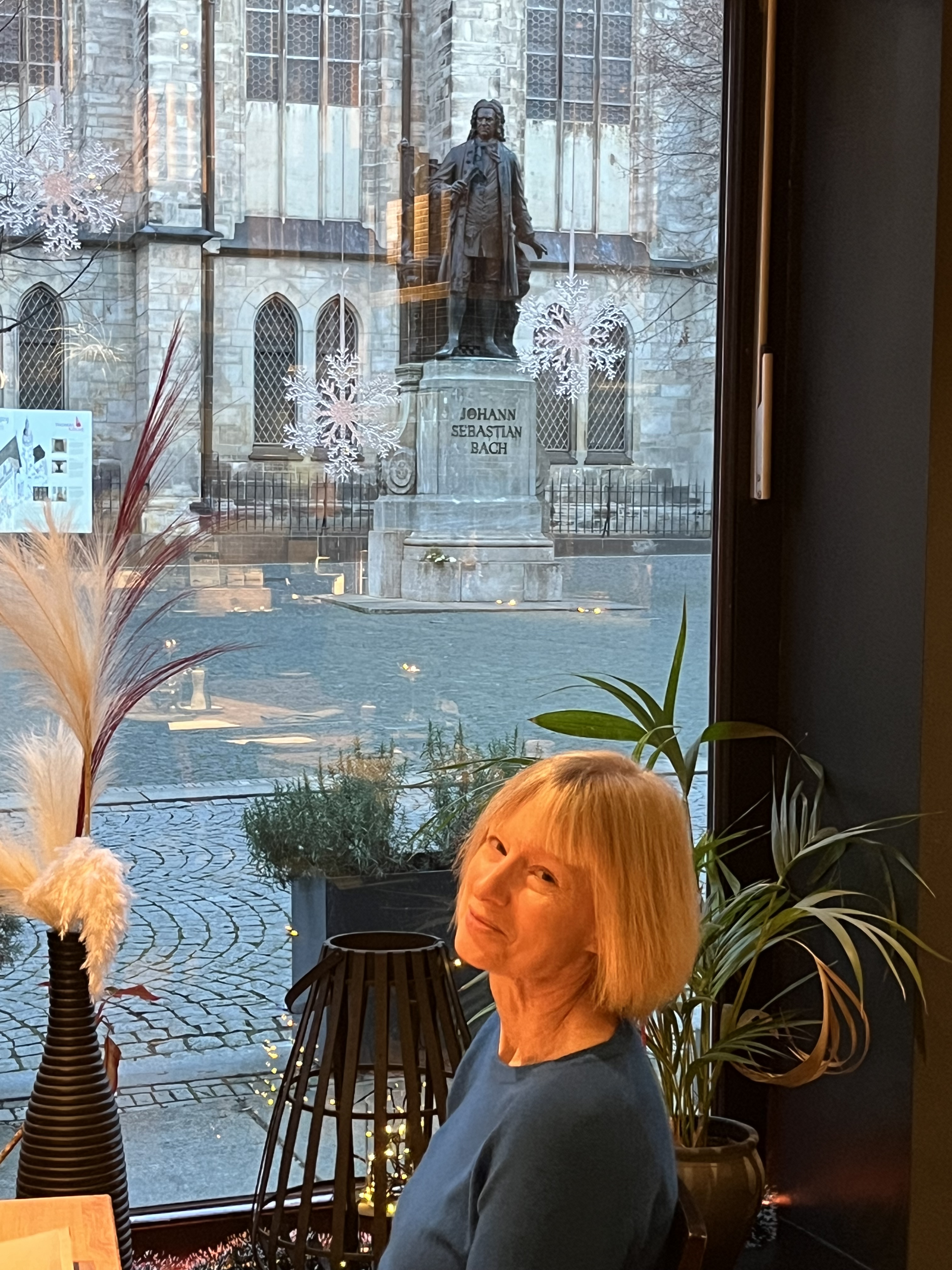
We were lucky to have picked a nice, quiet hotel across from the Thomas Kirche, where we could see Bach’s statue out of our bedroom window and from the breakfast room:
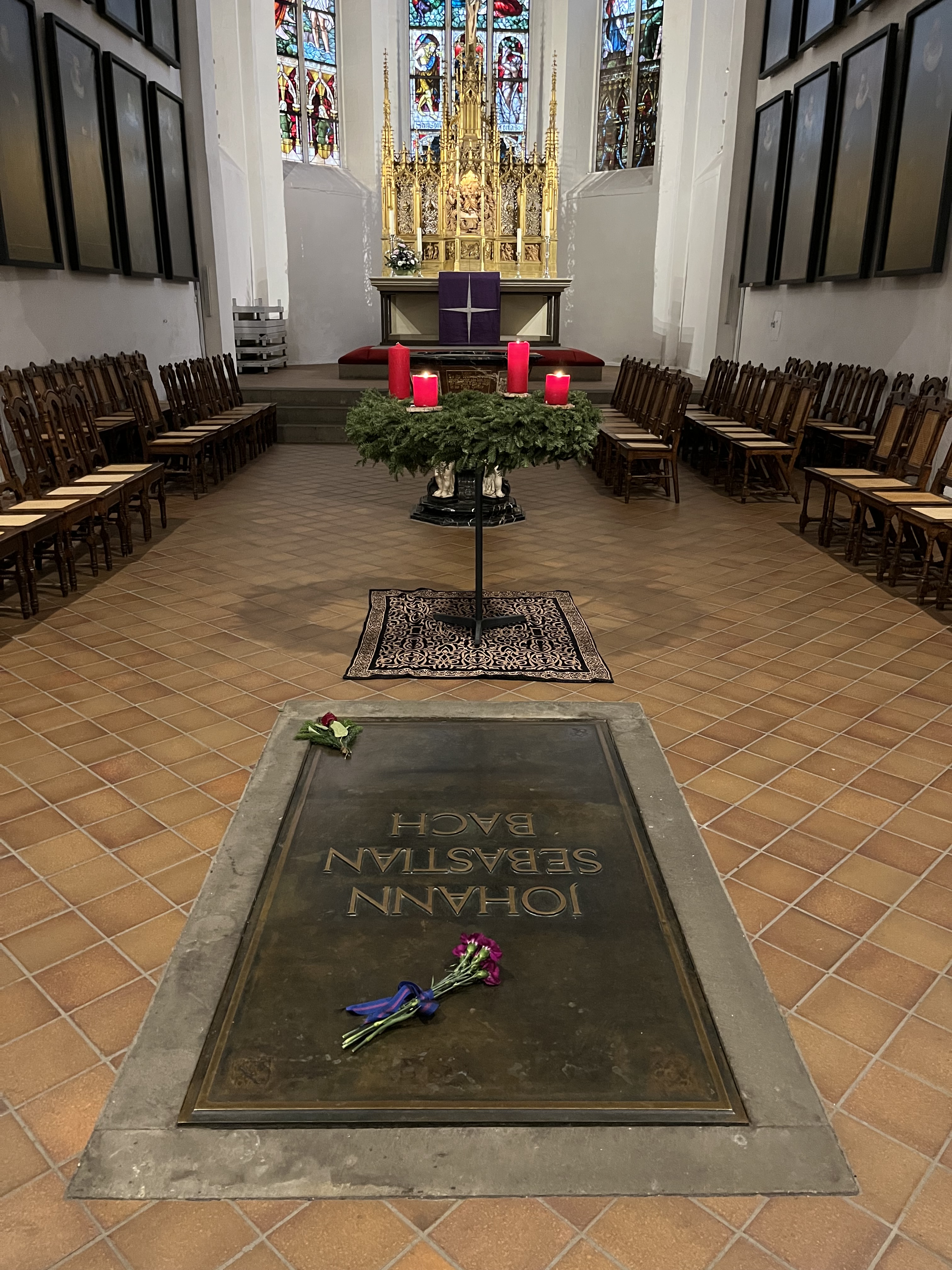
Here is the inside of the Thomas Kirche, where Bach directed his Thomas Choir and played the organ. During his lifetime he was not as highly regarded, and was buried in an unmarked grave for 150 years, before eventually being reburied in his Thomas Kirche:

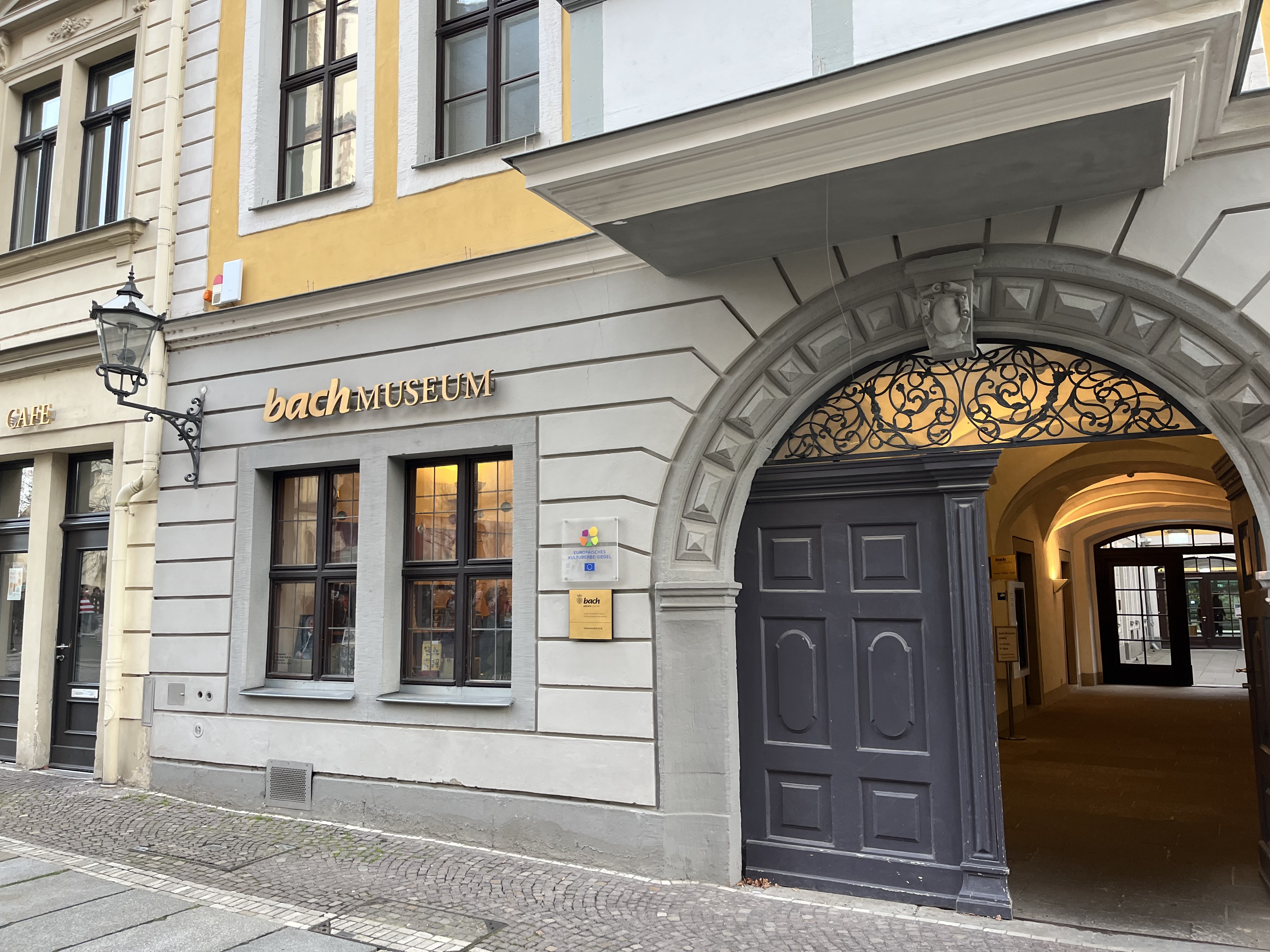
Here is the Bach Museum next to our hotel and across from what used to be the former Thomas School:
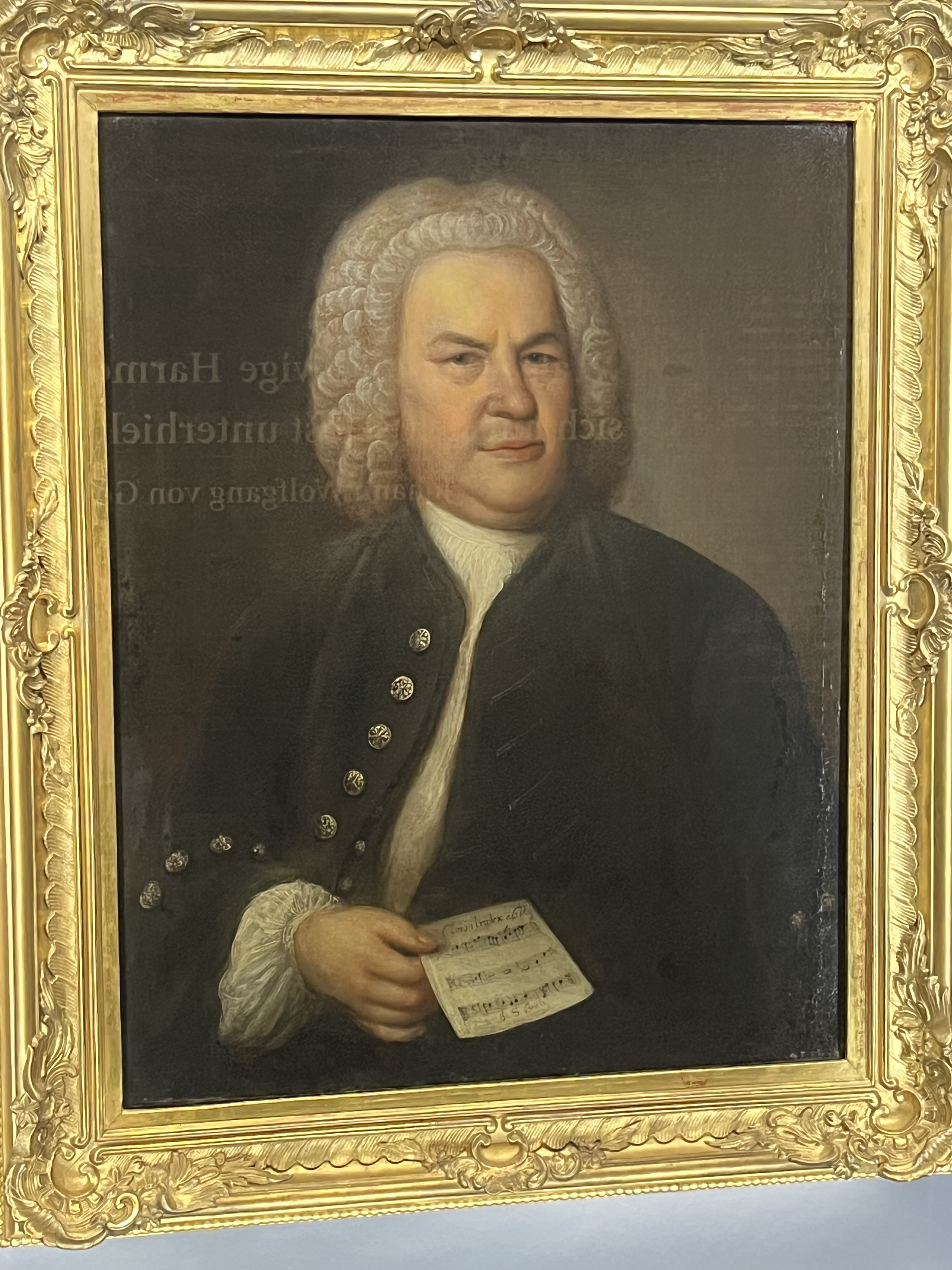
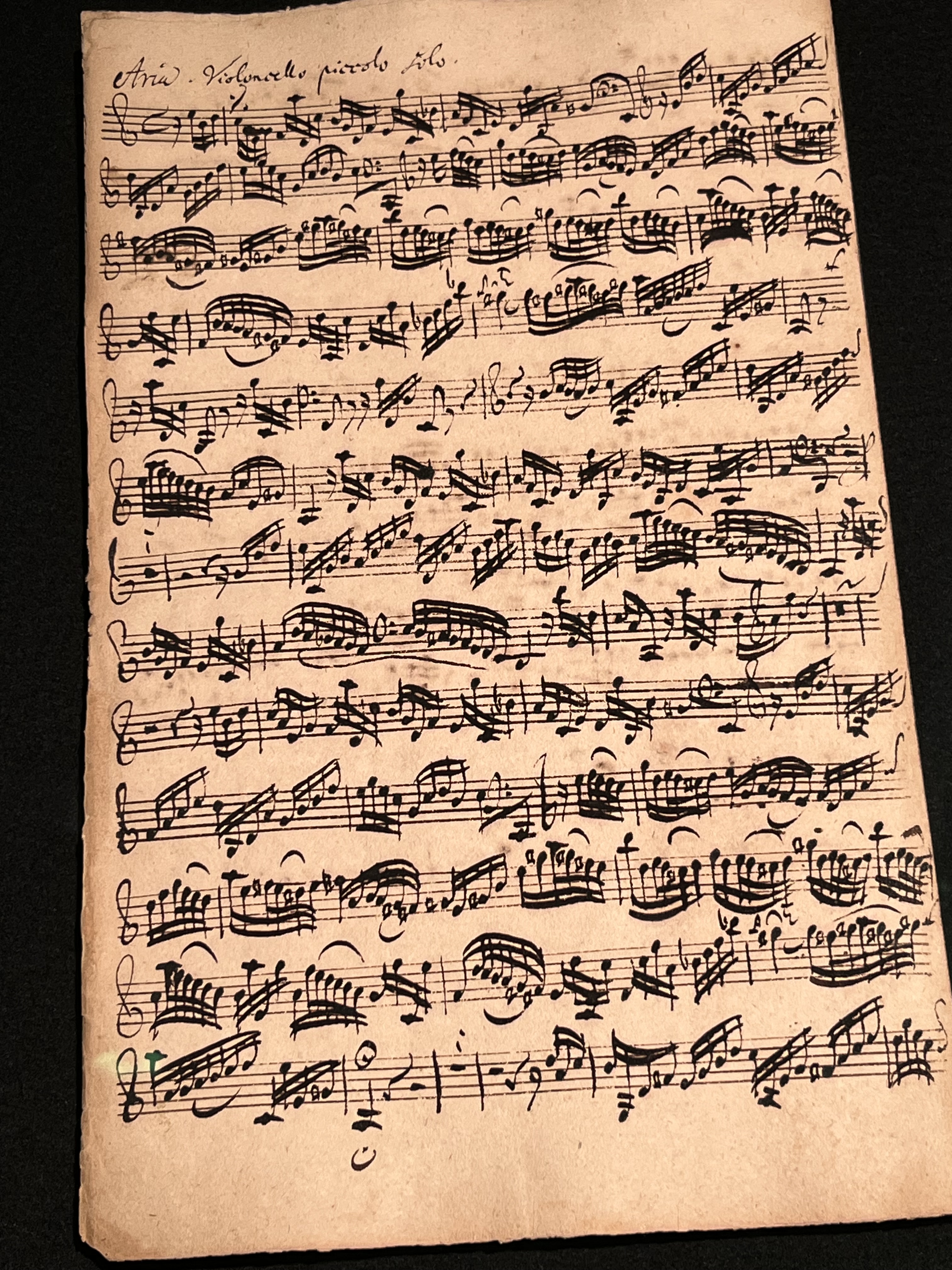

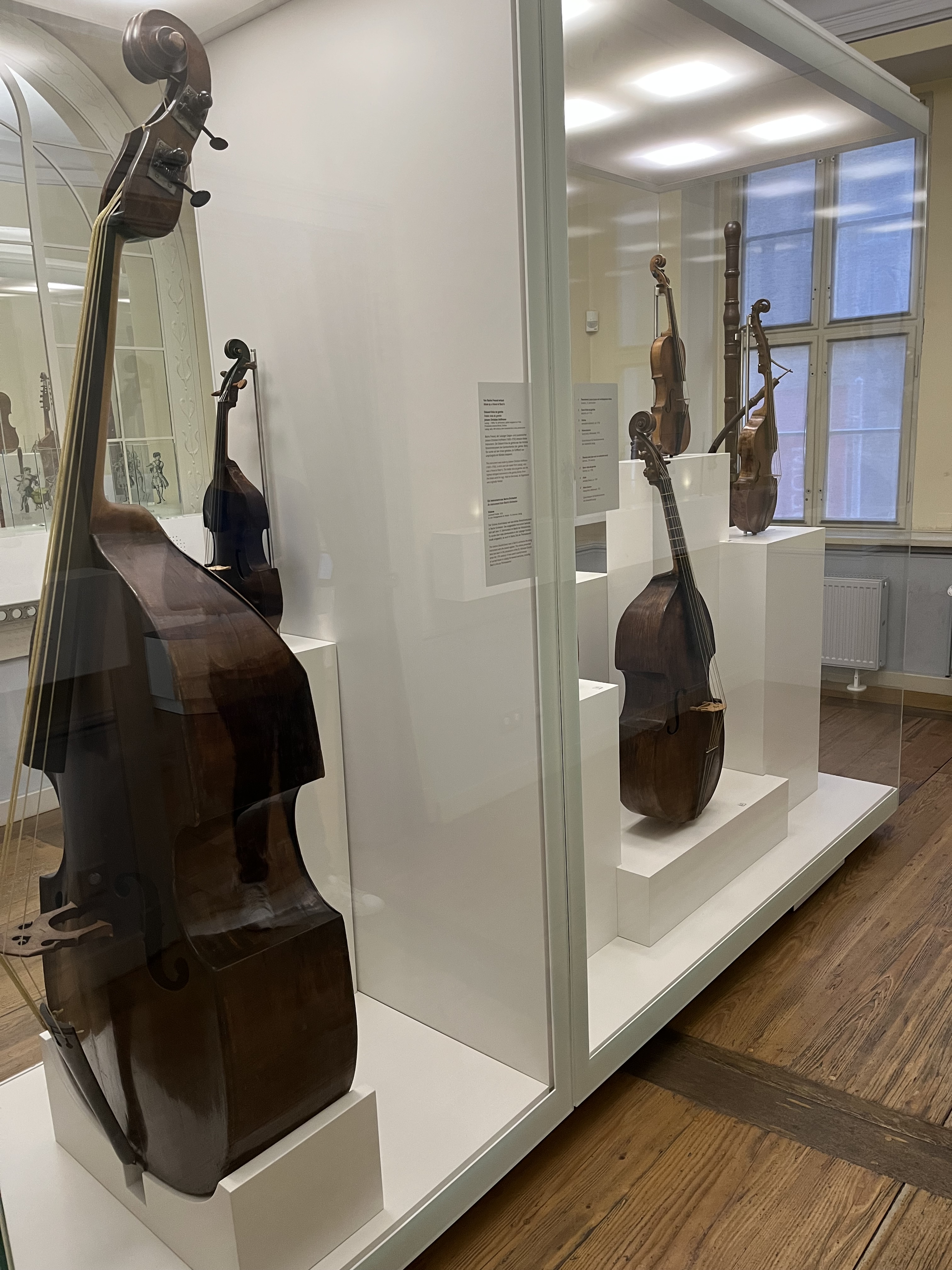
Above, an example of one of Bach’s handwritten pieces of music, the organ he used to play on, and some string instruments from his time.
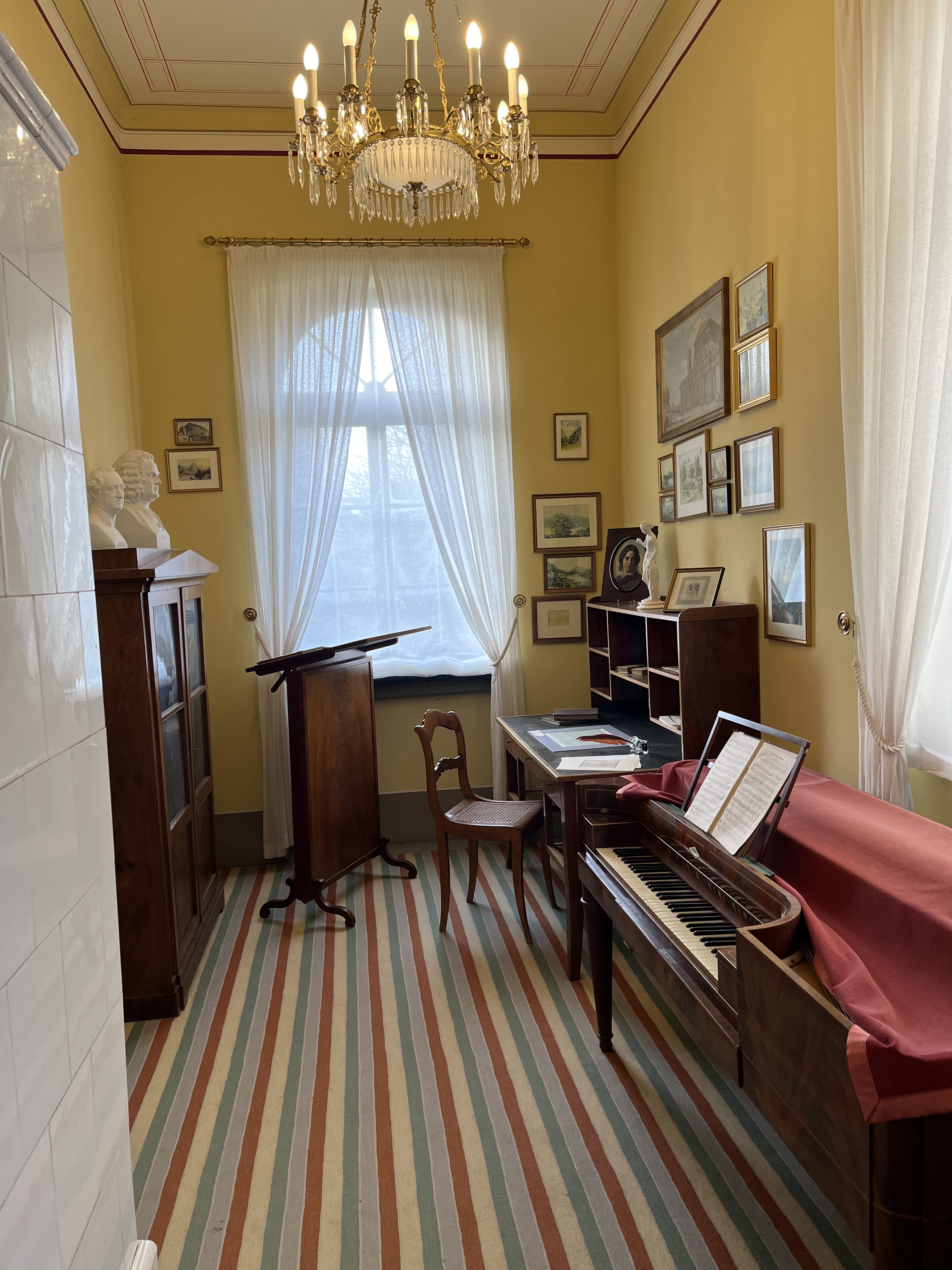
About 100 years after Bach, Felix Mendelssohn, a young musical prodigy, stepped into Bach’s footsteps as the Thomaskantor of Leipzig. Finding and performing some of Bach’s works, he became a main driver for Bach’s growing recognition. Mendelssohn became a highly regarded composer of the early Romantic music period and known for his original compositions. Widely known stand outs are for instance his Italian Symphony, his Violin Concerto, and his Wedding March, which is still being played at weddings around the world today. Unfortunately he died way too young at age 38. While in Leipzig, we visited his museum as well. In his music room Mendelssohn had two busts looking over his shoulder, one of Bach, whom he so highly regarded, and one of Goethe, whose poems inspired Mendelssohn to set a number of them to music:

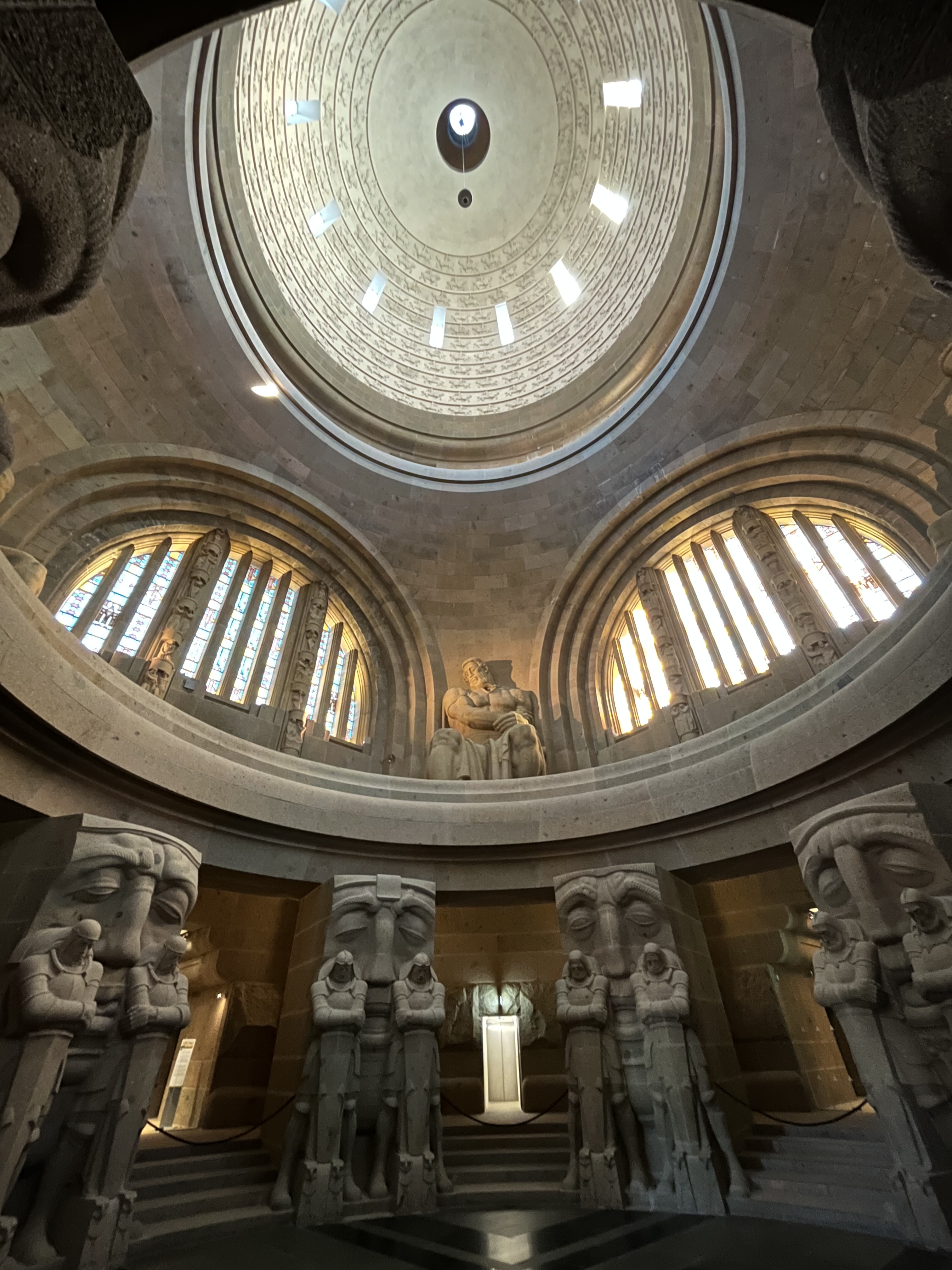
On the outskirts of Leipzig we visited the Voelkerschlachtdenkmal or Monument to the Battle of Nations. Europe is full of war cemeteries and monuments. This monument from 1913 commemorates the 1813 Battle of the Nations, during which Napoleon’s army received its first defeat by a coalition of Russians, Prussians, Austrians, and Swedes. Almost 1,000,000 soldiers were involved. This colossal granite-faced concrete monument is regarded as one of the best examples of Wilhelmine architecture. Personally, I find it hideous and the stuff of nightmare’s, yet that might be just the monument’s intent, to reflect the inhumane and gruesome monstrosity of the battle.


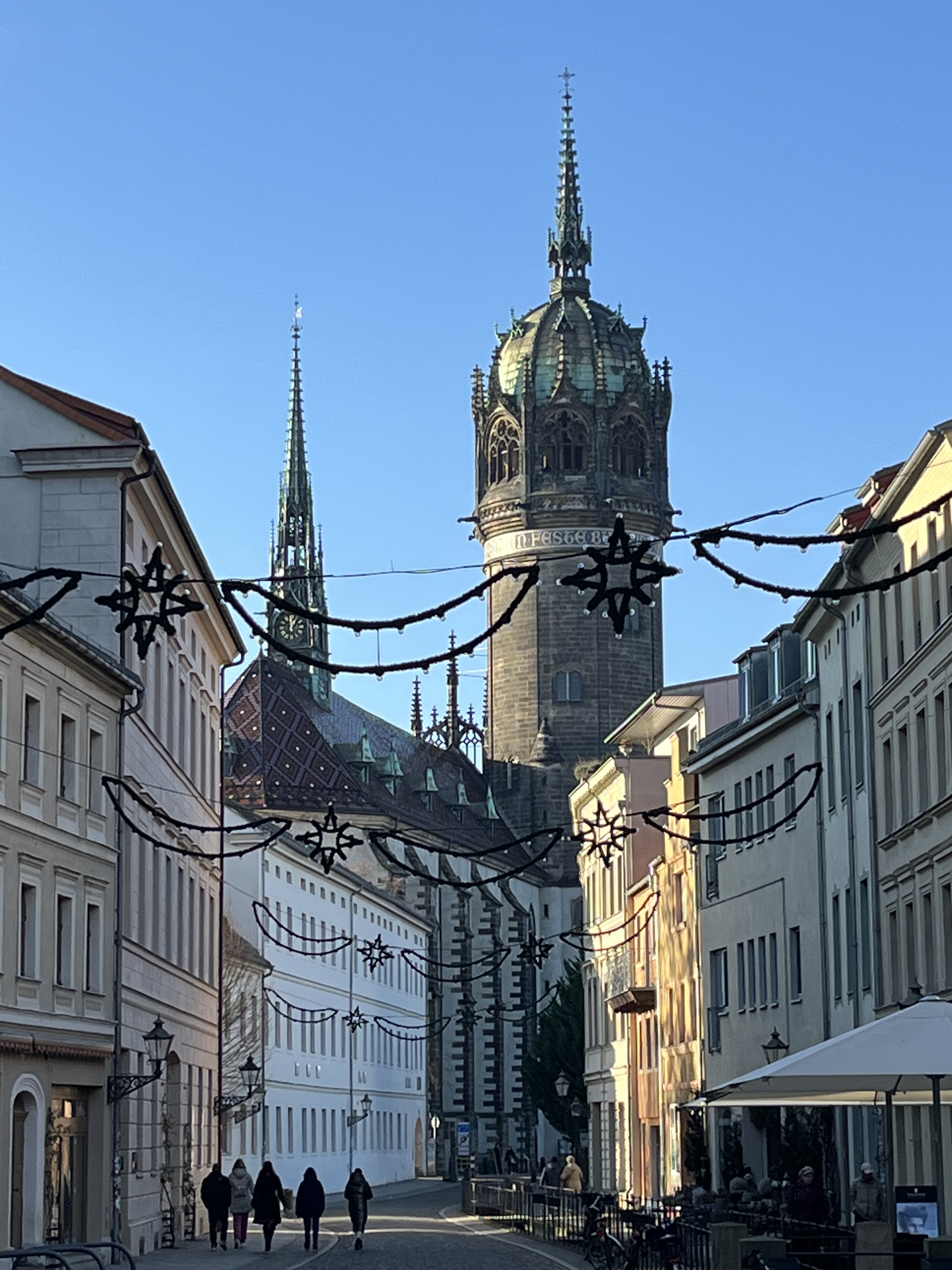
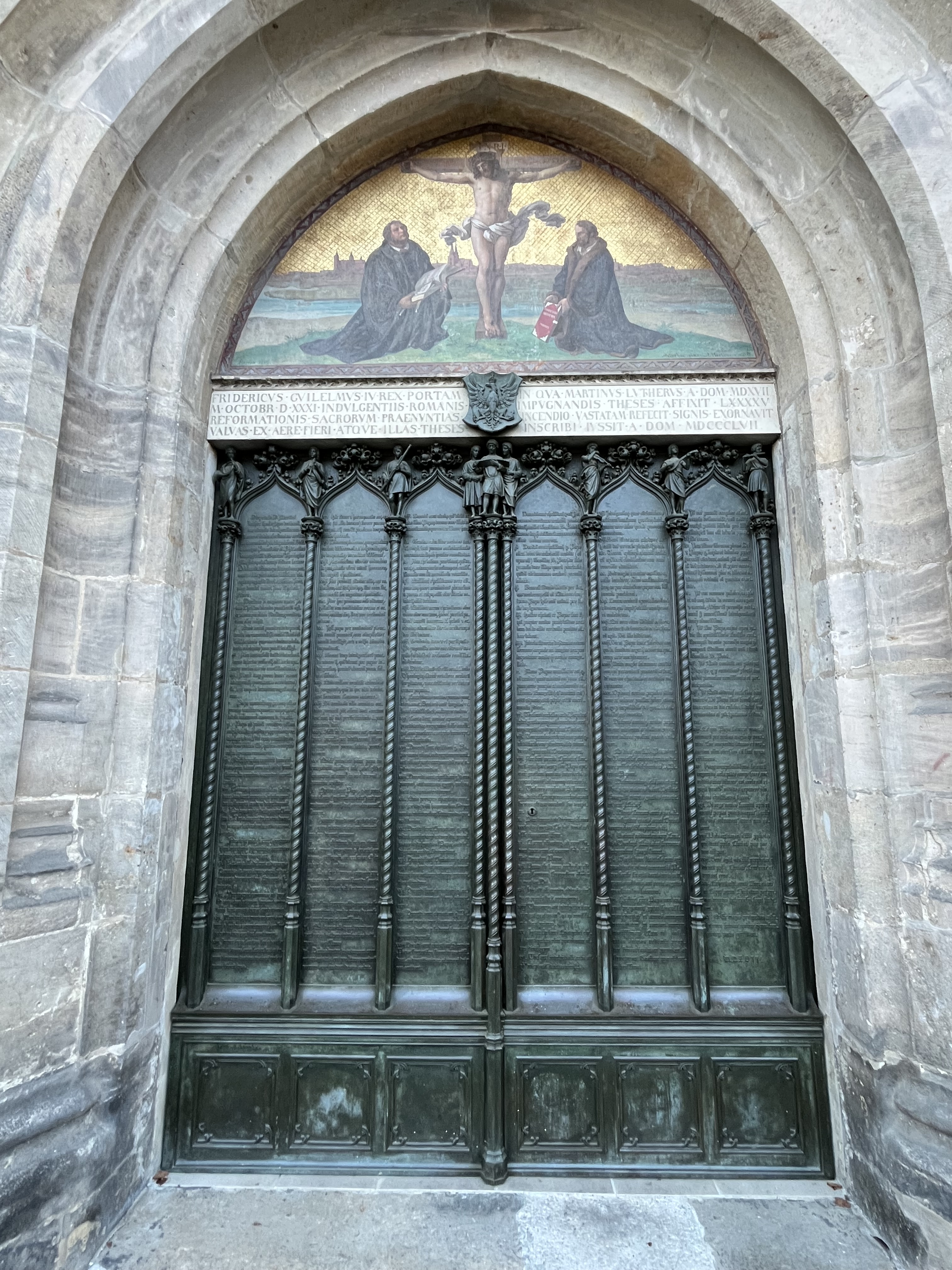
We are back on the trail of Martin Luther in the city of Wittenberg. In 1508 Luther started to teach theology at the University of Wittenberg, and in 1512 was awarded his Doctor of Theology. During his studies he came to reject several teachings and practices of the Roman Catholic Church, and felt growingly outraged over the practice of selling indulgences for the forgiveness of sins. Upset and eager to force debate on the subject, he famously nailed his 95 theses against the practice onto the door of Wittenberg’s Schlosskirche on October 31st, 1517. This act is regarded as the beginning of the Reformation, and in Protestant churches across the world, this day is annually celebrated as Reformation Day and often accompanied by singing Luther’s Reformation Hymn “A Mighty Fortress Is Our God”.
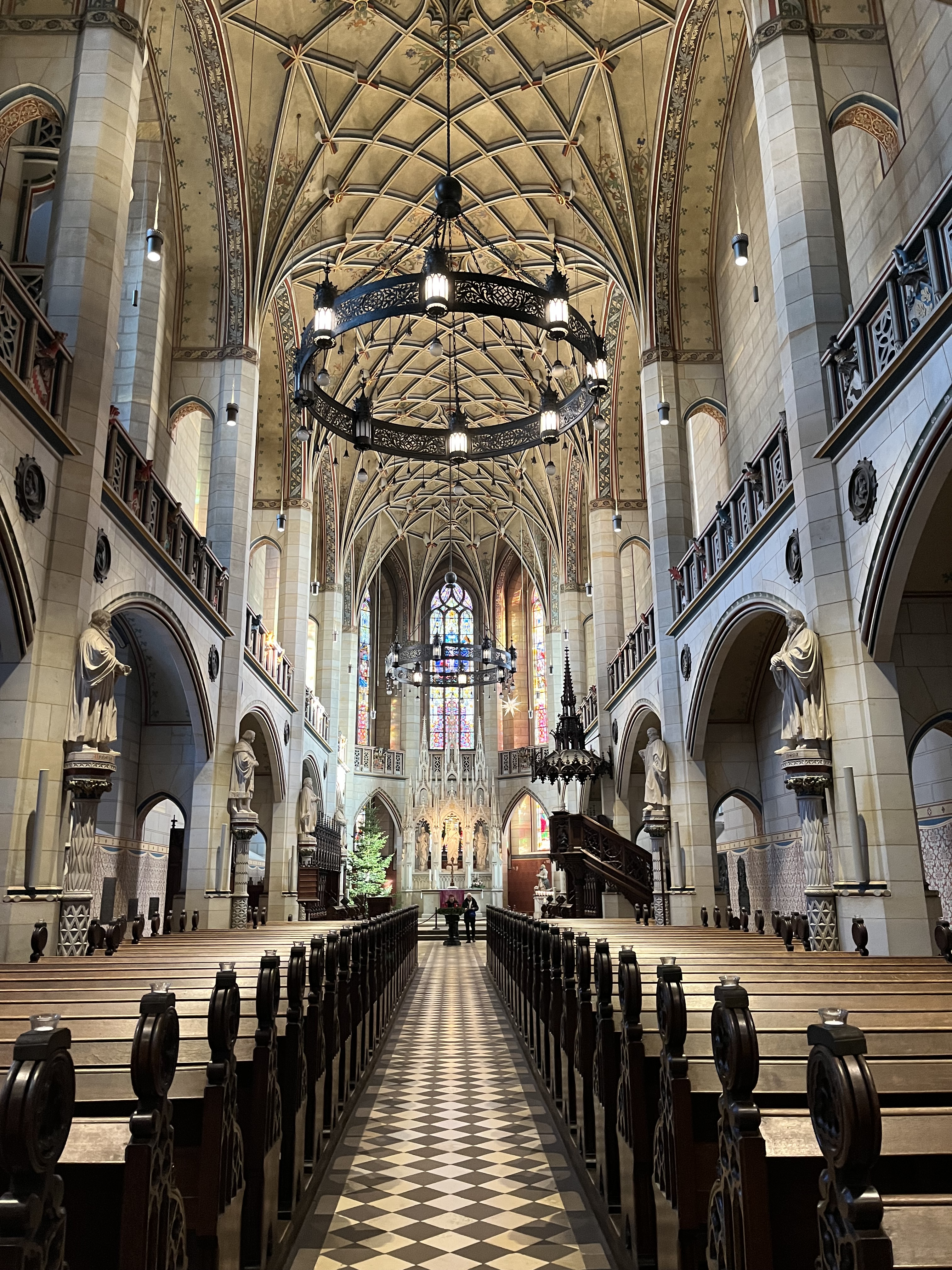
Below shows Wittenberg’s town center with the tower of the Schlosskirche and the interior of the church. The winged bronze door in the middle, shows the 95 theses and was installed after the original door was lost to a fire in 1760:
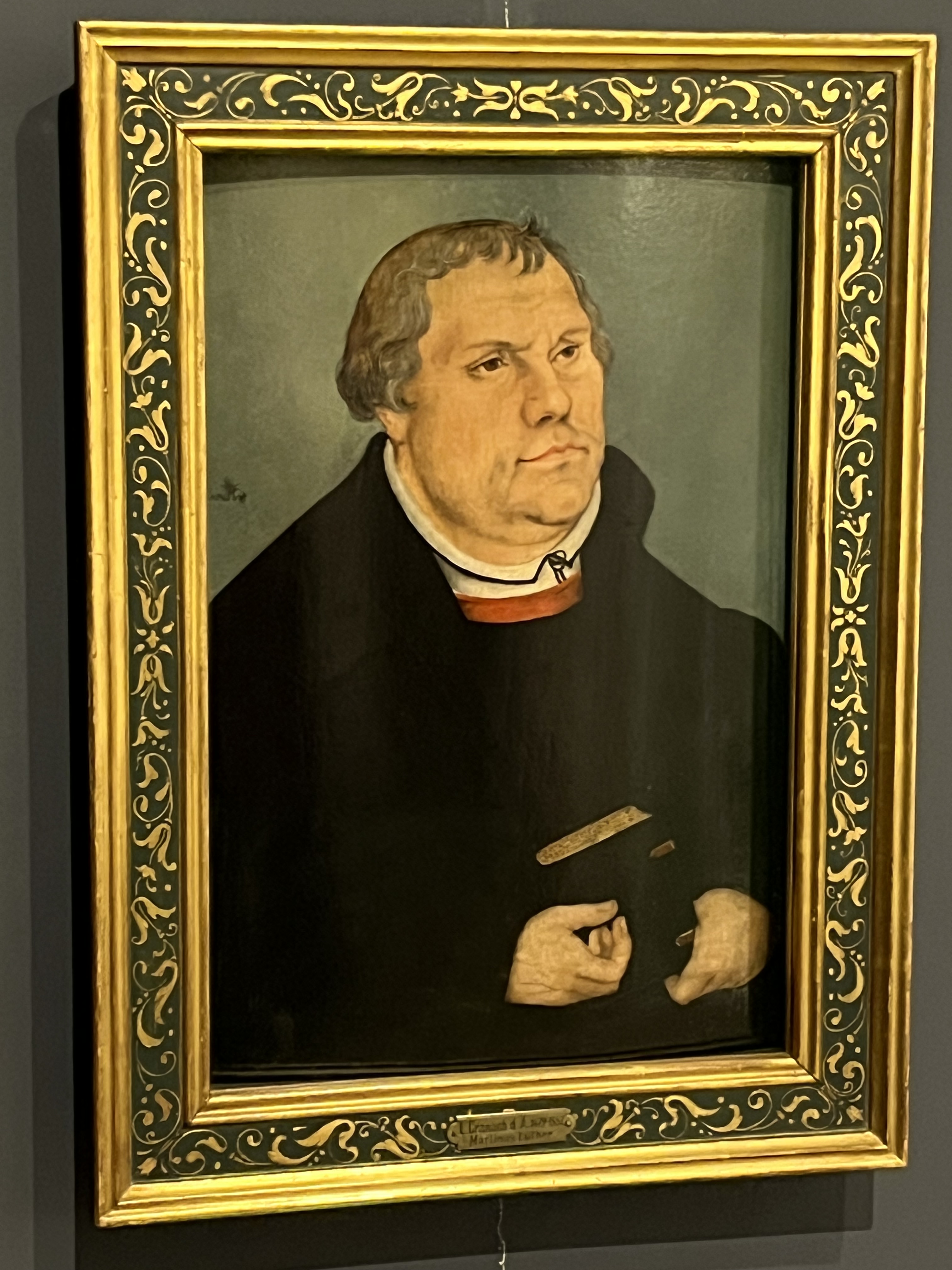
When one talks about the Reformation, one needs to realize that this movement, and the resulting church schism, did not develop overnight, nor through a single person, but was growing over decades through countless contributors. Philip Melanchthon, also a Professor of Theology at the University of Wittenberg was a close collaborator and friend of Martin Luther in the Reform movement. He stands next to Luther and John Calvin as a shaper of Protestantism.

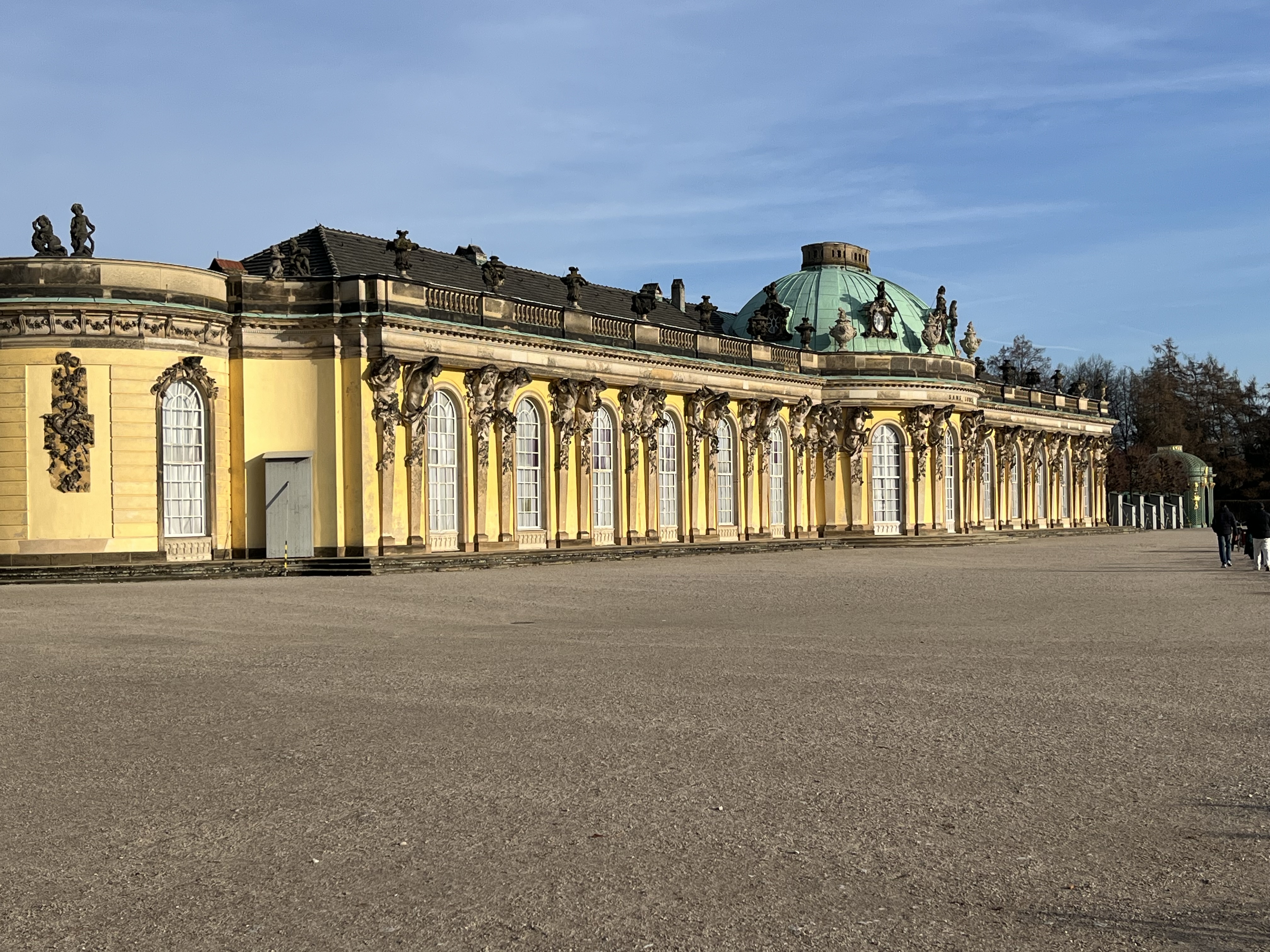
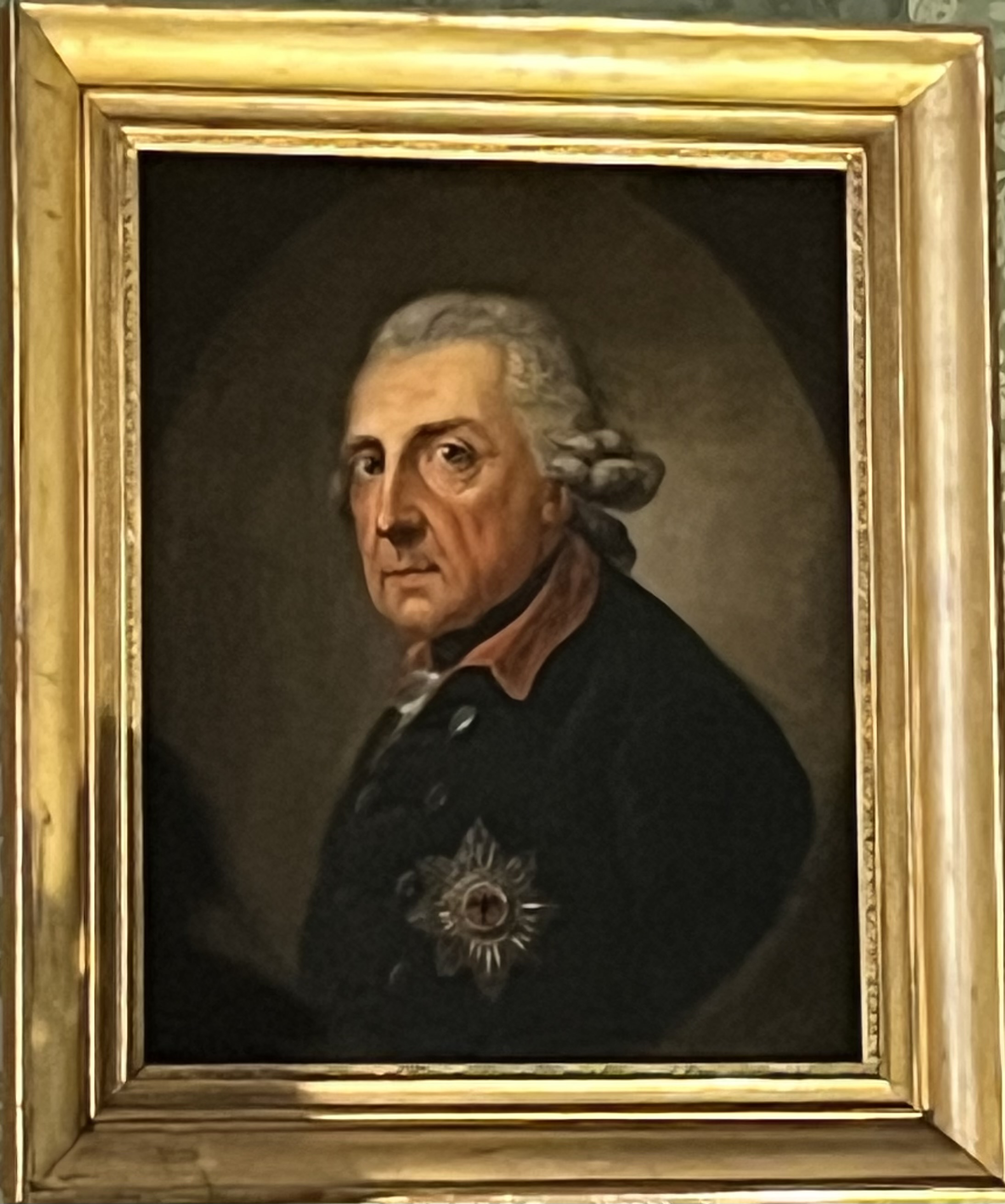
We were on the way to the German capital and stopped in Potsdam, the residence of the Prussian kings and the German Emperor until the end of WWI in 1918. It is a place of grand scale, pastoral gardens, and palaces, inspired by ideas of the enlightenment period. Its most famous palace is the Rococo style Palace of Sanssouci, which was built by the Prussian King Frederick the Great, nicknamed in German as Der Alte Fritz:
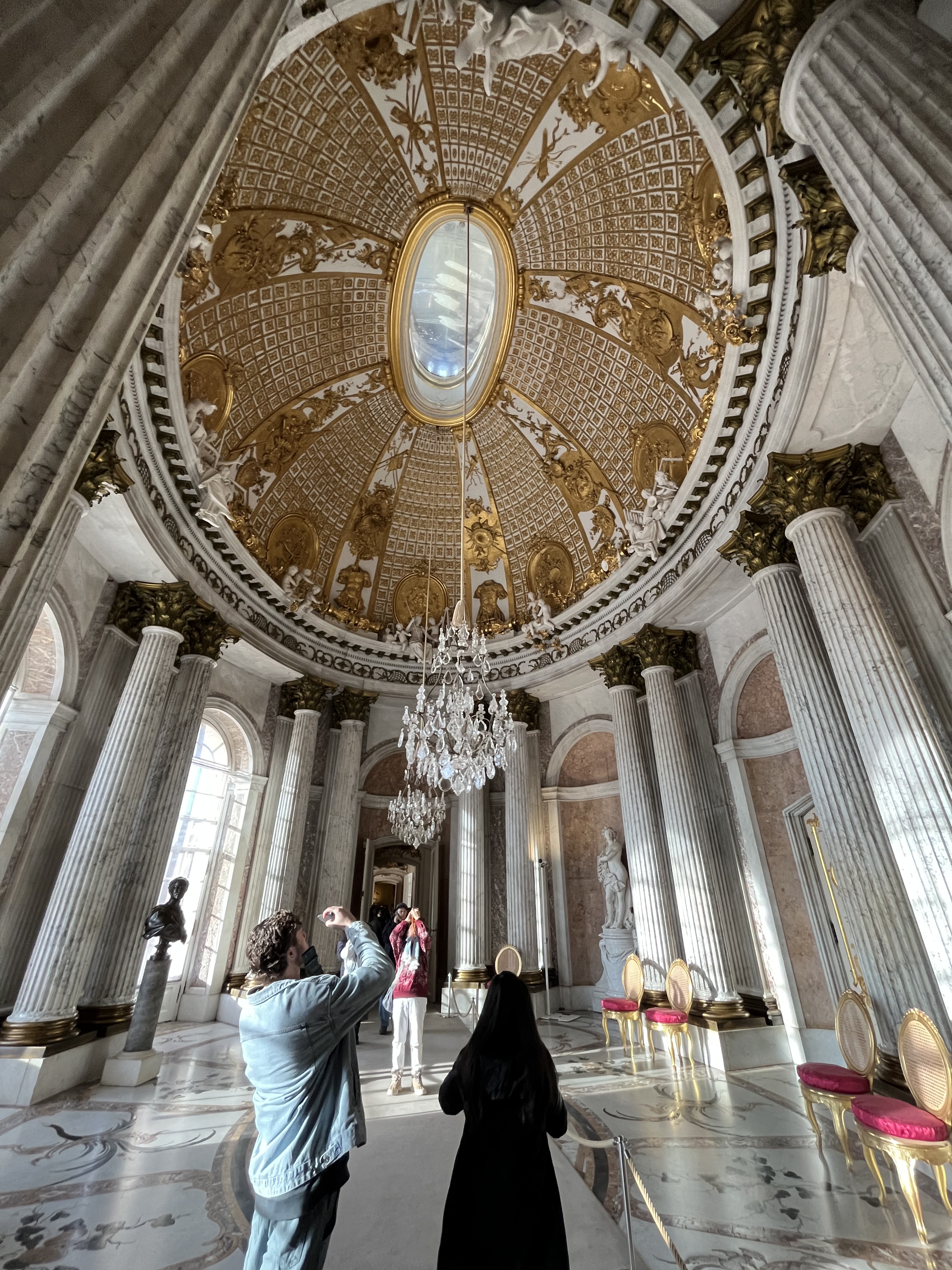
Here are some pictures from the inside of Sanssouci:


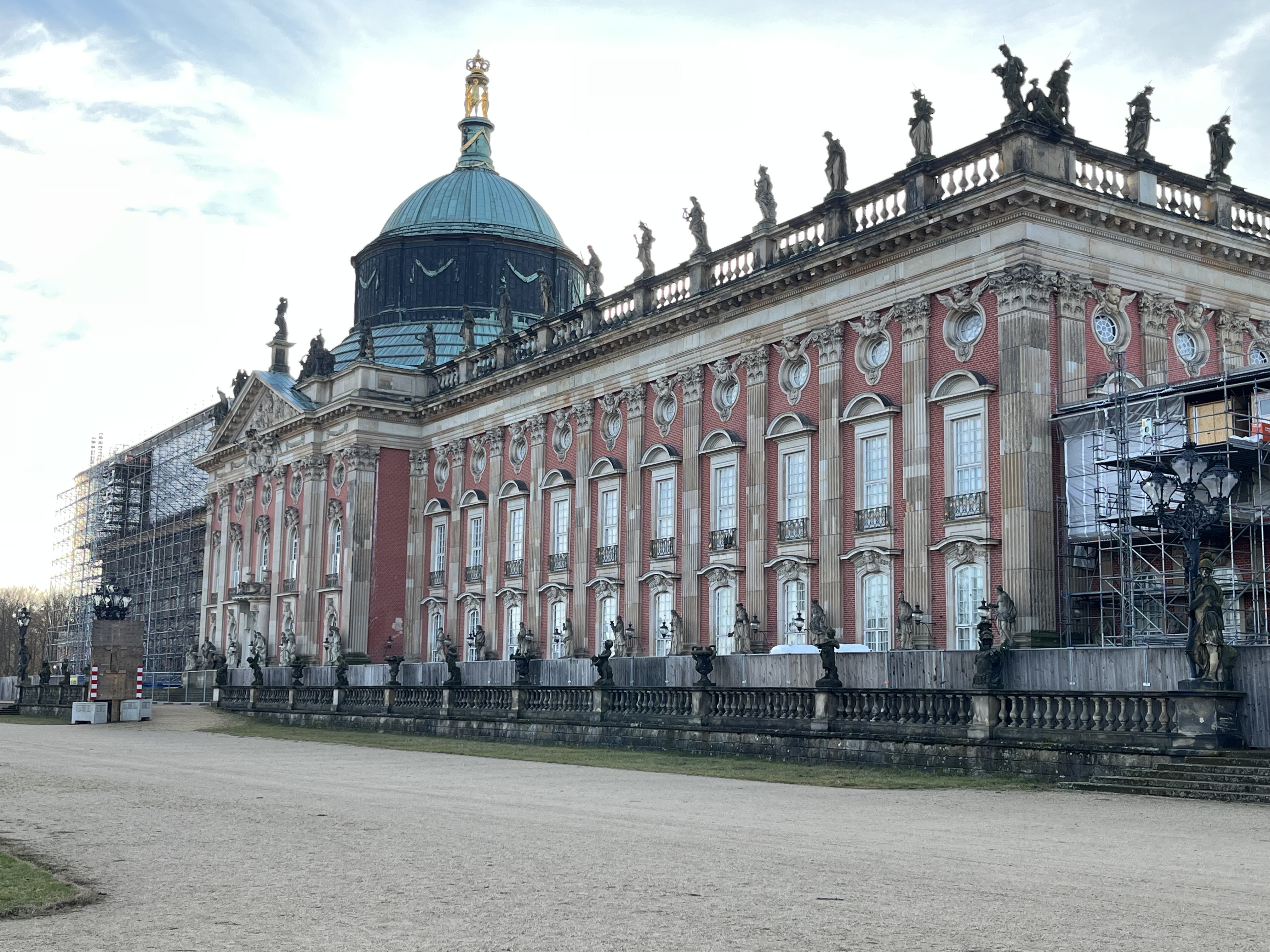
The Neues Palais, is just a 30 minute stroll through the large park from Sanssouci. It is considered the last great Prussian Baroque palace, and with over 200 not so small rooms, it is certainly huge. It is the place where, the Prussian kings and the German Emperor actually lived.
We had a guided tour booked for viewing the palace, and when we arrived we lucked out that nobody else had signed up for this time slot. We ended up with a very knowledgeable, entertaining, and engaging tour guide just for us two. It was a pleasure! The Neues Palais, with the large ballroom and dining room, reminded us of our visit to Versailles, yet here it was not quite as grand:

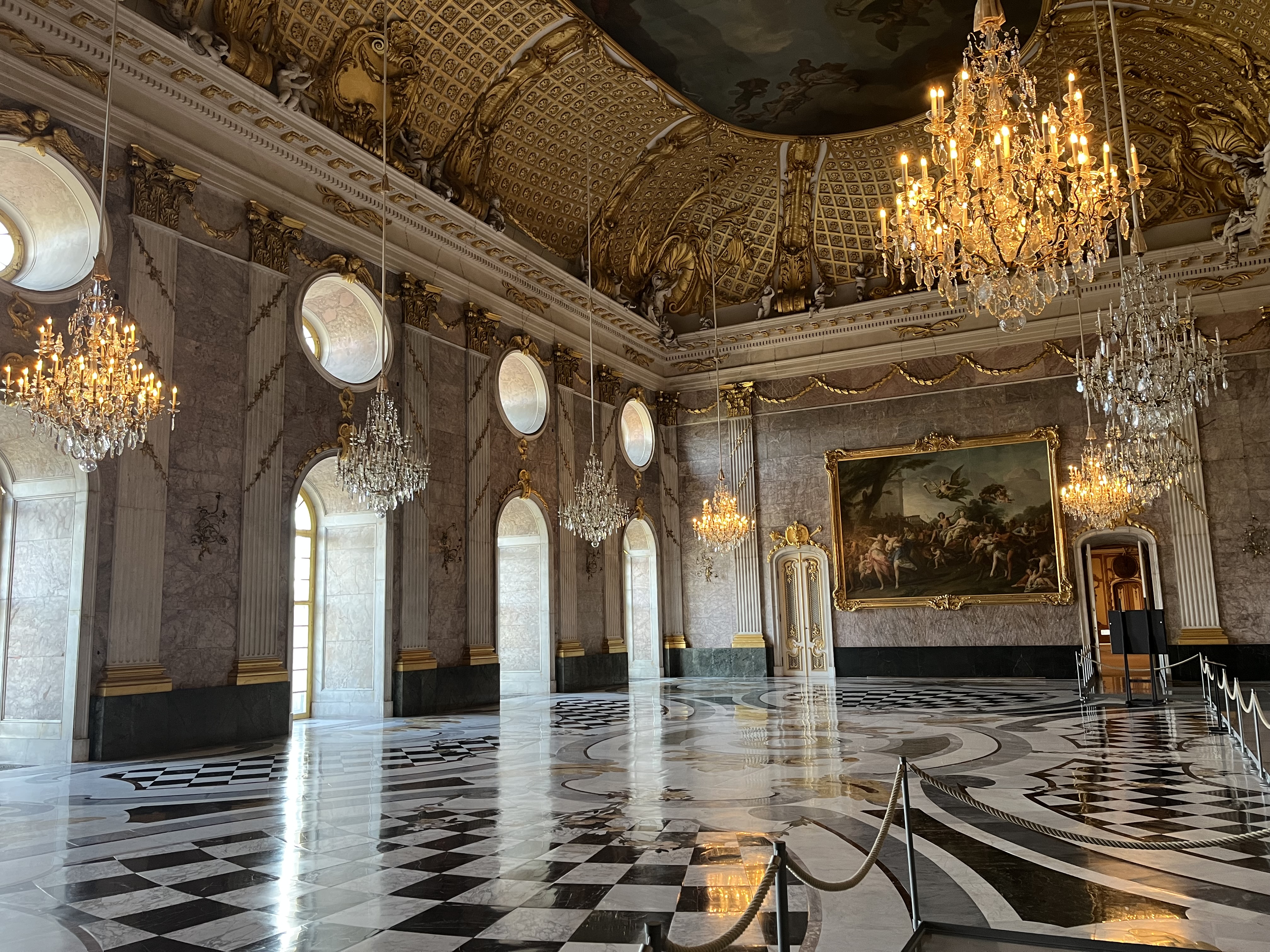
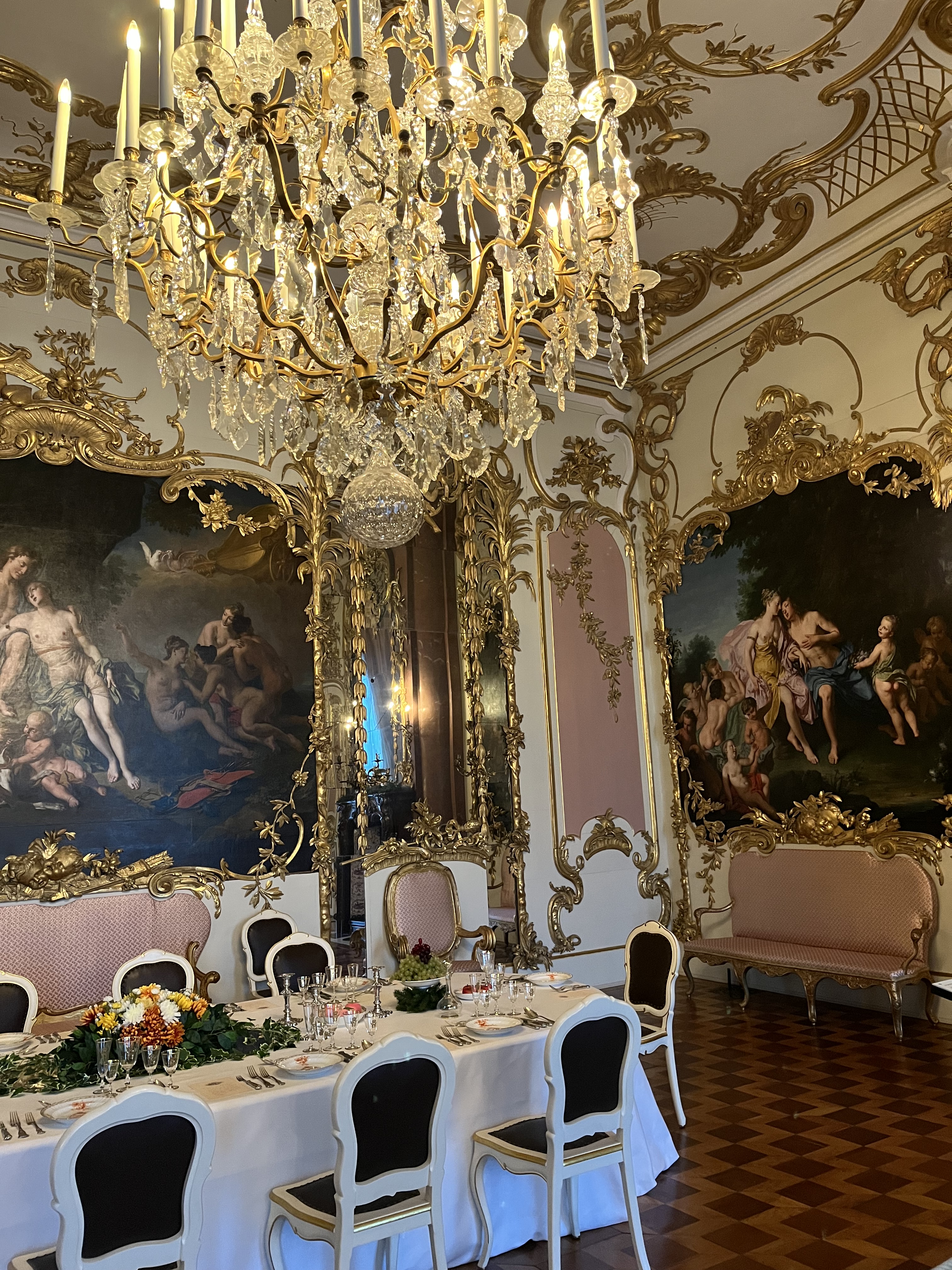

At the end of WWII Russian troops were stationed in the palace and started to deface and loot its interior. Fortunately, the commanding Russian officer in charge put a stop to it. Prior to the occupation, most of the furniture was moved to a place in the Netherlands for storage. During the DDR years the palace further deteriorated and since then is slowly being restored.
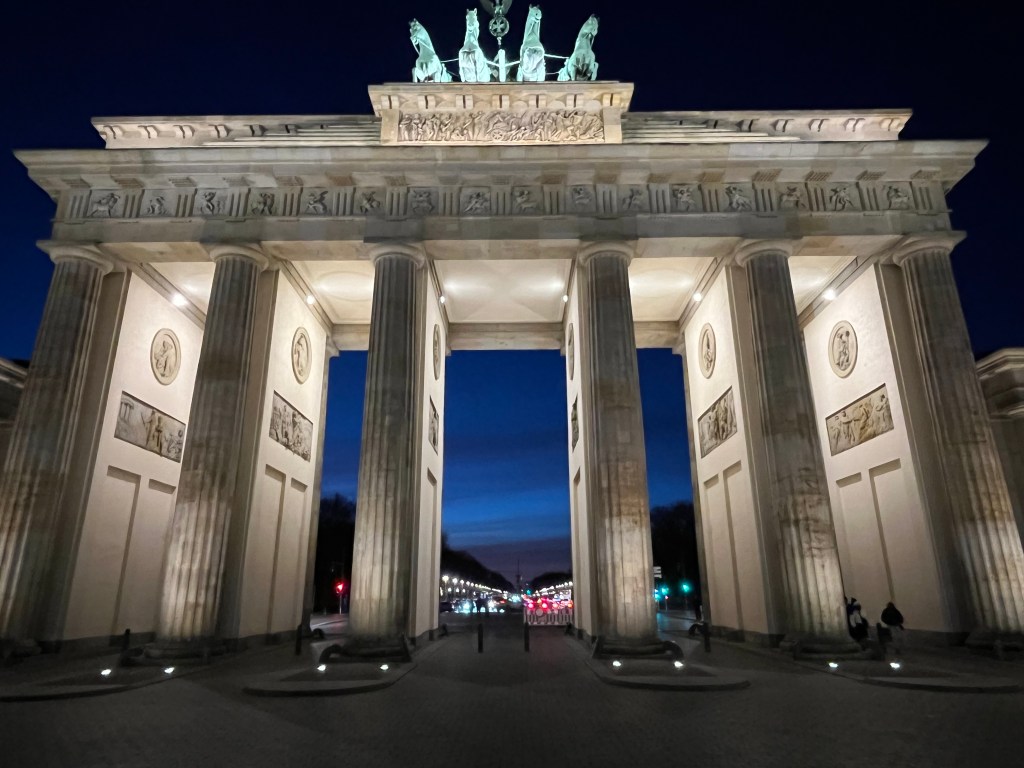
We’re in the center of Germany’s capital Berlin. With a population of 3.6 million, Berlin is Germany’s largest, and 5th largest city in Europe. The Brandenburg Gate above is Berlin’s most iconic, over two hundred year old, landmark. After the construction of the Wall it used to be a memorial of division, as it was located in the restricted area and could not be visited by East or West Germans, and after the fall of the Wall in 1989, the gate became a symbol of German unity. More on the Berlin Wall and Germany’s Reunification will follow below.
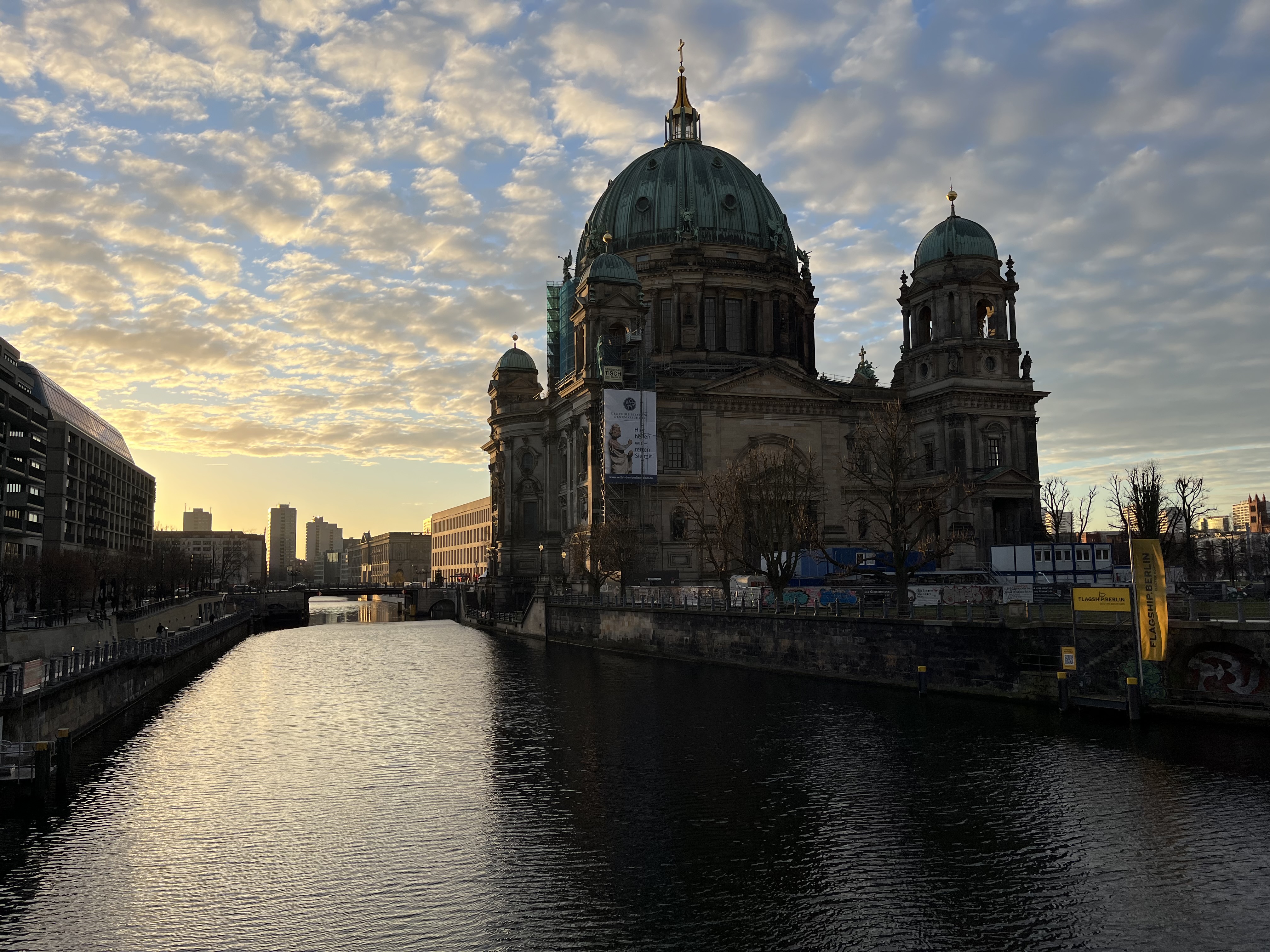

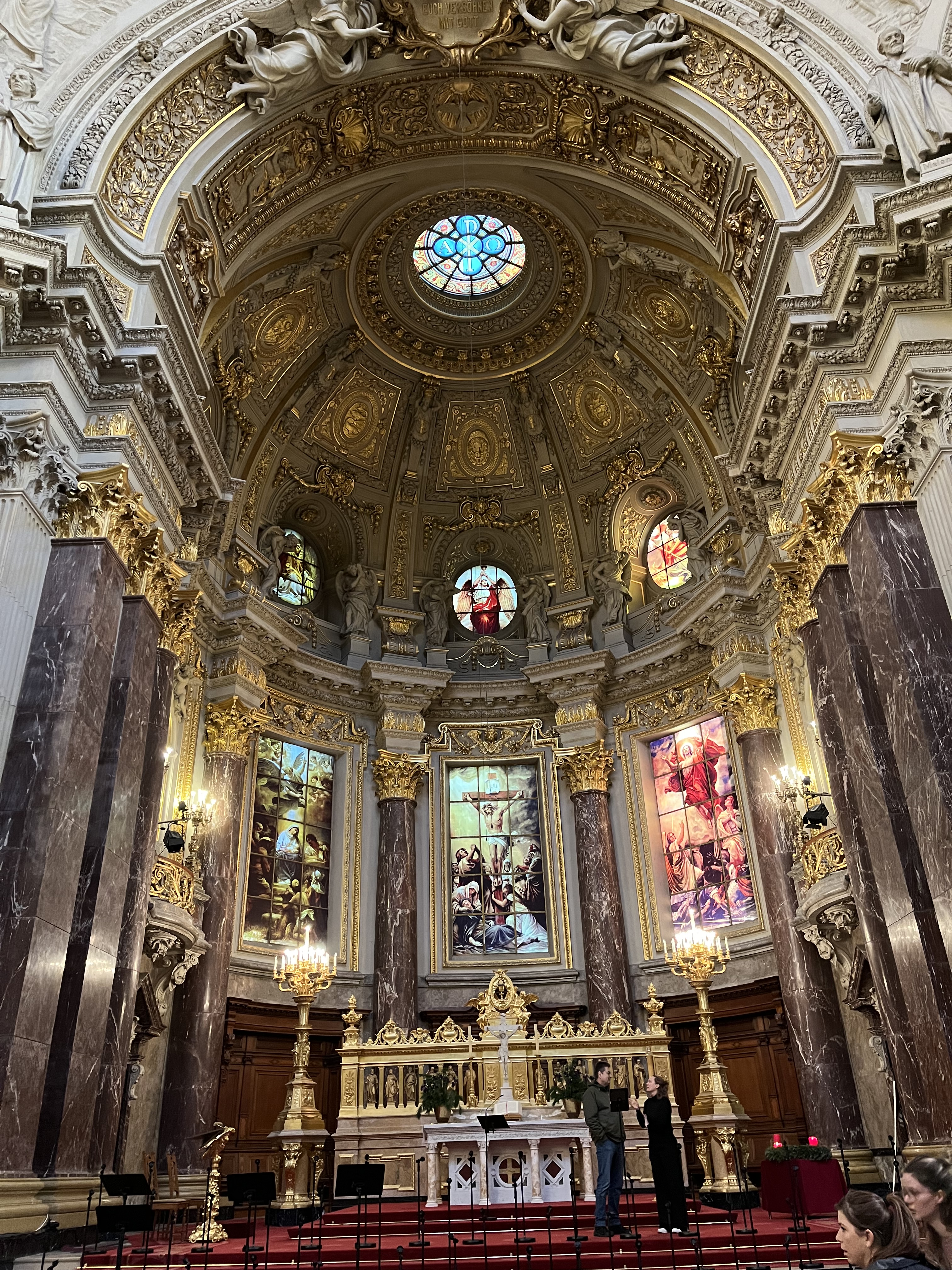
The Renaissance and Baroque style Berlin Cathedral, pictured above and below, was built between 1894 and 1905, much more recently than one would think. It is the largest Protestant church in Germany. Inside, looking up into the big dome of the church, we noticed a slight resemblance to Saint Peter’s Cathedral in Rome.

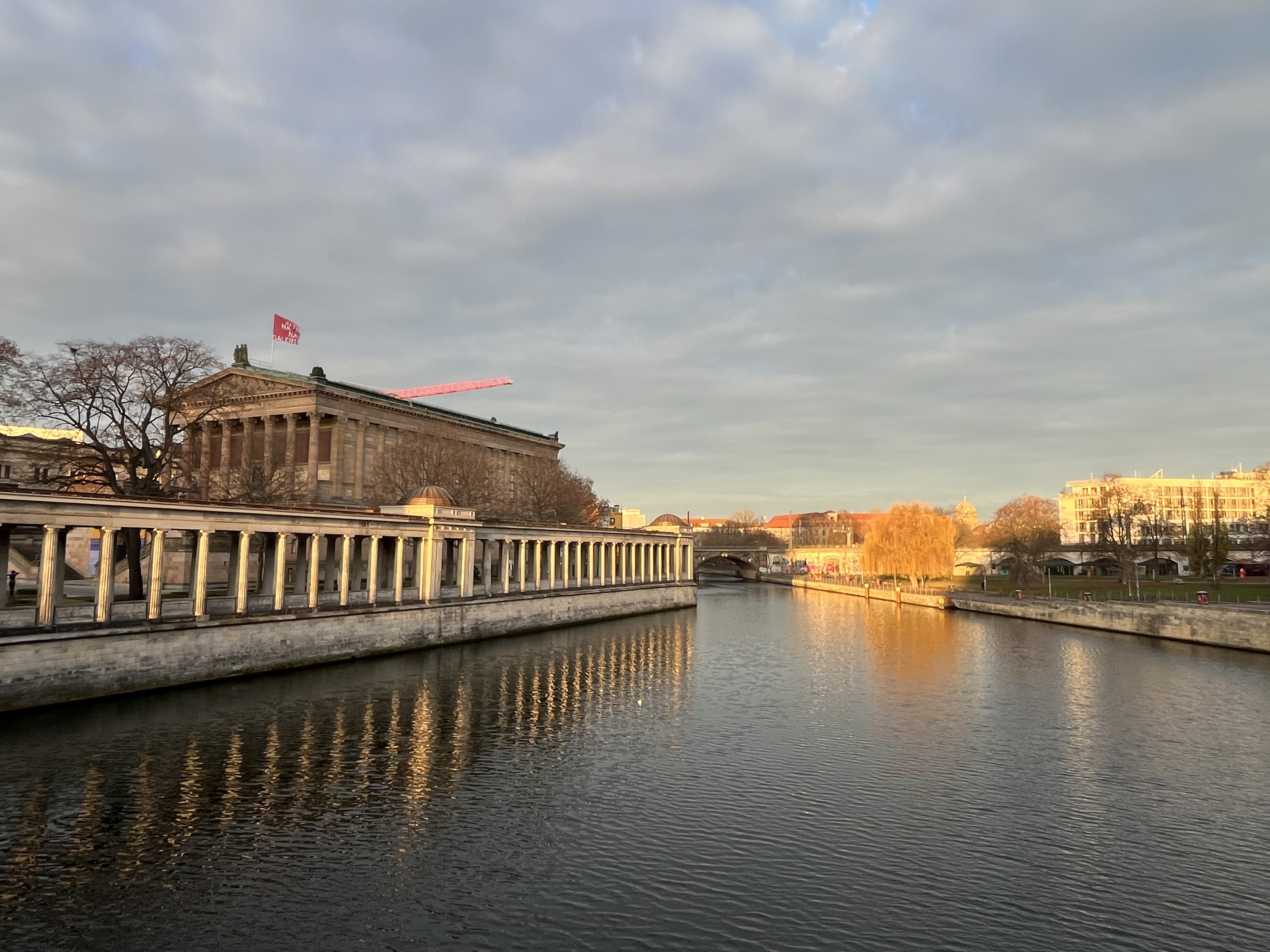
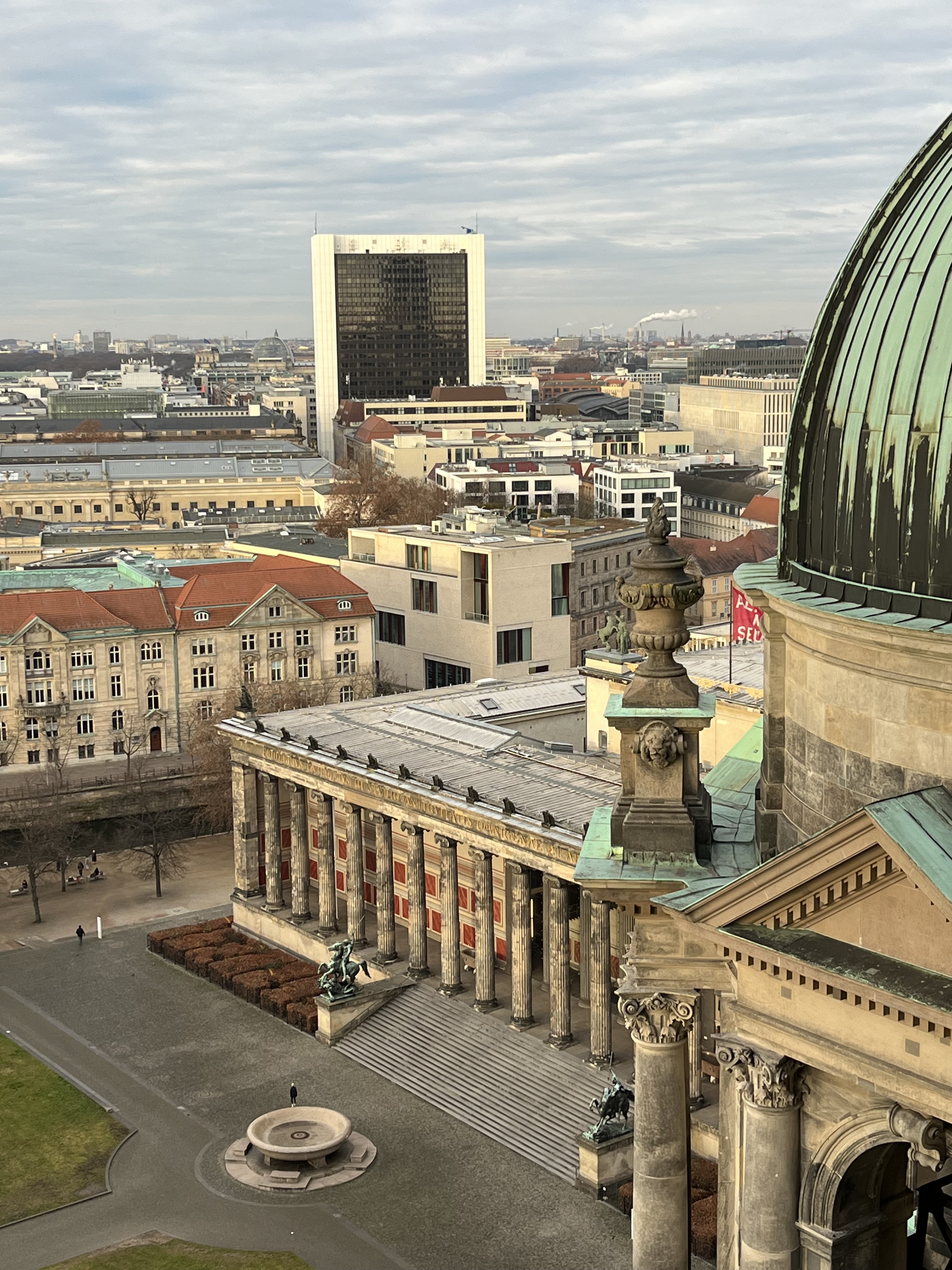
Since Reunification, the German government has been working on rebuilding the Museum Island, located in former East Berlin, just adjacent to the Berlin Cathedral along the Spree River. As one of the most important museum sites in Europe, it was built by order of the Prussian kings between 1830 and 1930. The Museum Island consists of the Altes Museum, Neues Museum, Alte National Galerie, Bode Museum, and Pergamon Museum, with the last one unfortunately still closed due to ongoing reconstruction.
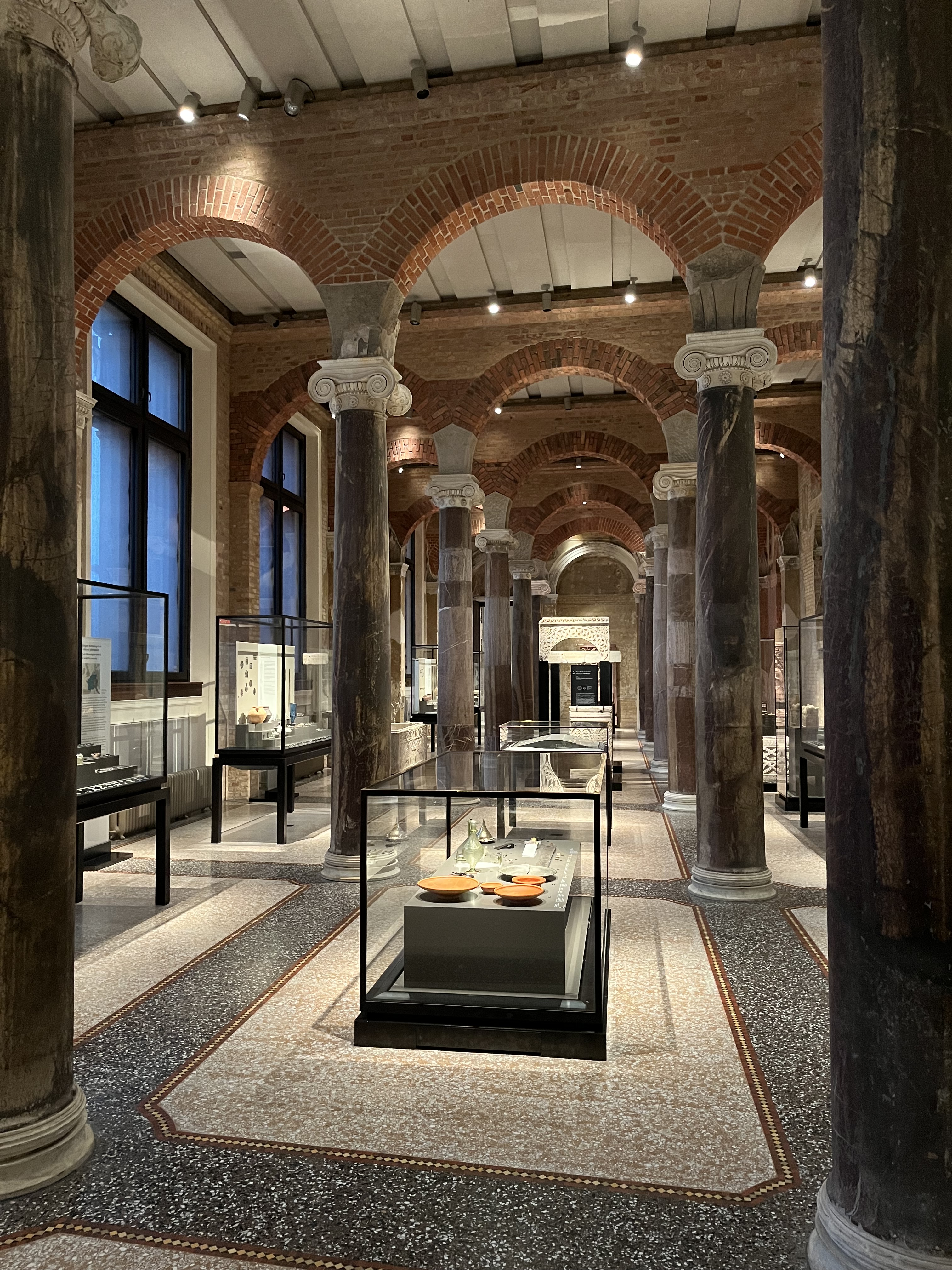
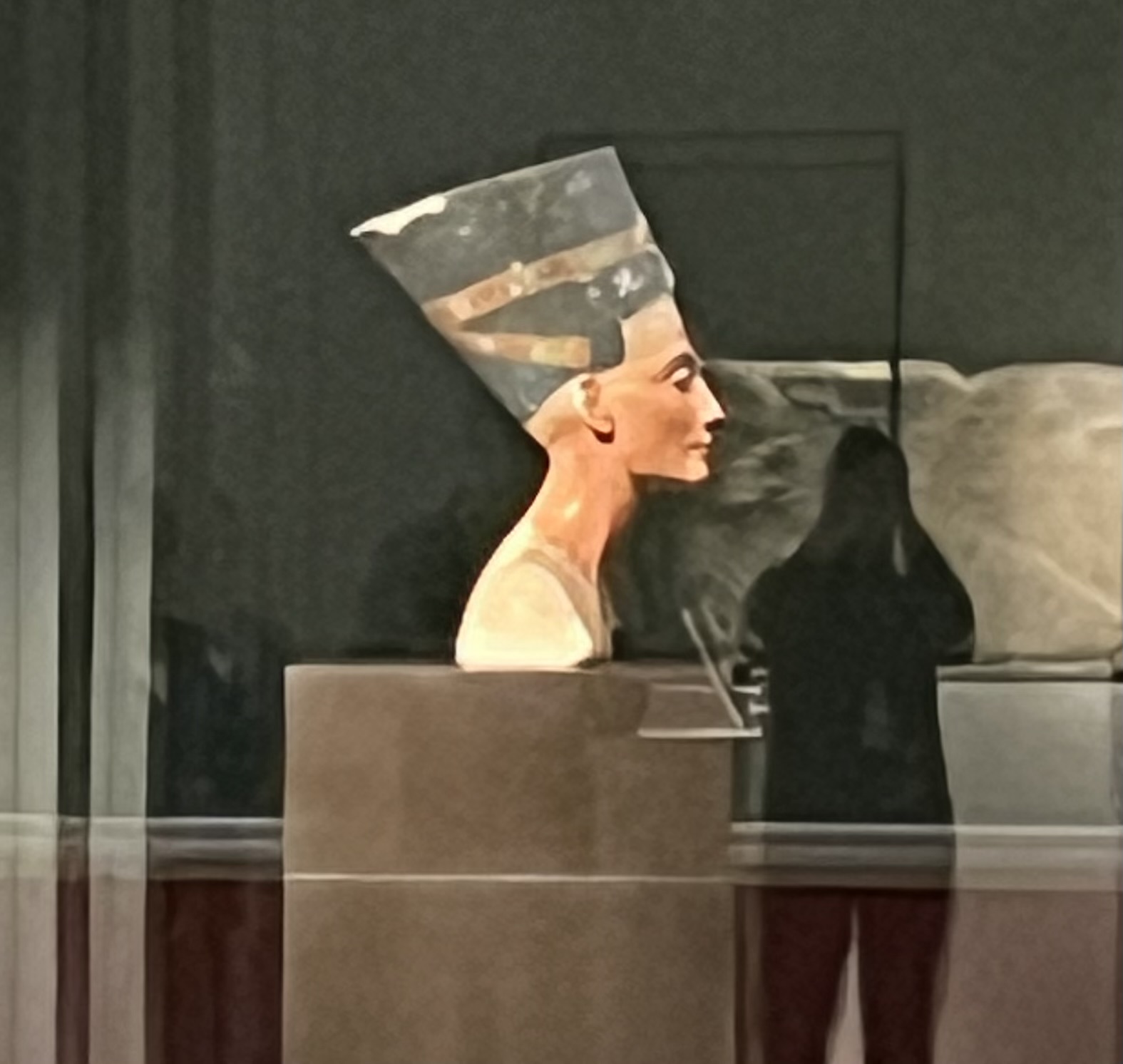
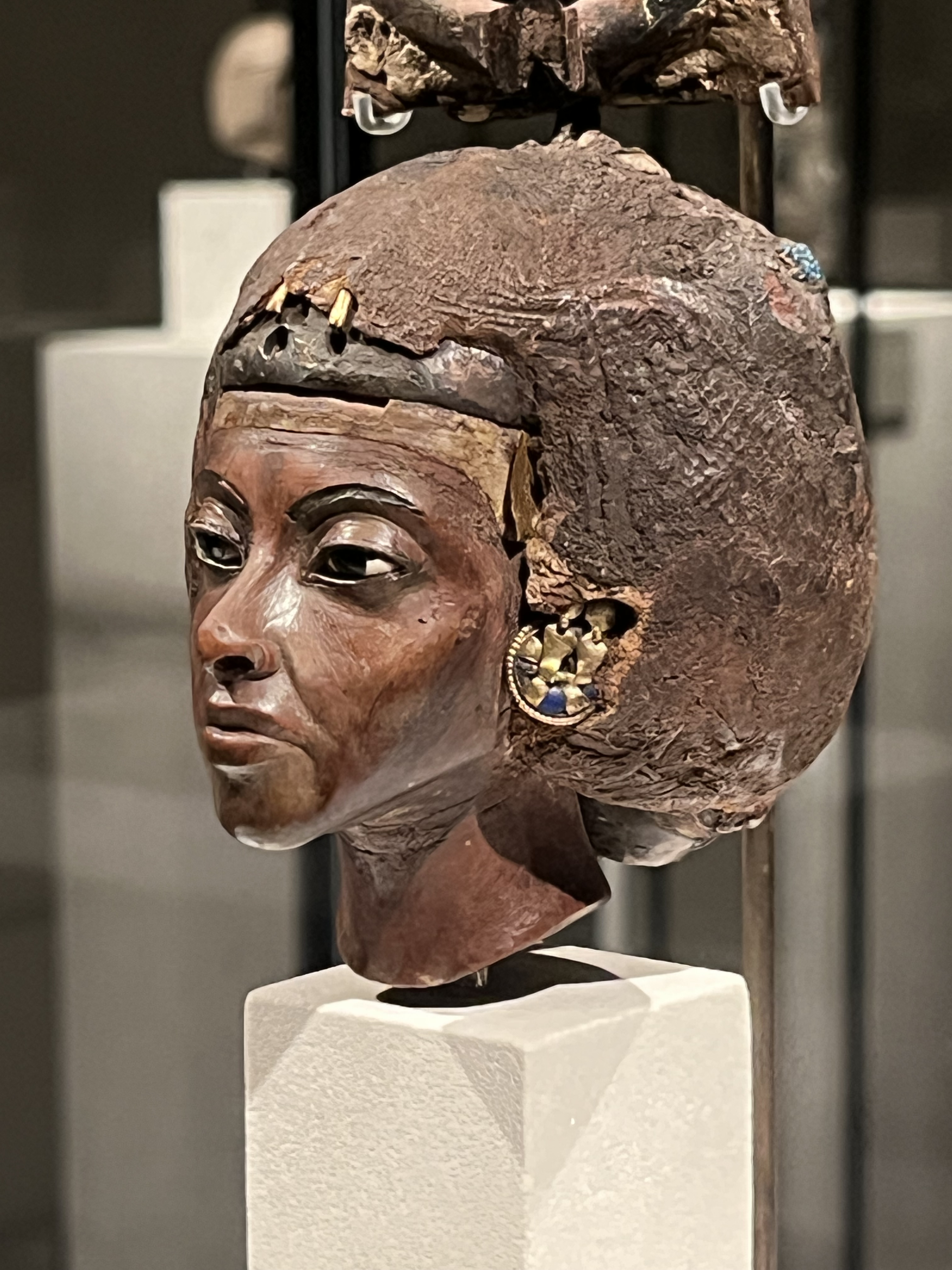
Here are some impressions, especially from the elaborate Egyptian collection inside the Neues Museum, with the famous Nefertiti bust. As you notice in the reflection of the Nefertiti picture, where I am the only person taking a photograph, and, as you might notice in the pictures of the empty exhibition halls, we had the pleasure of visiting Berlin during a very quiet period of the year.




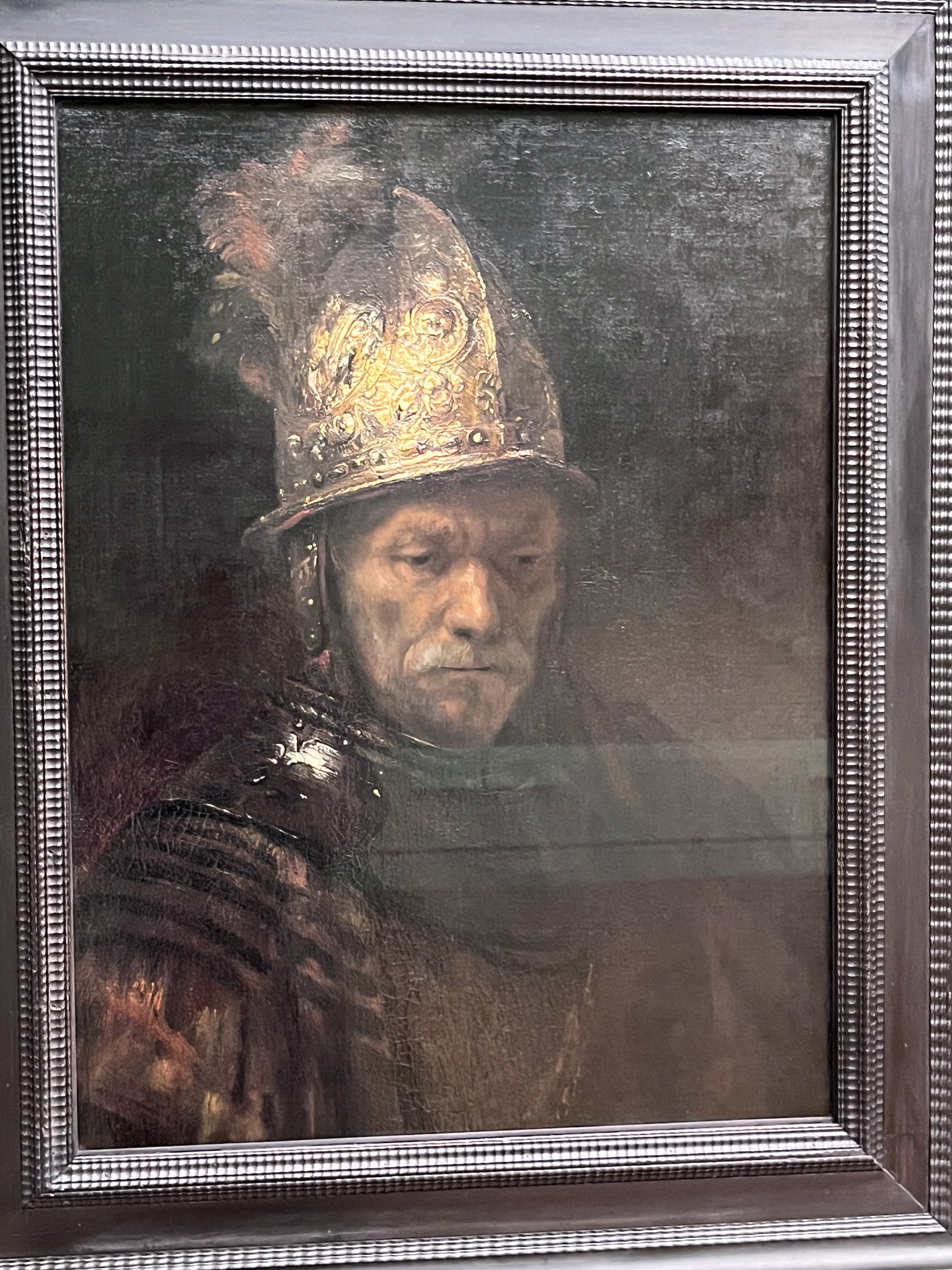
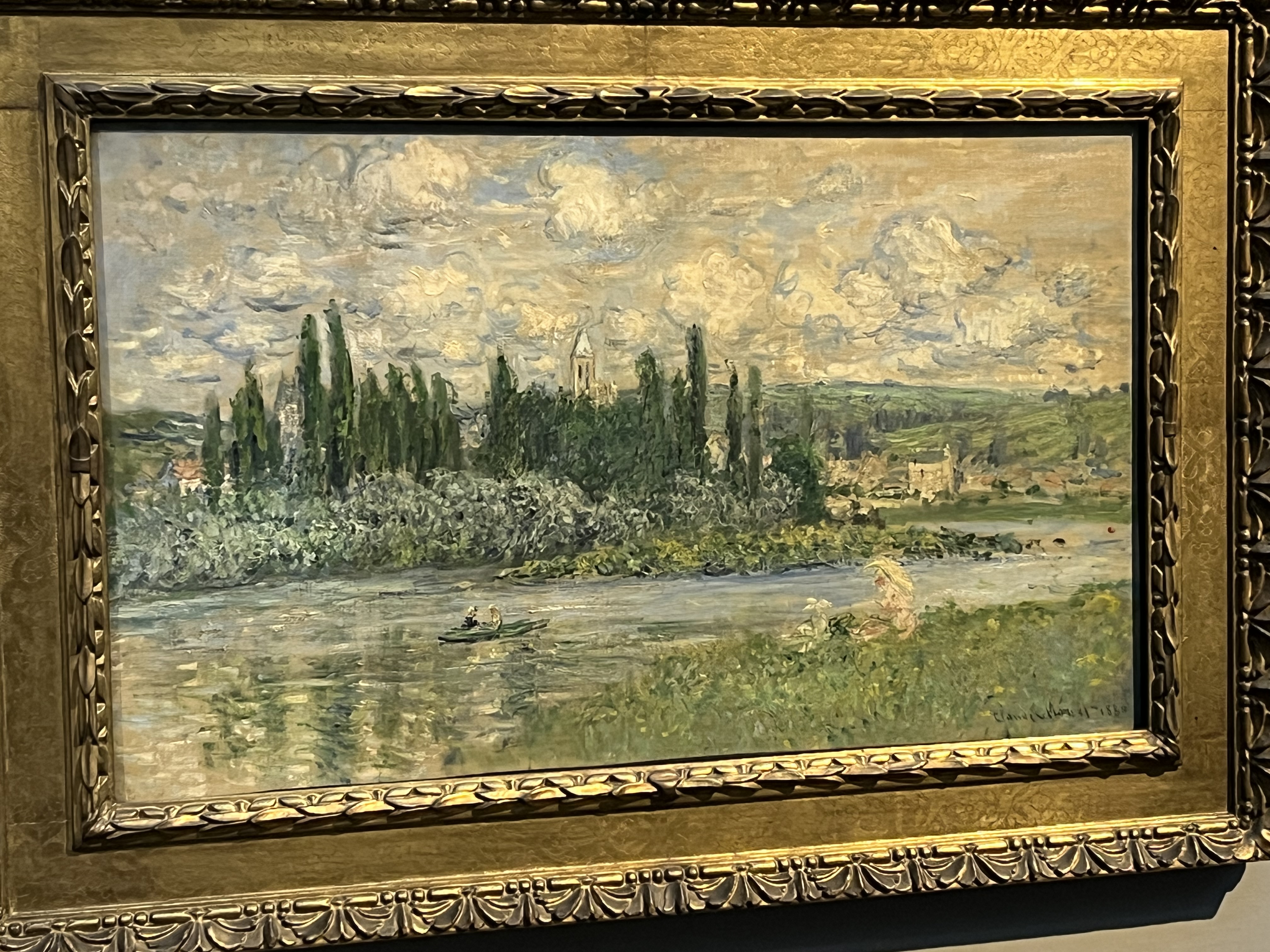
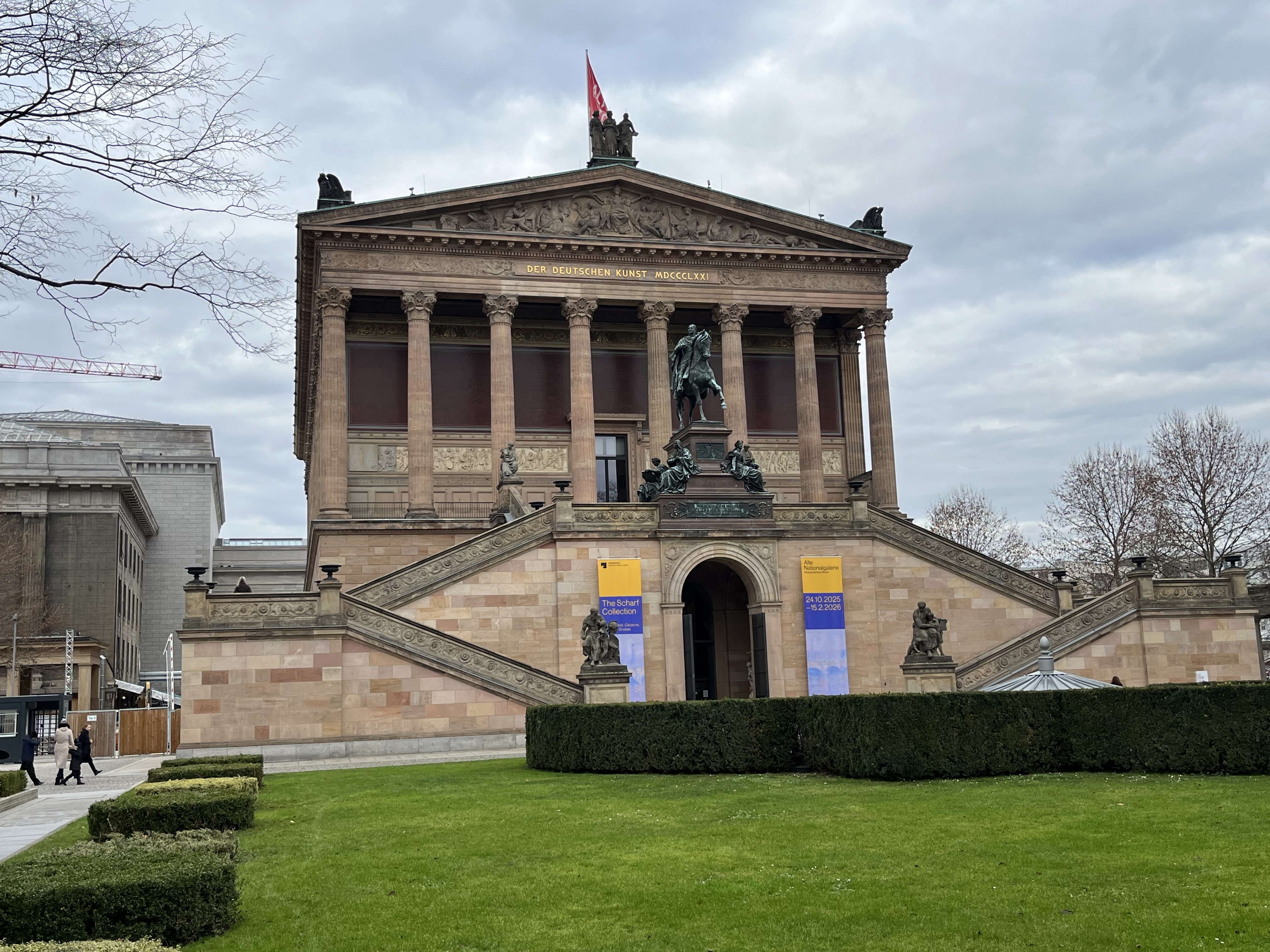
Above, The Man With The Golden Helmet painting by Rembrandt, is actually located in the Gemaelde Galerie, another Berlin museum which we visited outside of the Museum Island.
By now the reader might ask how I could write a travel blog about visiting Berlin without talking about WWII and, in particular, about Germany’s Nazi regime at a place where the evidence and ample museums covering the subject stare into your face? The short answer is, that I would never be able nor willing to squeeze such an important and complex subject into my blog.
As a German citizen growing up in Germany during the 60s and 70s, I was taught in school about the ins and outs of that era in graphic detail and multiple times, to the extent that shame and guilt still haunt me today about this sensitive German part of history. I’ve visited and seen the Verdun WWI sites, the Normandy WWII sites, the Dachau concentration camp, and multiple sites and museums in Nuremberg and Berlin especially devoted to the subject. Through thorough and ample education on the subject, the post war German government did an excellent job of trying to prevent such atrocities to ever happen again on German soil. I would advise everyone to take advantage of these readily available educational opportunities. Because, as the saying goes, if we don’t learn from the past, history is bound to repeat itself. And unsettlingly, with recent political developments in the West, and a younger generation growing up that appears to be unknowledgeable and/or unwilling to properly engage on this subject, this starts to ring frighteningly true!
As one aftermath of WWII, Germany’s Russian controlled Eastern Sector closed the border to the West, and in 1961 erected the almost 1,000 mile long fortified border, which included a 1,500′ wide, guarded protective strip and the actual Wall. This carved a hideously arbitrary scar and separation into the landscape, running through Germany and straight through its capital of Berlin. All this, to prevent more people from fleeing the communist controlled DDR. This was the most elaborate and fortified border wall anywhere, maybe except the border separating North and South Korea, and it led right through the center of Berlin, cutting through neighborhoods, and obliterating houses and churches in its path. Below is a stretch of the original Wall at the Bernauer Strasse neighborhood that was intentionally left standing as a memorial:
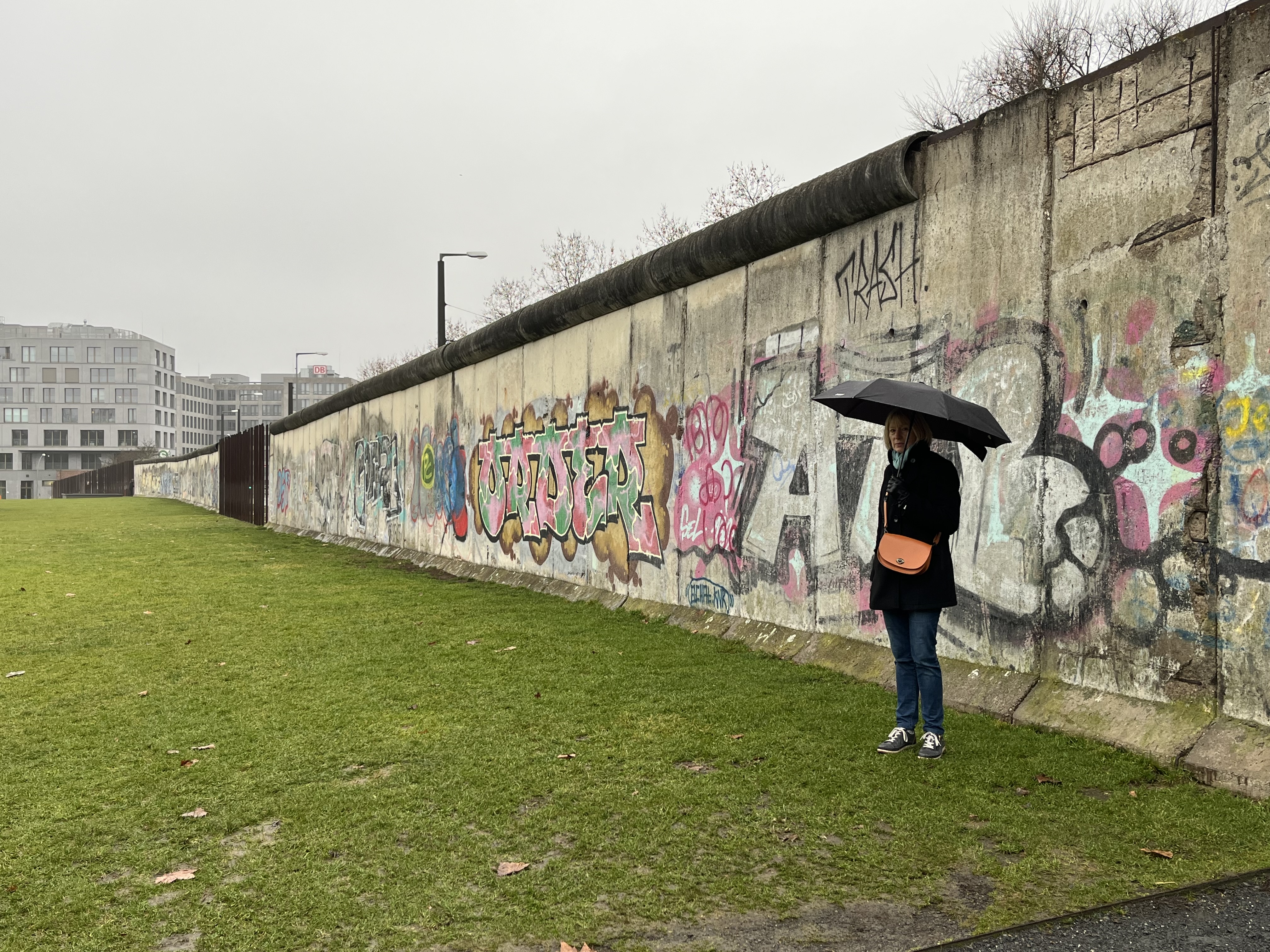
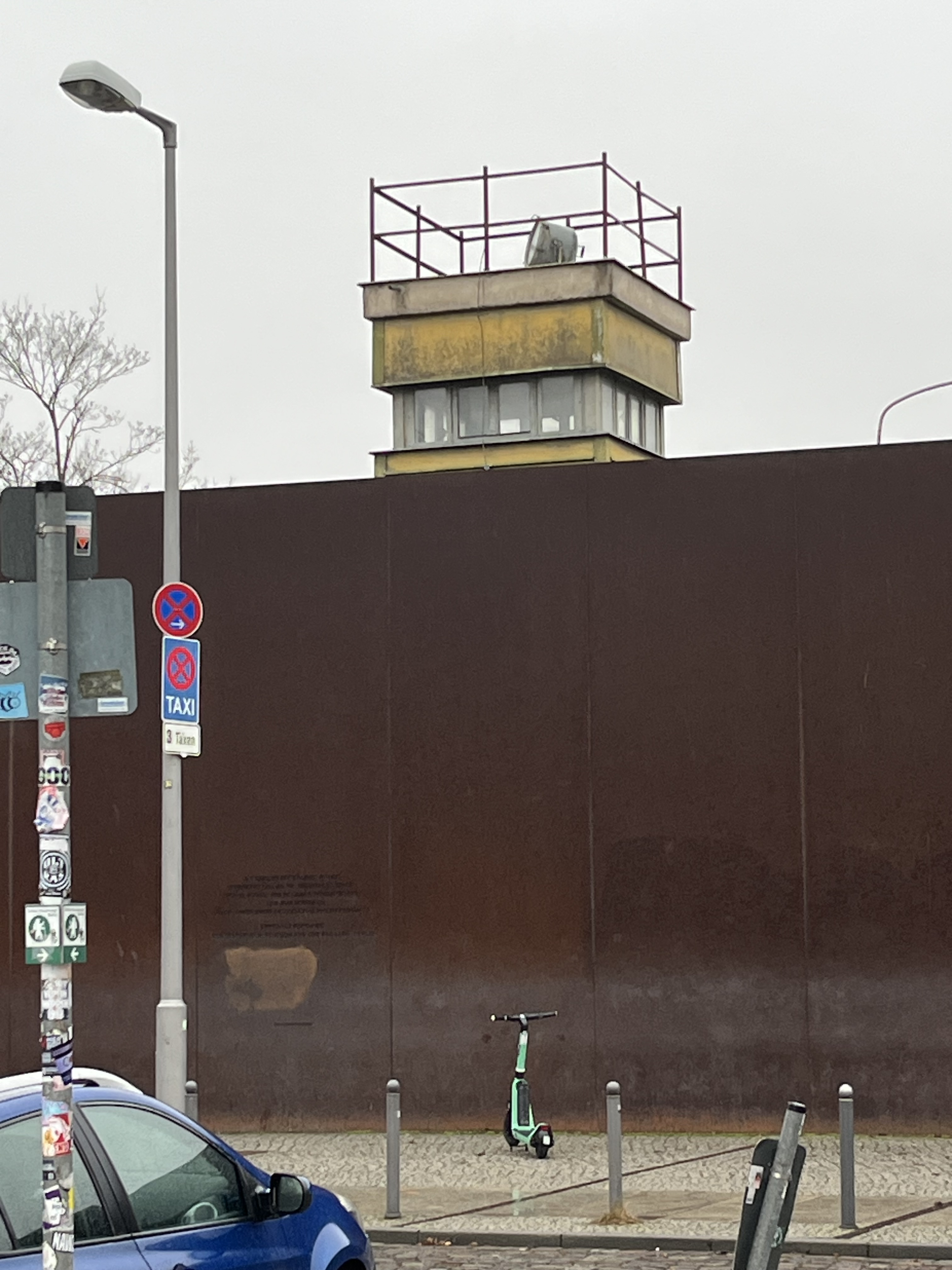

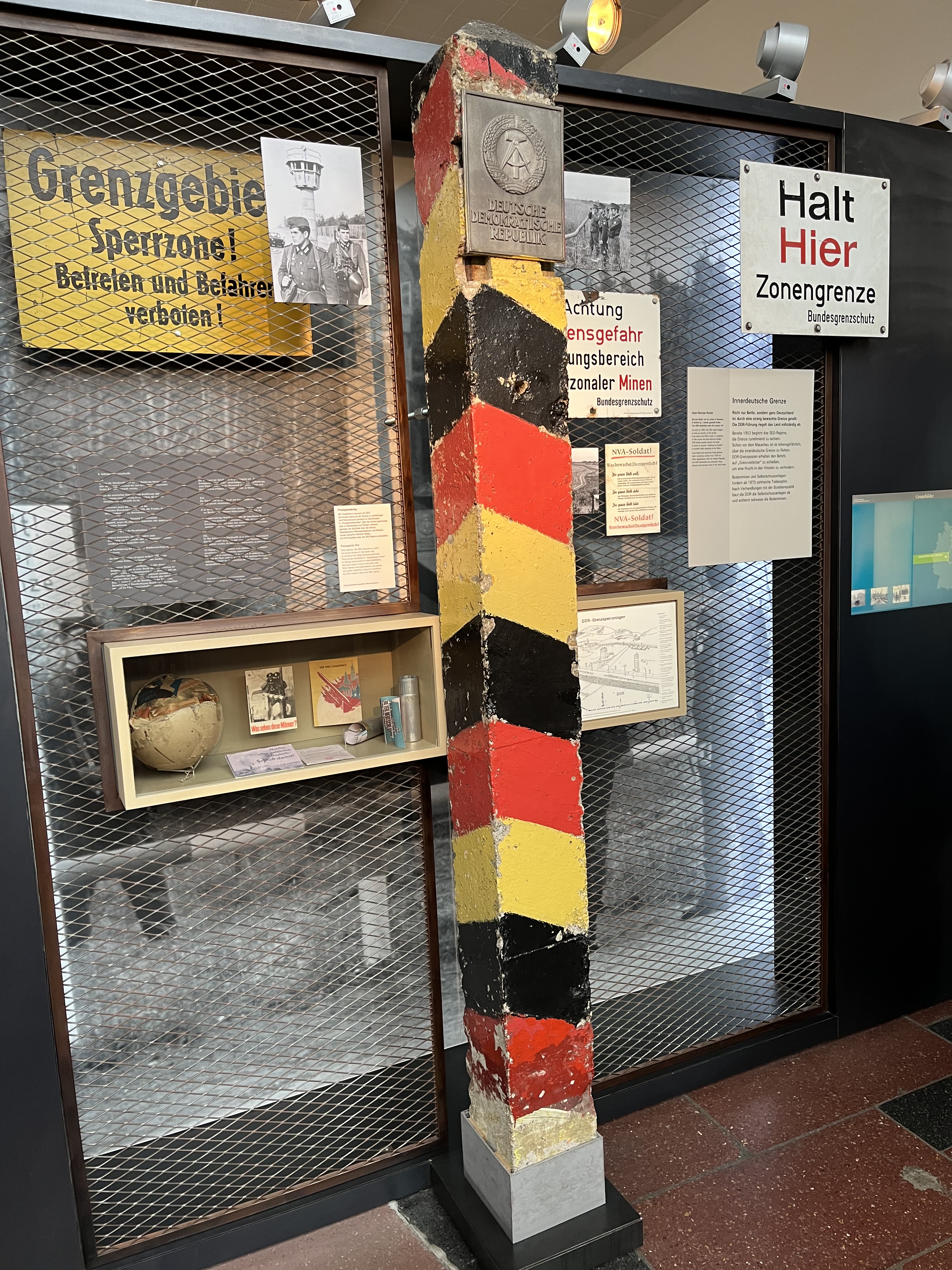

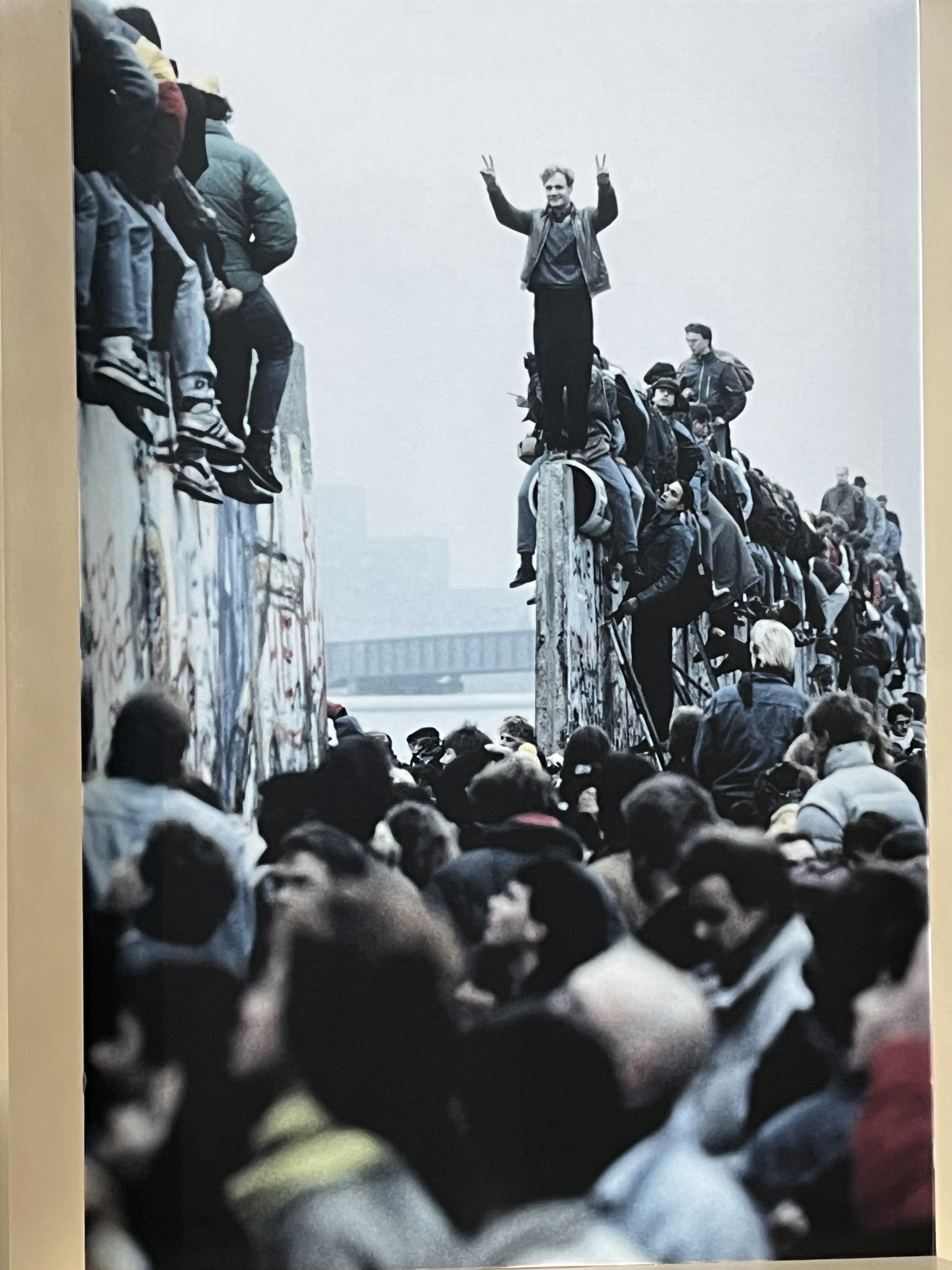
I vividly remember the 9th of November 1989, when a colleague in my office came running and yelled to me: “Have you heard? Have you heard, that the Wall came down…”!
It certainly rang unbelievable to me at the time.
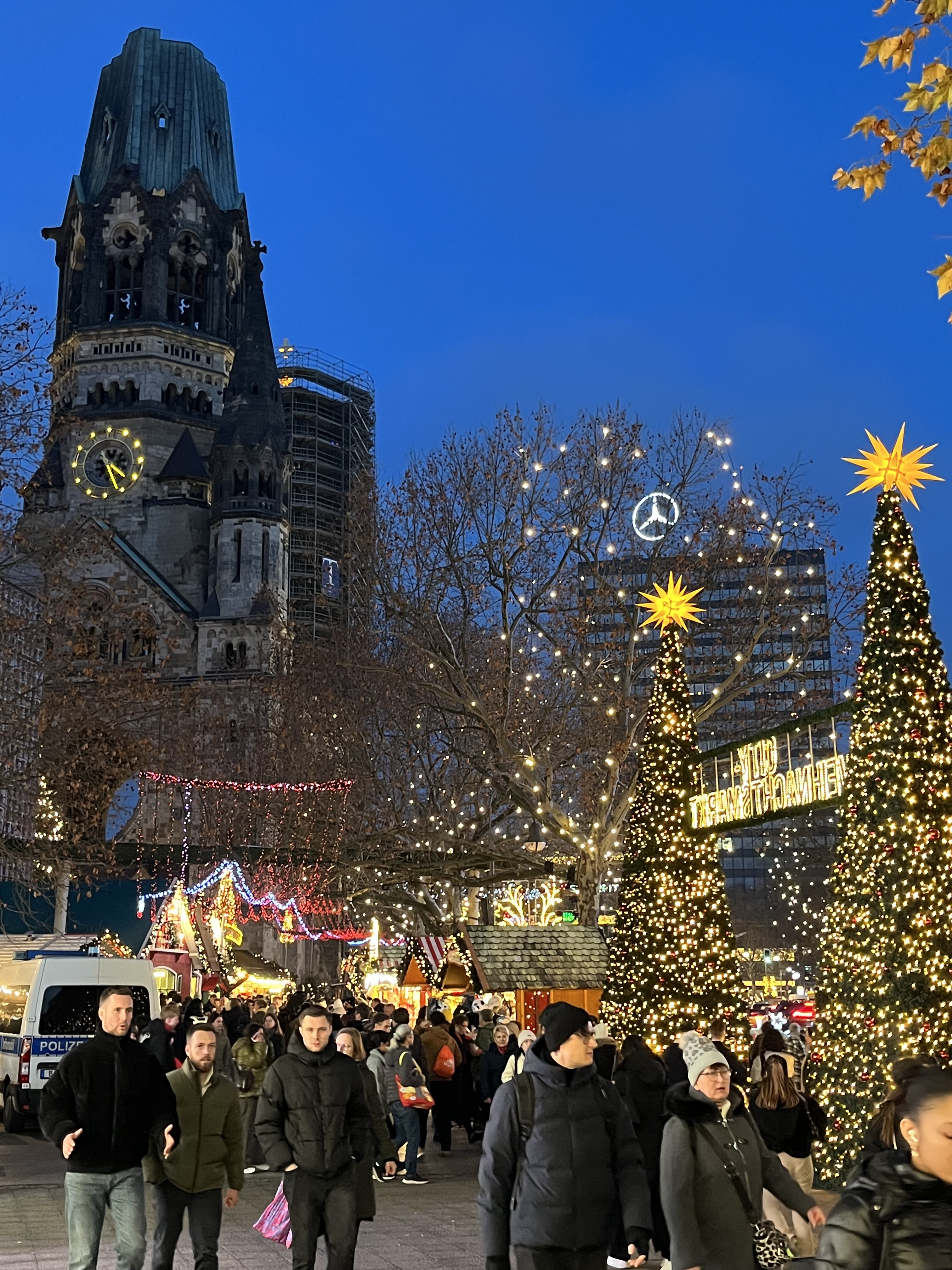
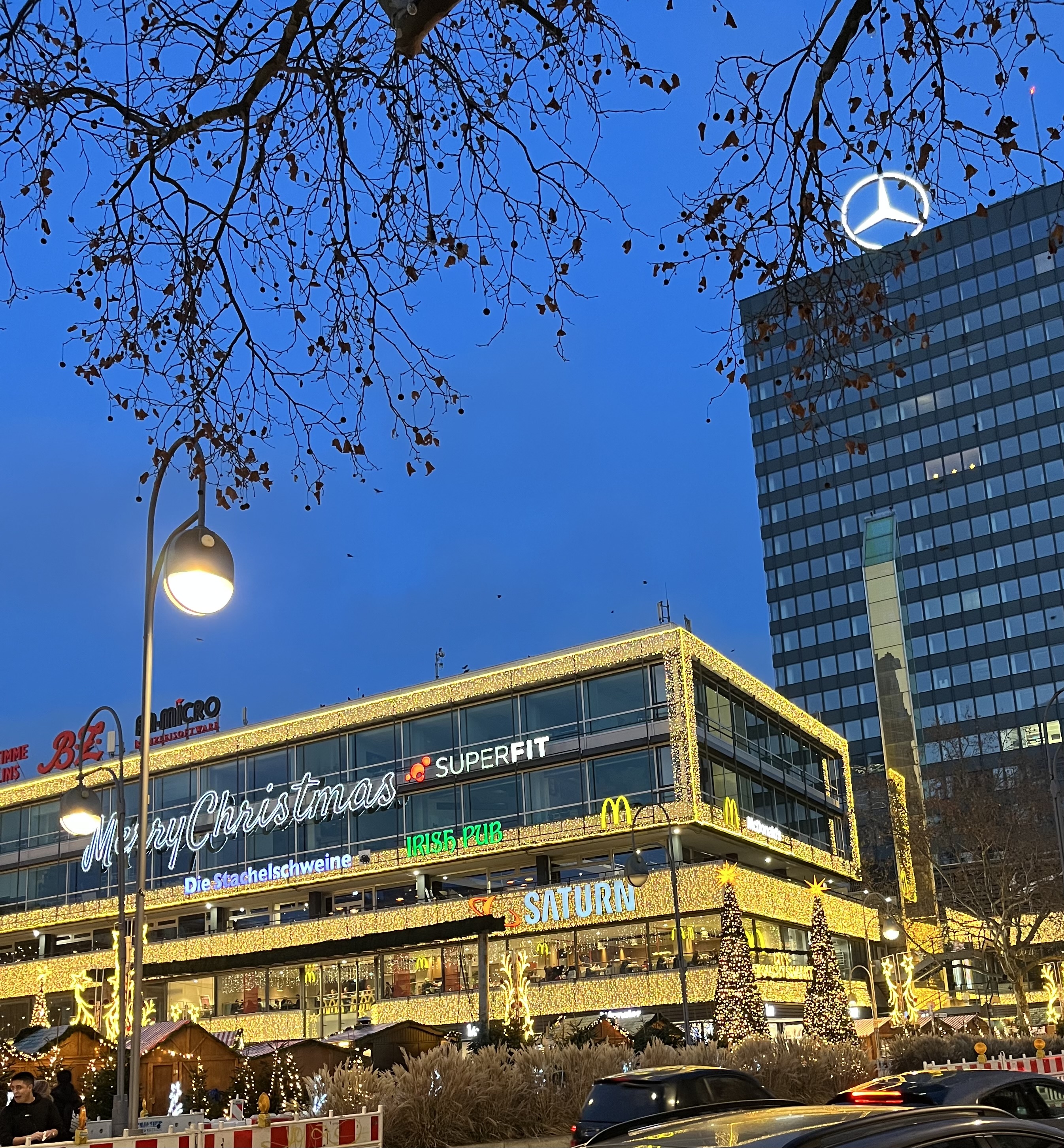
Above are pictures of the center of former West Berlin, the big, vibrant shopping area of the “Kurfuerstendamm”. During our visit, the area was crowded with holiday shoppers, especially inside the big KaDeWe or Kaufhaus Des Westens, which, with 650,000 square feet, is the second largest department store in Europe behind Harrods of London.
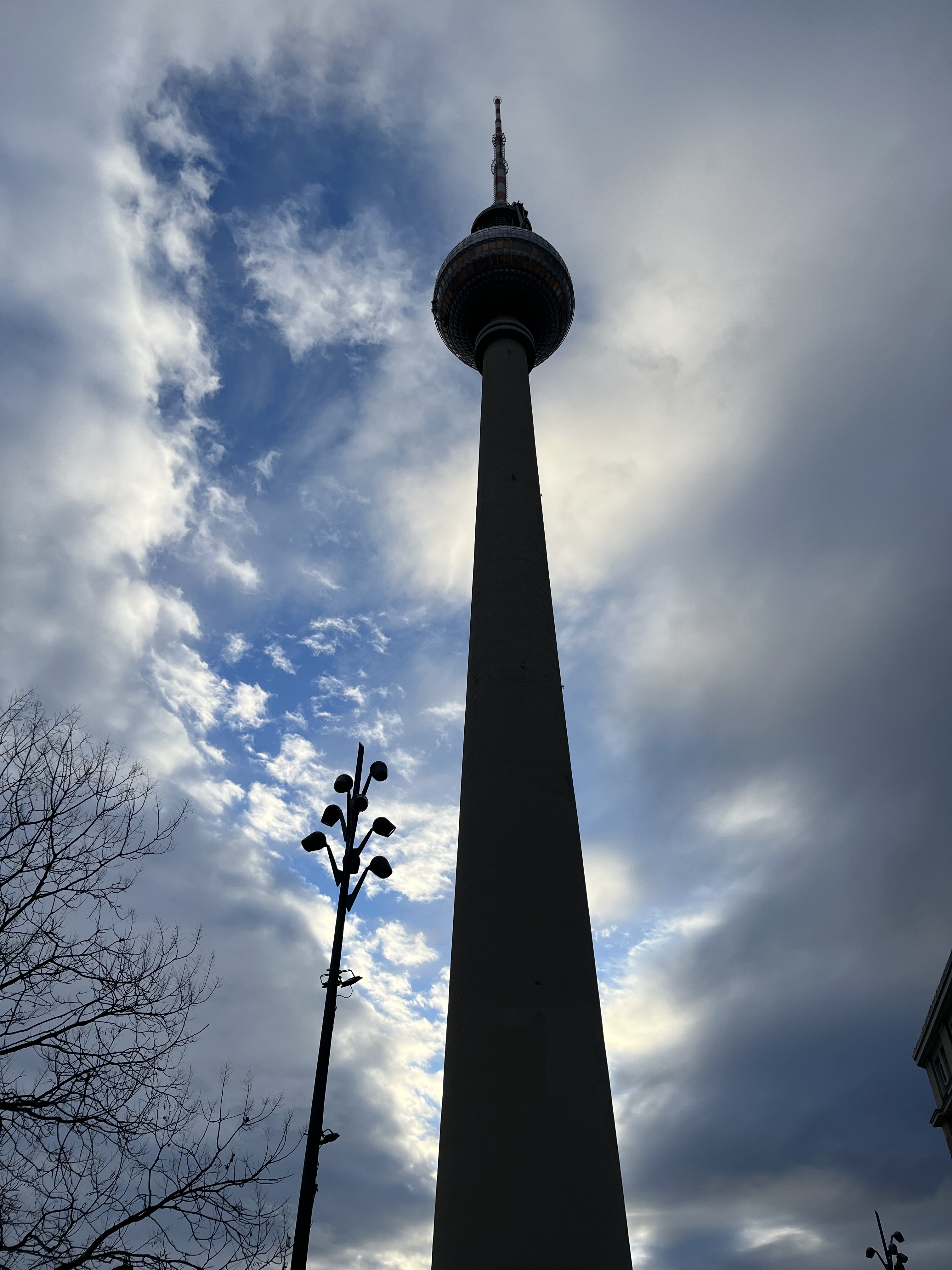
And more impressions of Berlin, including the Berliner Fernsehturm (Berlin TV Tower) pictured below. Built in 1969, this over 1,200′ tall tower is located next to Berlin’s former East German center at Alexander Platz, and it is visible from almost everywhere inside the city. The Fernsehturm used to be a prestige object of the DDR.


This VW – Volkswagen Group display just off Berlin’s Unter den Linden grand avenue, is an excellent demonstration of Germany’s economic rise and prosperity after WWII:
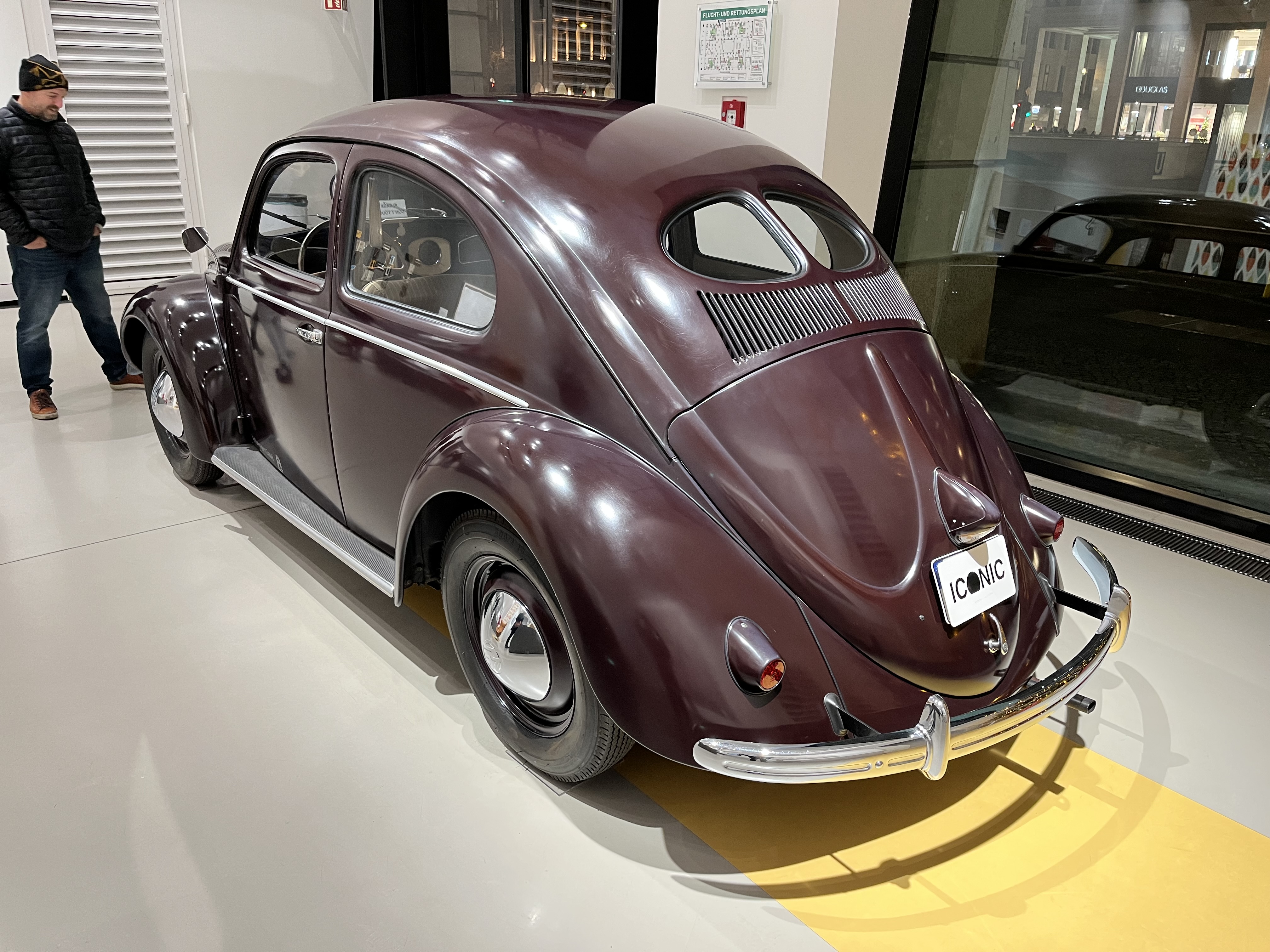
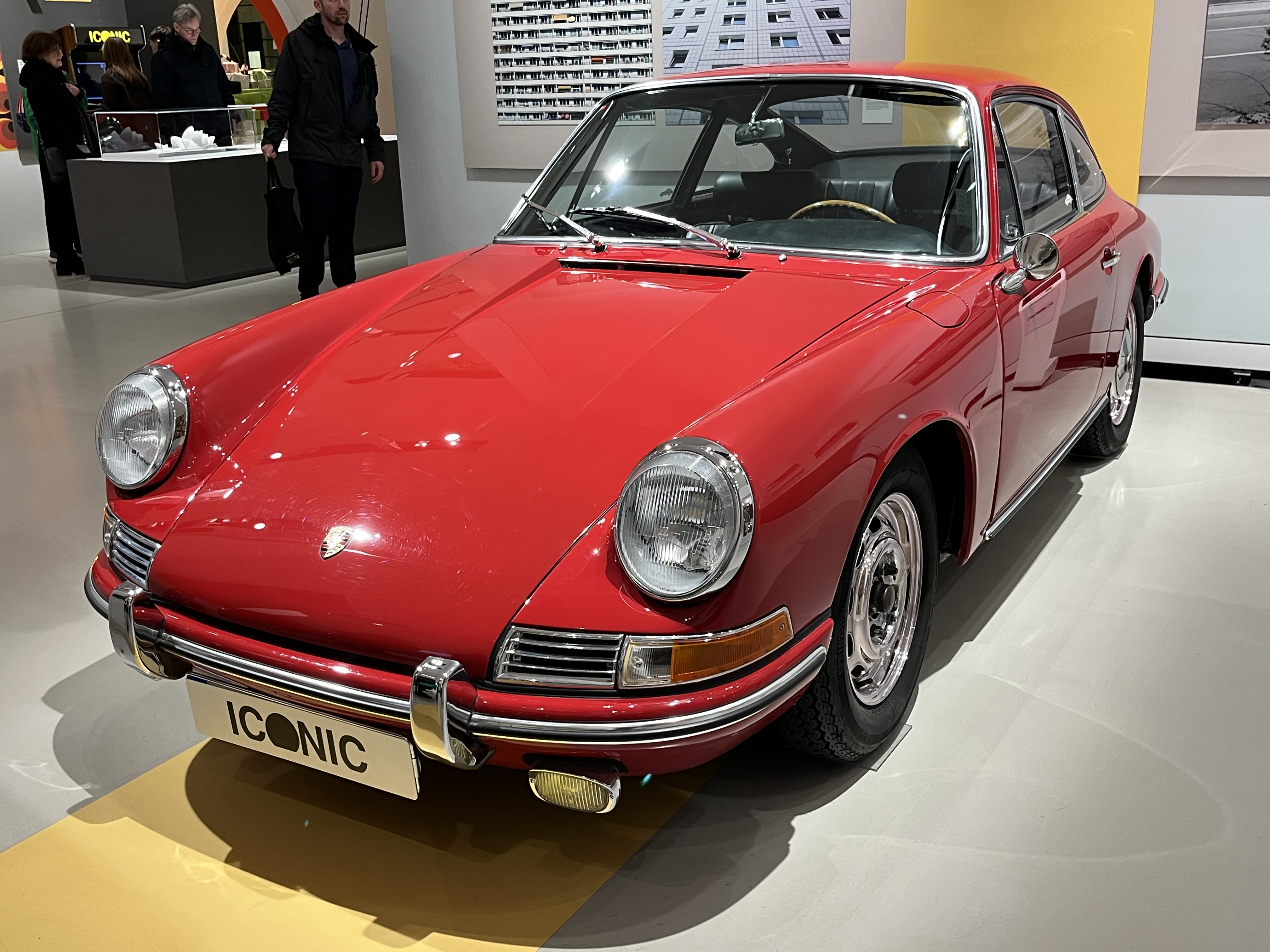

Overall we were pleasantly surprised by our visit to Berlin. We found Berlin to have the best public transportation system we’ve encountered anywhere. There is a close knit network of buses, trams, subways, and S-Bahns, that one can get practically anywhere in the city without much of a delay. And the trams, buses, subway cars, and stations were clean and we felt totally safe everywhere we went. This was better than for instance our experiences in Paris or London.
Berliners themselves might be a little direct and casual, yet we perceived them as mostly easy going, approachable, and open. Almost like in Dresden, we noticed Berlin’s closeness to Europe’s East, by the frequent use of eastern languages spoken and by the conduct of the people. Noticeable was the amount of English with accents that we heard. Here in Berlin, as in many places around the world, English is the language that connects people of different cultures.
Here is a picture of Berlin’s newly built Hauptbahnhof:

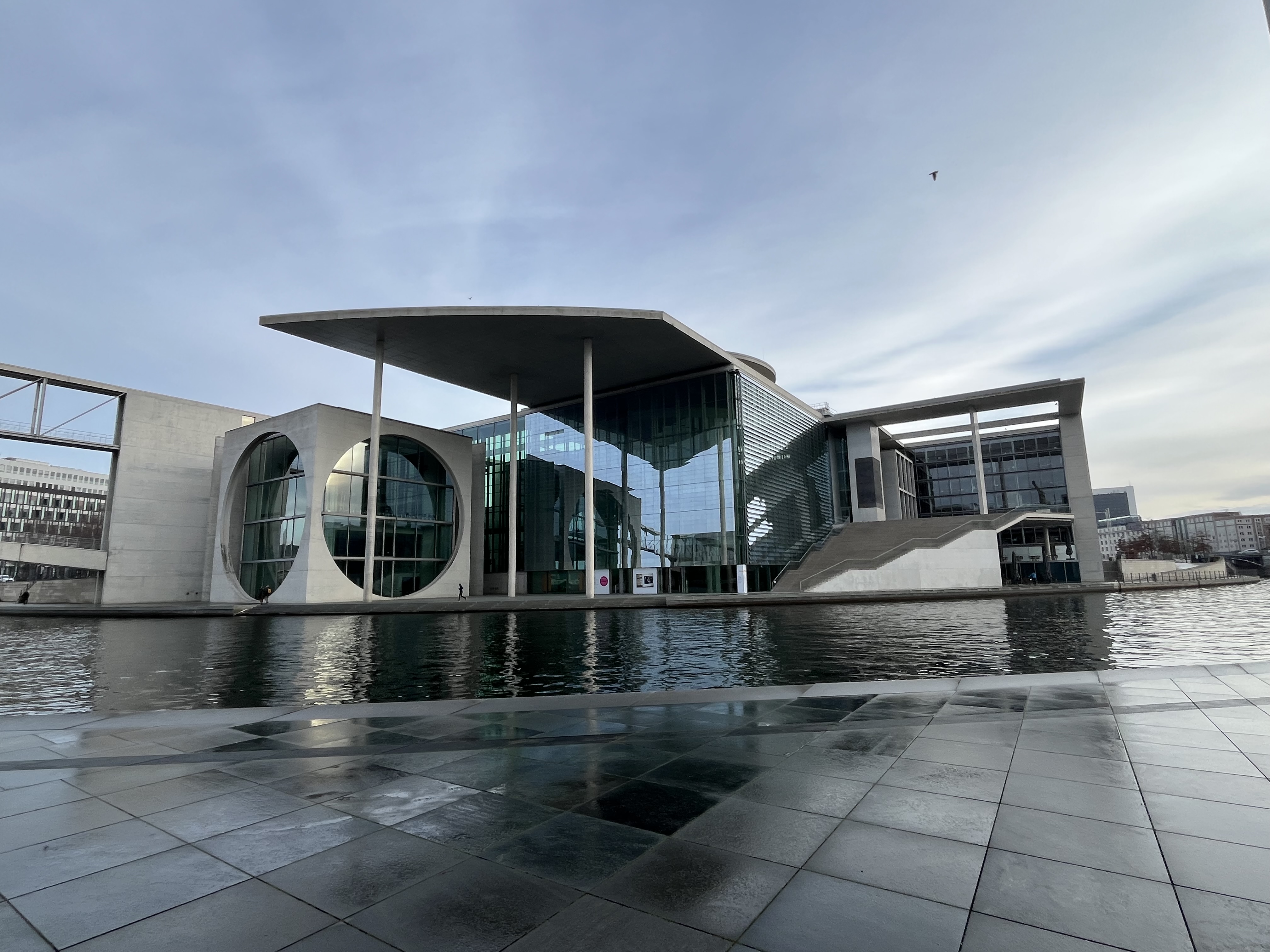
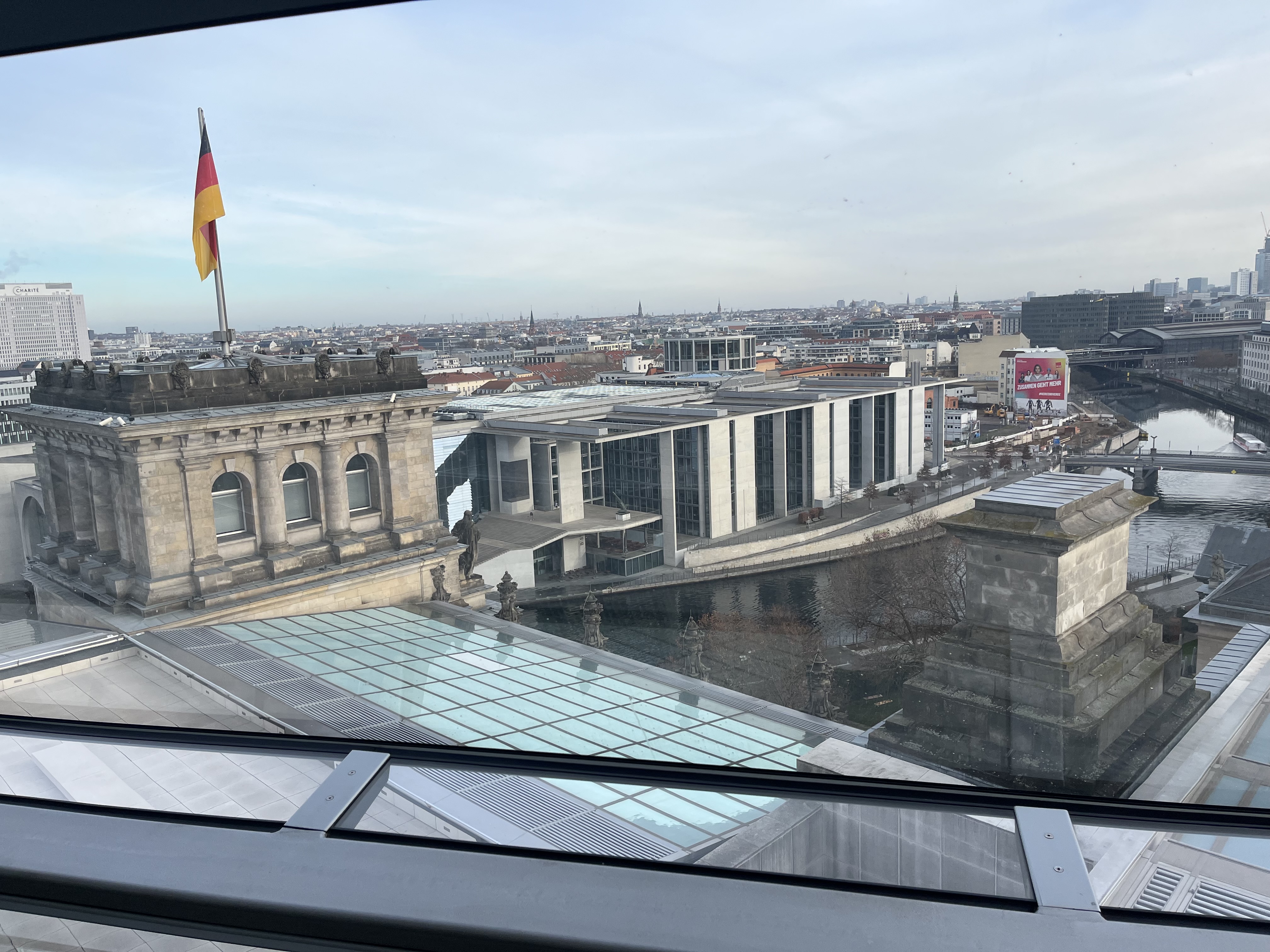
And below is Germany’s newly built federal Regierungsviertel, or government quarters, on the banks of the Spree river next to the rebuilt Reichtstag and close to the Brandenburg Gate. This modern and beautifully integrated new federal government quarter of Germany exudes dynamism and transparent confidence.

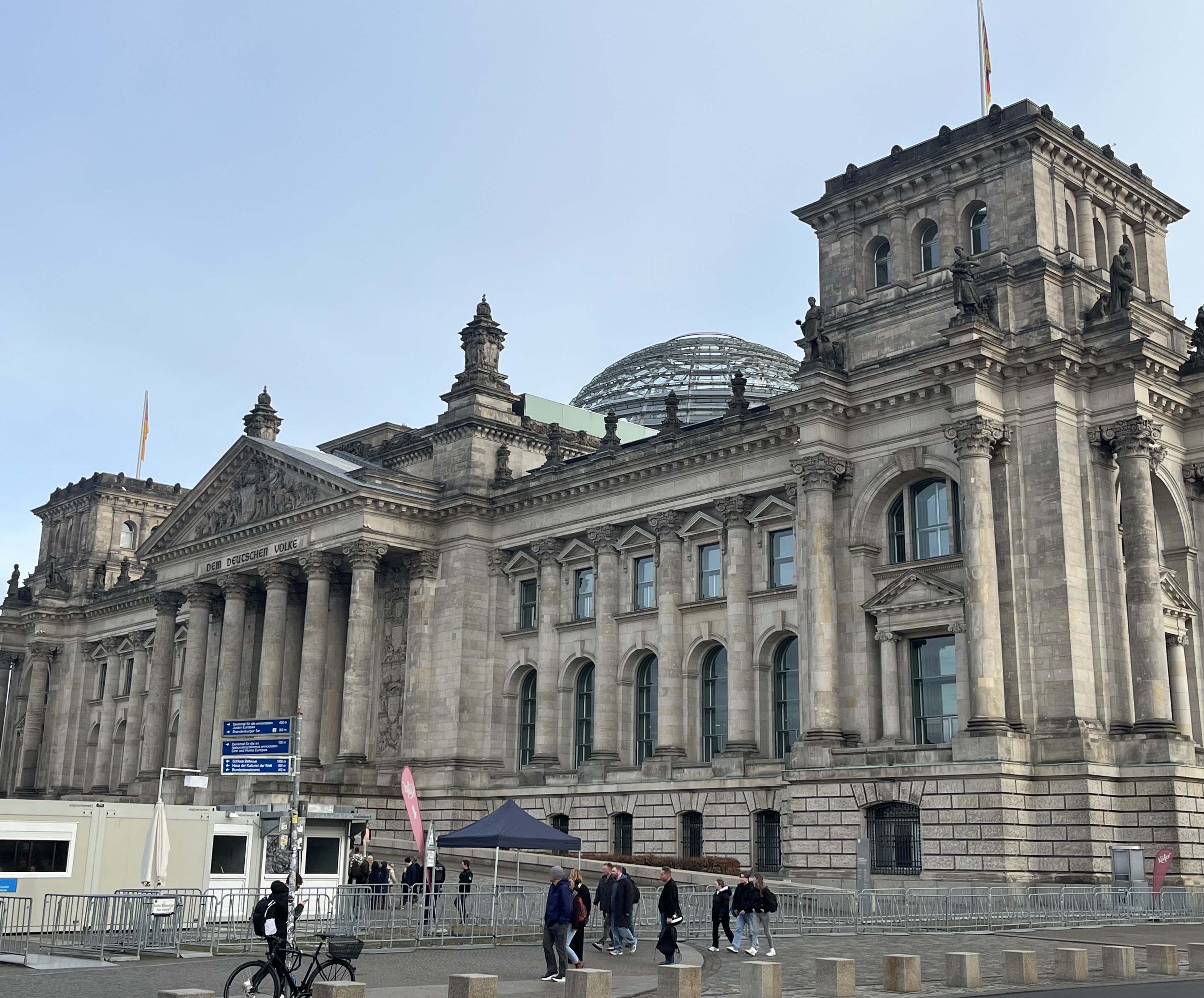
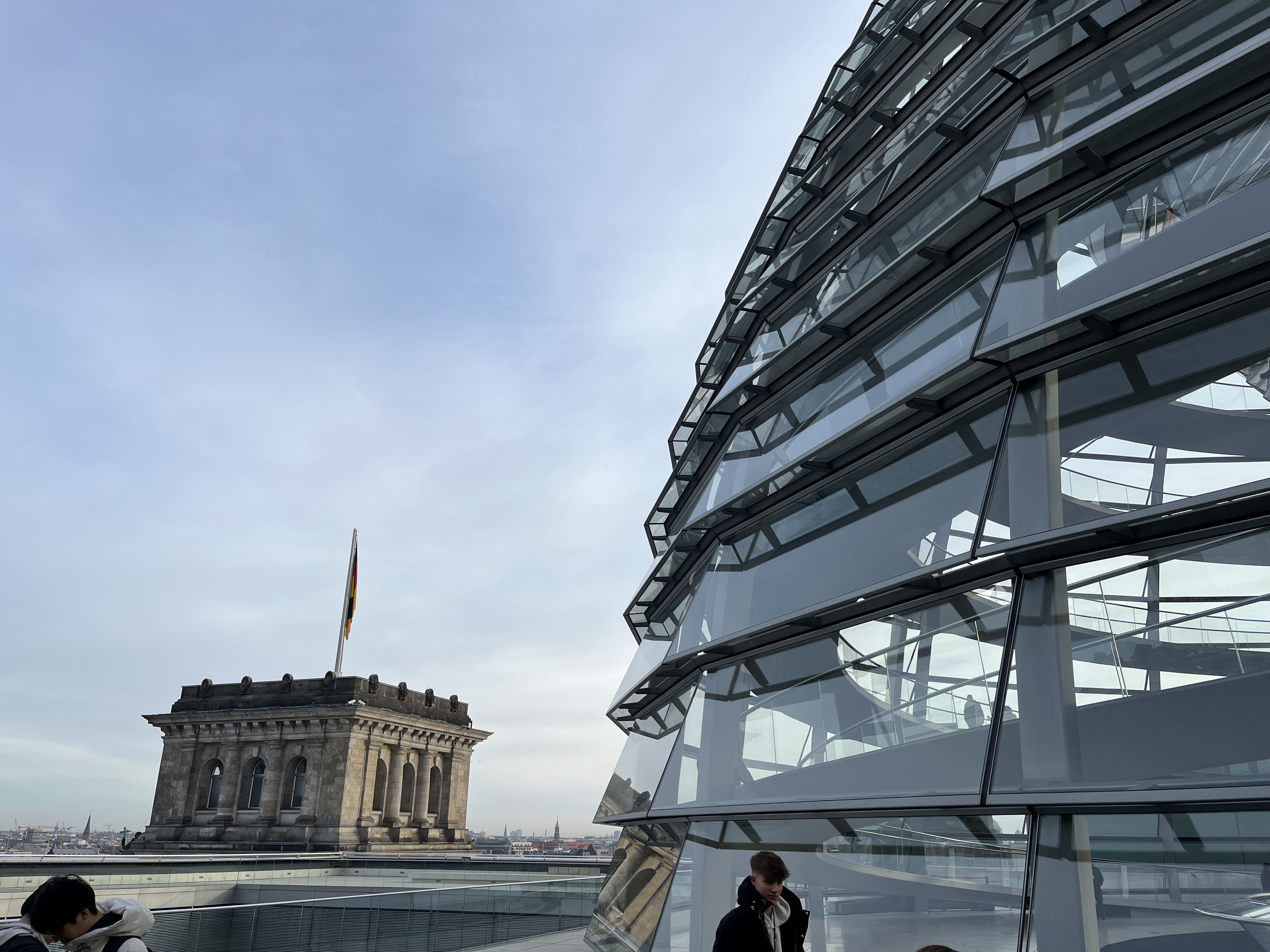
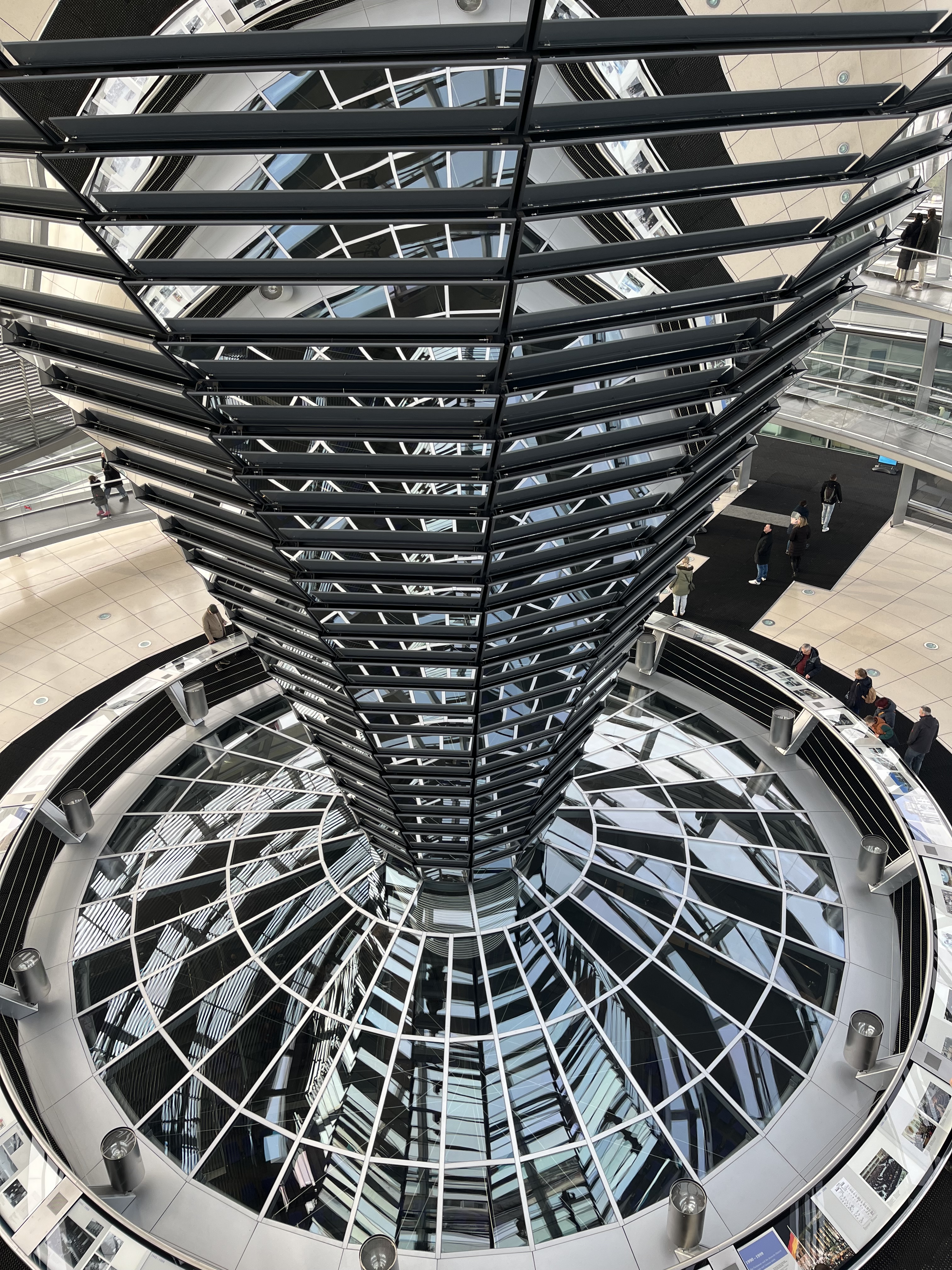
Above, just opposite from the modern government buildings pictured previously, is the reconstructed Neo-Rennaissance Reichstag building from 1894. It used to house the Reichstag, or legislature of the German Empire and subsequent Weimarer Republik. In 1933 the building burnt under suspicious circumstances during the rise of Hitler and aided him and his Nazi regime to solidify their power. Due to its proximity to the Wall, the Reichstag building couldn’t be used by either West or East Germany. In 1999 the reconstruction of the building, with its new, iconic glass dome was completed. The glass dome brings light, reflection, and transparency to the German Bundestag, parliament, below the dome:



During our entire trip through Germany’s former East, we noticed the incredible amount of investments made since Germany’s reunification, evident in the up to date infrastructure, like new roads, public buildings, public transportation, museums, sites of cultural importance, etc. All in all, since 1989 Germany has invested over 2 trillion Euros into the states that made up Eastern Germany to bring this, under the DDR regime, neglected part of Germany up to western standards. Today the productivity of these states still lags somewhat behind the western part of Germany, yet based on our experience traveling through Germany’s old West, this incredible public investment effort came about, to a great extent, by budget shrinking in western states. This is evident in the western infrastructure deterioration, like the DB-Deutsche Bundesbahn, which some decades ago used to be known for reliability and punctuality, whereas nowadays some neighboring countries don’t allow the DB onto their rail systems due to it’s unreliability. Or the West’s deteriorating public roads and Autobahns with their huge backlog in bridge replacement projects, or of public buildings like schools in general.
This incredible rebalancing effort within Germany has noticeably taken a toll on the West and brought much needed improvements to the East. It has taken, and will take, more than one generation to rebalance the legacy of 44 years of communist rule. After all this effort, and the obvious improvement in living standard, it is especially puzzling to me that an increasingly large share of eastern Germans today are politically aligning themselves with parties of authoritarian tendencies. Apparently, even now after living for an entire generation in West Germany’s open society and social market economy, self determination and reliance, as well as living in a racial and religiously diverse society, doesn’t appeal to everyone.
With Germany’s location in the center of Europe, it’s size and history, no other country is tied closer to the success or failure of Europe than Germany.
Today Germany faces big challenges. It has a rapidly aging population, and an export dependent industry that is increasingly challenged and pressured by competitors like China. It also needs to invest heavily in its energy independence and self defense, as the United States has become unreliable and openly questions and undermines its commitment to the 80 year old Western Alliance’s success story and post WWII order. All this, while a besieged Ukraine on Europe’s eastern flank continues to need western support to defend itself from the aggression of an ambitiously westerly expanding Russia.
Despite this multitude of big challenges, I think that Germany currently still is on the best course to successfully deal with them, yet in these rapidly changing times, we will see what the future holds for Germany and thus for Europe.

And with these big thoughts we ended our Deutschland Reise and headed straight west to my home turf in the Rhineland.

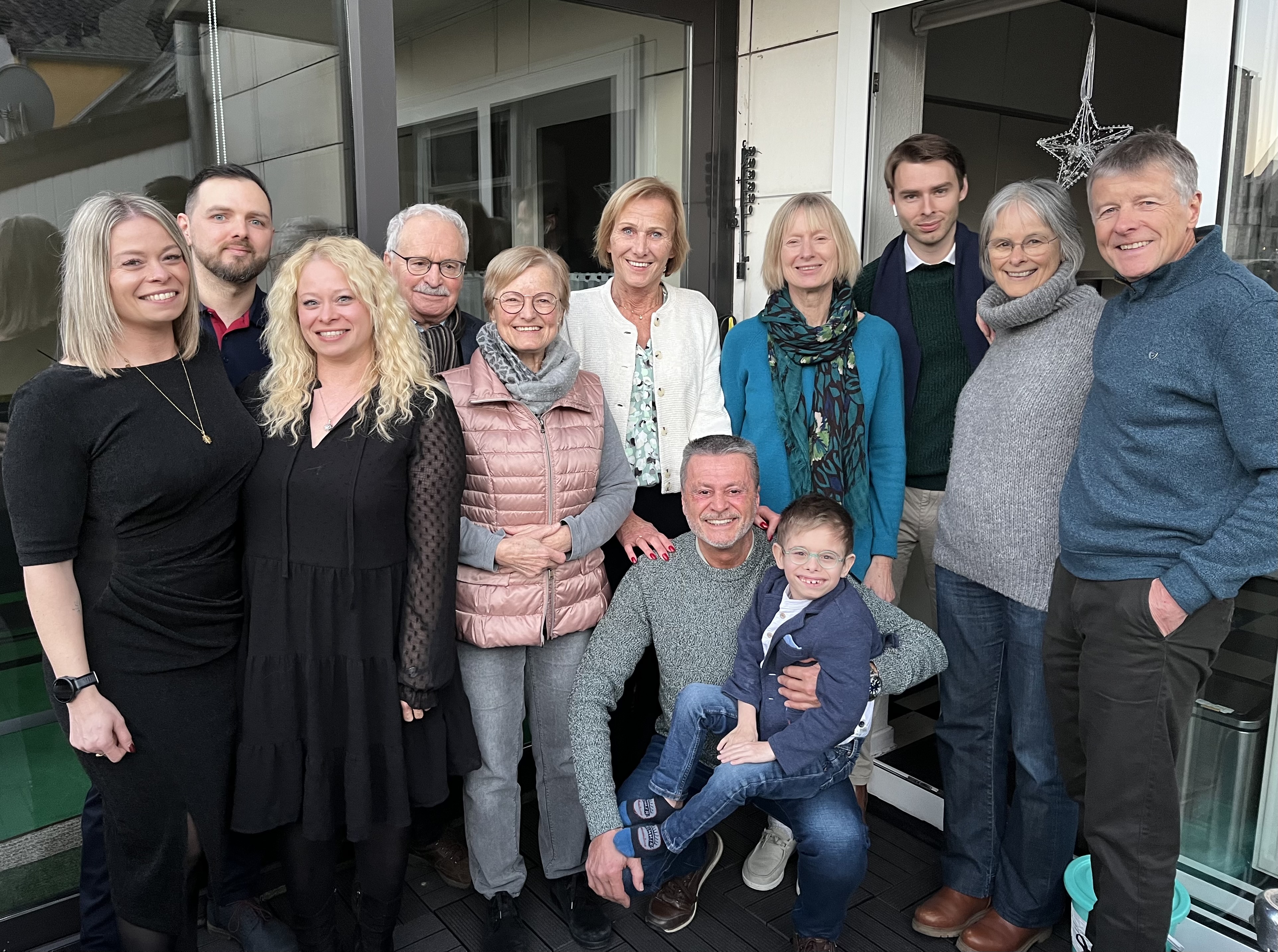
Here, in my hometown of Emmerich next to the Dutch border we spent the Christmas days with my relatives. My brother still runs the jewelry store that my father started 70 years ago, and here, us siblings fortunately can still gather in the home we all grew up in.


Frohe Weihnachten, and Happy New Year 2026!



 Barney & Lauri's Burgundy & Beyond Adventure
Leave a reply to Tracy Cancel reply